Thank you for visiting SNEWPapers!
Sign up free
Gazette Of The United States
New York, New York County, New York
What is this article about?
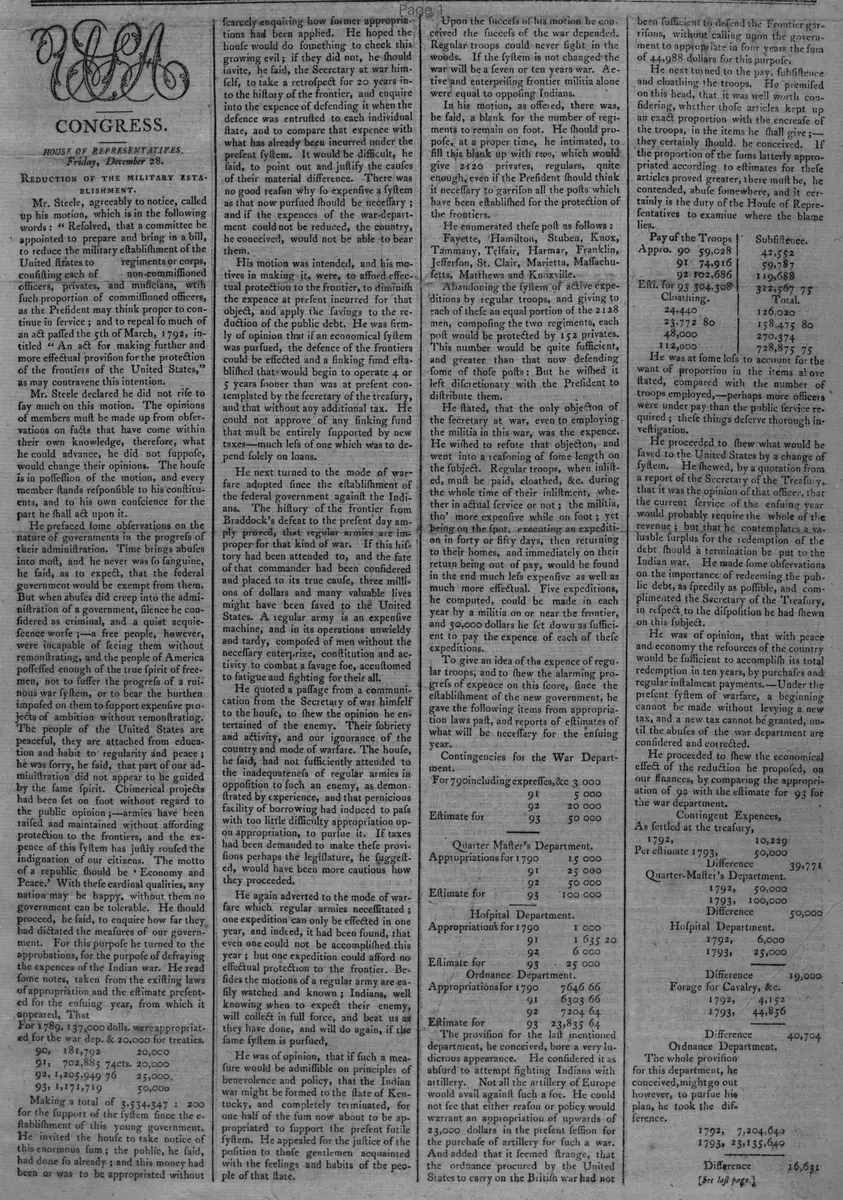
In the U.S. House of Representatives on December 28, 1792, Mr. Steele proposed reducing the military establishment to two regiments for frontier protection, criticizing the costly Indian war system and advocating militia use. Debate ensued with supporters and opponents, motion referred to committee of the whole.
Merged-components note: Merged embedded tables into the main congressional debate story on reducing the military establishment, which continues across pages 1 and 4. Tables provide supporting financial data referenced in the text.
Clippings
1 of 2
OCR Quality
Full Text
HOUSE OF REPRESENTATIVES.
Friday, December 28.
REDUCTION OF THE MILITARY ESTABLISHMENT.
Mr. Steele, agreeably to notice, called up his motion, which is in the following words: "Resolved, that a committee be appointed to prepare and bring in a bill, to reduce the military establishment of the United States to regiments or corps, consisting each of non-commissioned officers, privates, and musicians, with such proportion of commissioned officers, as the President may think proper to continue in service; and to repeal so much of an act passed the 5th of March, 1792, entitled "An act for making further and more effectual provision for the protection of the frontiers of the United States," as may contravene this intention."
Mr. Steele declared he did not rise to say much on this motion. The opinions of members must be made up from observations on facts that have come within their own knowledge, therefore, what he could advance, he did not suppose, would change their opinions. The house is in possession of the motion, and every member stands responsible to his constituents, and to his own conscience for the part he shall act upon it.
He prefaced some observations on the nature of governments in the progress of their administration. Time brings abuses into most, and he never was so sanguine, he said, as to expect, that the federal government would be exempt from them. But when abuses did creep into the administration of a government, silence he considered as criminal, and a quiet acquiescence worse;—a free people, however, were incapable of seeing them without remonstrating, and the people of America possessed enough of the true spirit of freemen, not to suffer the progress of a ruinous war system, or to bear the burthen imposed on them to support expensive projects of ambition without remonstrating.
The people of the United States are peaceful, they are attached from education and habit to regularity and peace; he was sorry, he said, that part of our administration did not appear to be guided by the same spirit. Chimerical projects had been set on foot without regard to the public opinion;—armies have been raised and maintained without affording protection to the frontiers, and the expense of this system has justly roused the indignation of our citizens. The motto of a republic should be 'Economy and Peace.' With these cardinal qualities, any nation may be happy, without them no government can be tolerable. He should proceed, he said, to enquire how far they had dictated the measures of our government. For this purpose he turned to the appropriations, for the purpose of defraying the expenses of the Indian war. He read some notes, taken from the existing laws of appropriation and the estimate presented for the ensuing year, from which it appeared, That
For 1789, 137,000 dollars were appropriated for the war dept. & 20,000 for treaties.
1790, 181,792
20,000
1791, 702,885 74cts. 20,000
1792, 1,205,949 76 25,000.
1793, 1,171,719 50,000
Making a total of 3,534,347 : 200 for the support of the system since the establishment of this young government.
He invited the house to take notice of this enormous sum; the public, he said, had done so already; and this money had been or was to be appropriated without scarcely enquiring how former appropriations had been applied. He hoped the house would do something to check this growing evil; if they did not, he should invite, he said, the Secretary at war himself, to take a retrospect for 20 years into the history of the frontier, and enquire into the expense of defending it when the defence was entrusted to each individual state, and to compare that expense with what has already been incurred under the present system. It would be difficult, he said, to point out and justify the causes of their material difference. There was no good reason why so expensive a system as that now pursued should be necessary; and if the expenses of the war-department could not be reduced, the country, he conceived, would not be able to bear them.
His motion was intended, and his motives in making it, were, to afford effectual protection to the frontier, to diminish the expense at present incurred for that object, and apply the savings to the reduction of the public debt. He was strongly of opinion that if an economical system was pursued, the defence of the frontiers could be effected and a sinking fund established that would begin to operate 4 or 5 years sooner than was at present contemplated by the Secretary of the treasury, and that without any additional tax. He could not approve of any sinking fund that must be entirely supported by new taxes—much less of one which was to depend solely on loans.
He next turned to the mode of warfare adopted since the establishment of the federal government against the Indians. The history of the frontier from Braddock's defeat to the present day amply proved, that regular armies are improper for that kind of war. If this history had been attended to, and the fate of that commander had been considered and placed to its true cause, three millions of dollars and many valuable lives might have been saved to the United States. A regular army is an expensive machine, and in its operations unwieldy and tardy, composed of men without the necessary enterprise, constitution and activity to combat a savage foe, accustomed to fatigue and fighting for their all.
He quoted a passage from a communication from the Secretary of war himself to the house, to shew the opinion he entertained of the enemy. Their sobriety and activity, and our ignorance of the country and mode of warfare. The house, he said, had not sufficiently attended to the inadequateness of regular armies in opposition to such an enemy, as demonstrated by experience, and that pernicious facility of borrowing had induced to pass with too little difficulty appropriation upon appropriation, to pursue it. If taxes had been demanded to make these provisions perhaps the legislature, he suggested, would have been more cautious how they proceeded.
He again adverted to the mode of warfare which regular armies necessitated; one expedition can only be effected in one year, and indeed, it had been found, that even one could not be accomplished this year; but one expedition could afford no effectual protection to the frontier. Besides the motions of a regular army are easily watched and known; Indians, well knowing when to expect their enemy, will collect in full force, and beat us as they have done, and will do again, if the same system is pursued.
He was of opinion, that if such a measure would be admissible on principles of benevolence and policy, that the Indian war might be formed to the state of Kentucky, and completely terminated, for one half of the sum now about to be appropriated to support the present futile system. He appealed for the justice of the position to those gentlemen acquainted with the feelings and habits of the people of that state.
Upon the success of his motion he conceived the success of the war depended. Regular troops could never fight in the woods. If the system is not changed the war will be a seven or ten years war. Active and enterprising frontier militia alone were equal to opposing Indians.
In his motion, as offered, there was, he said, a blank for the number of regiments to remain on foot. He should propose, at a proper time, he intimated, to fill this blank up with two, which would give 2120 privates, regulars, quite enough, even if the President should think it necessary to garrison all the posts which have been established for the protection of the frontiers.
He enumerated these posts as follows: Fayette, Hamilton, Stuben, Knox, Tammany, Telfair, Harmar, Franklin, Jefferson, St. Clair, Marietta, Massachusetts, Matthews and Knoxville.
Abandoning the system of active expeditions by regular troops, and giving to each of these an equal portion of the 2128 men, composing the two regiments, each post would be protected by 152 privates. This number would be quite sufficient, and greater than that now defending some of those posts: But he wished it left discretionary with the President to distribute them.
He stated, that the only objection of the Secretary at war, even to employing the militia in this war, was the expense. He wished to refute that objection, and went into a reasoning of some length on the subject. Regular troops, when enlisted, must be paid, clothed, &c. during the whole time of their enlistment, whether in actual service or not: the militia, tho' more expensive while on foot; yet being on the spot, executing an expedition in forty or fifty days, then returning to their homes, and immediately on their return being out of pay, would be found in the end much less expensive as well as much more effectual. Five expeditions, he computed, could be made in each year by a militia on or near the frontier, and 30,000 dollars he set down as sufficient to pay the expense of each of these expeditions.
To give an idea of the expense of regular troops, and to shew the alarming progress of expense on this score, since the establishment of the new government, he gave the following items from appropriation laws past, and reports of estimates of what will be necessary for the ensuing year.
Contingencies for the War Department.
Hospital Department.
Ordnance Department.
The provision for the last mentioned department, he conceived, bore a very ludicrous appearance. He considered it as absurd to attempt fighting Indians with artillery. Not all the artillery of Europe would avail against such a foe. He could not see that either reason or policy would warrant an appropriation of upwards of 23,000 dollars in the present session for the purchase of artillery for such a war. And added that it seemed strange, that the ordnance procured by the United States to carry on the British war had not been sufficient to defend the Frontier garrisons, without calling upon the government to appropriate in four years the sum of 44,988 dollars for this purpose.
He next turned to the pay, subsistence and clothing the troops. He premised on this head, that it was well worth considering, whether those articles kept up an exact proportion with the increase of the troops, in the items he shall give ;— they certainly should, he conceived. If the proportion of the sums latterly appropriated according to estimates for these articles proved greater, there must be, he contended, abuse somewhere, and it certainly is the duty of the House of Representatives to examine where the blame lies.
Pay of the Troops Subsistence.
Appro. 90 59,028 42,552
91. 74,916 59,787
92 102,686 119,688
Esti. for 93 304,308 312,567 75
Clothing. Total.
24,440 126,020
23,772 80 158,475 80
48,000 270,374
112,000. 728,875 75
He was at some loss to account for the want of proportion in the items above stated, compared with the number of troops employed,—perhaps more officers were under pay than the public service required ; these things deserve thorough investigation.
He proceeded to shew what would be saved to the United States by a change of system. He shewed, by a quotation from a report of the Secretary of the Treasury, that it was the opinion of that officer, that the current service of the ensuing year would probably require the whole of the revenue ; but that he contemplates a valuable surplus for the redemption of the debt should a termination be put to the Indian war. He made some observations on the importance of redeeming the public debt, as speedily as possible, and complimented the Secretary of the Treasury, in respect to the disposition he had shewn on this subject.
He was of opinion, that with peace and economy the resources of the country would be sufficient to accomplish its total redemption in ten years, by purchases and regular installment payments.—Under the present system of warfare, a beginning cannot be made without levying a new tax, and a new tax cannot be granted, until the abuses of the war department are considered and corrected.
He proceeded to shew the economical effect of the reduction he proposed, on our finances, by comparing the appropriation of 92 with the estimate for 93 for the war department.
Contingent Expenses,
As settled at the treasury, 1792, 10,229:
Per estimate 1793, 50,000
Difference 39,771
Quarter-Master's Department.
1792, 50,000
1793, 100,000
Difference 50,000,
Hospital. Department.
1792, 6,000
1793, 25,000
Difference 19,000
Forage for Cavalry, &c.
1792, 4,152
1793, 44,856
Difference, 40,704
Ordnance Department,
The whole provision for this department, he conceived, might go out however, to pursue his plan, he took the difference.
1792, 7,204,640
1793. 23,135,649
Difference 16,631
(See last page)
| For 79 including expenses, &c 3 000 | ||
| 91 | 5 000 | |
| 92 | 20 000 | |
| Eltimate for | 93 | 50 000 |
| Quarter Master's Department, Appropriations for 1790 | 15 000 |
| 91 | 25 000 |
| 92 | 50 000 |
| 93 | 100 000 |
| Appropriations for 1790 | I 000 |
| 91 | 1 635 20 |
| 92 | 6 000 |
| Estimate for 93 | 25 000 |
| Appropriations for 1790 | 7646 66 |
| 91 | 6303 66 |
| 92 | 7204 64 |
| Estimate for 93 | 23,835 64 |
Pay, Subsistence and Clothing:
1792, : 270.374
1793 728,875
Difference
458,501
Total saved : dols.. 624,607
This was the annual saving he proposed.
In his calculation, he remarked, he neglected the bounty held out to the 1600
men yet to be enlisted. As he was counting by tens and hundreds of thousands,
this sum he did not think worth attending
to.
He concluded, that the decision of this
question would speak the sense of the
house in regard to the existing system,
and whether there was in the government
a serious desire to obtain permanent peace,
to defend the frontier effectually, and to
provide, without resorting to new taxes
or loans, for the regular and speedy re-
duction of the public debt.-An object
which seems to be highly desired by the
Secretary of the Treasury, and all other
disinterested citizens throughout the
union.
Mr. Hartley declared himself against
the object of the motion. He was of o-
pinion that at this time, when a treaty of
peace was depending, it would be highly
dangerous to adopt any step for reducing
our military establishment. The president
he said, appeared to him to have acted
with the greatest economy in organizing
the forces he was empowered to raise,
He stated the difficulty of raising troops
in this country, and again insisted on the
impolicy of disbanding those enlisted at
this critical period. A respectable force
kept up, might produce peace by spring,
and in that case no one would regret the
expense of the equipment.
The part of the country from which
the gentleman who made the motion came,
it was true, was not exposed to the incur-
sions of the Indians but this was, by no
means the case in other parts of the Unit-
ed States.
He then adverted to Mr. Steele's argu-
ments to prove that regular troops were
unequal to a contest with Indians. There
was no instance in which, he answered, a
body of regular troops had been beaten
by an equal number of Indians. The ar-
my in the campaign of 1791 was undisci-
plined; the only regiment properly dis-
ciplined at the time of General St. Clair's
defeat was not in the engagement ; this
instance therefore of the Indians' success
should not, he conceived, be brought in-
to view as a proof of the inefficacy of re-
gular troops in such a war. It was evi-
dent that the troops on the frontiers this
season had afforded very effectual protec-
tion to the frontiers of Pennsylvania and
Virginia.
He dwelt on the impropriety of em-
ploying the militia on this service; the di-
stress that the loss of a considerable body
of heads of families in a district would
occasion was too serious an evil to think
light of. Men enlisting as regulars, on
the other hand, were chiefly adventurers
and single men, the loss of whom would
be much less felt.
Mr. Parker rose in favor of the motion.
He adverted to the effects produced by
an increase of the standing forces of this
country; it immediately occasioned a pro-
portional increase of the armies of our
jealous neighbours to the North and
South. He mentioned a paper that was
Some time since read in the House. a me.
age or talk from Lord Dorchester to the
Indians;-in it they were told that Prince
Edward, a son of their friend the great
King, had arrived with a chosen band of
warriors to protect them. The Indians,
he said, had a higher idea of the military
protection of the British, and would pre-
fer it to ours. The British were better
acquainted with the effect of military pa-
rade on the Indians, and better able with
their veteran troops to take advantage of
those feelings. Every effort of ours to
enhance our military reputation, by an
increase of forces, would be followed by
a similar step in the British colony ; and
we should, in the end, only make war on
our finances. The British, he stated, were
better able to afford to make a perpetual
Shew of military: it was more consistent
with the spirit of their political instituti.
ons, 'A similar system was not well a-
dapted to the sentiments of the people
here, where citizen-soldiers were ready to
turn out for something substantial only.
Before this last war with the Indians.
depredations had no doubt been made by
them on our territory, and by our people
on theirs, but nothing serious had occur-
red till the war was begun.
He approved of garrisoning those posts
that could afford shelter to the inhabit-
ants of the frontiers in case of attack:
but did not think regular troops adequate
to any other task in an Indian war. . He
insisted on the opinion, that the militia
alone were equal to undertake an offensive
war against the Indians
Mr. Fitzsimons first spoke of the im-
portance of the question. It strikes at a
total alteration of the system' adopted to
preserve peace and protect our frontier
citizens. He was not of opinion that
those citizens on the frontiers were able
to protect the country. The light which
would be thrown on the subject in the
course of the debate, he expected, would
determine the point. He hoped the
question would be amply discussed ; but
in the mean time he was sorry, he said,
to see an attempt made to influence the
opinions of members by statements and
calculations, which he imagined were by
no means accurate. He mentioned an
instance in which they had been placed in
such a point of view as might make an
improper impression. The gentleman
stated that the war had cost the Union
upwards of 3,545,000 dollars.
Mr. Steele said in explanation, that he
had asserted, that sum had already been
appropriated or was called for.
Mr. Fitzsimons said the money appro-
priated was not all expended, and that
asked for was still in the power of the
House to grant or not. He could not
positively say, at first view of the gentle-
man's calculations, whether they were all
equally erroneous; but this instance, he
conceived, was not much in favor of his
accuracy. Circumstances might very well
account for a difference in the expense of
an army; troops near Fort Washington
could not be provided at the same rate as
in more populous parts of the states.—
The depending treaty of peace, he de.
clared, raised a great objection in his
mind to the object of the motion. If on
consideration, however, it should appear
that the frontiers could be better defended
without regulars, and a valuable saving
made, he should be in favor of the mo-
tion. He reminded the gentleman, that
when he quoted the amount of the saving
he proposed, he had forgot to take into
view the expense of the five Kentucky
expeditions.
Mr. Steele said he had mentioned that
these might each cost 30,000 dollars.
Mr. White expressed his dislike to re-
gular standing forces, and that he wished
more use had been made of the militia a-
gainst the Indians; yet he was averse to
a reduction, unless a more effectual plan
of defence was offered as a substitute to
that now in use.
It was moved to refer the motion to a
committee of the whole.
Mr. Steele expressed his wish to see the
object of the motion discussed in commit-
tee. He said something on the accuracy
of his statements, which had been que-
tioned, and again mentioned the source
from which they were drawn.
Mr. Williamson, as a proof of the ef-
ficacy of militia in opposition to the In-
dians, cited the instance of Major Adair's
resistance to a body greatly superior in
numbers.
Mr. Smith, S. C. declared himself a-
gainst the object of the resolution. The
President, he said, had the power to dis-
band any part of the army, when their
service was no longer wanted; and his
confidence in the President (a feeling
which, from the unanimous vote of re-e-
lection, he had recently received, seemed
to be very prevalent) led him to feel well
satisfied that they would not be kept in
service unnecessarily one moment.
Mr. Dayton next rose. He said he
was in favor of referring the motion to a
committee of the whole House. He
should not, he declared, have risen, if
he had not heard from the two members
from North-Carolina, the strangest per-
version of argument, and the most extra-
ordinary kind of reasoning he ever re-
membered to have heard. The member
who spoke first, from North-Carolina, de.
cried every idea of energy and efficiency
in regular disciplined troops, considering
them not only inefficient, but contempti-
ble, when employed against Indians, and
to confirm his assertion had instanced the
expedition and defeat under General St.
Clair, when it was well known that there
were not in fact two companies of regular
disciplined infantry in the army of that
General. The other member had as ex-
travagantly'commended the back-country
militia, and extolled them for their effi-
ciency and success in Indian warfare, of
which Major Adair, in a late rencounter
with a superior body of savages, had, he
said, furnished an evidence.
In answer to this, Mr. D. was com-
pelled to remark, what he should other-
wise never have done, that the affair al.
luded to, made on his mind a very dif-
ferent impression, and led to a conclusion
directly contrary to that which the gen-
tleman had drawn from it-The major,
had unquestionably been surprised, and as
unquestionably been beaten, and suffered
the capture of almost all his horses
and other property in his camp; but
what he conceived to be still worse,
it appeared that at the commence.
ment of the action, about half of his
men deserted him,and secured them-
selves within the garrison. This in-
stance of the prowess of irregulars
selected by the N. C. member to sup-
port his arguments would, Mr.Day-
ton believed, be found upon enqui-
ry to be an unfortunate one.
As he was upon the floor, Mr.
Dayton observed, that he could not
refrain from taking some further
notice of the laboured speech which
the house had just heard from the
mover of the proposition under con.
sideration. He should, he said, be
short, for no member could be sup-
posed to be prepared to answer a
speech which certainly no one could
have expected to have heard within
these walls; but as he thought it
probable such another one would
never again be uttered there, he
could not omit a remark or two
upon it. It was admirably calcu-
lated, and would seem to have been
designed, to prejudice the people of
the United States against the whole
administration of the government.
It would doubtless be recollected
that but a few days ago, this very
gentleman was strenuously contend-
ing for propriety, decorum and de-
cency in debate, which he complain-
ed was not observed by gentlemen
who were opposed to the report of
the committee on the failure of the
western expedition; notwithstanding
this, not content with levelling
the most unbounded censure against
the head of the war department, he
had lavished the most virulent abuse
upon the President of the United
States particularly, and upon a large
majority of both houses of Congress.
The member had produced a va-
riety of arithmetical statements and
calculations, the accuracy and truth
of which not only had been questio.
ened, but denied by other members
who had replied to him. One thing
Mr. Dayton said he could not avoid
remarking, which was that that
gentleman had presented as unac-
countable and mysterious, the en-
creased appropriations for the war
department for 91, 92, and 93, as if
it was in any wise strange, that 2000
men should require more ordnance,
hospital and quarter-master's stores
than 1000, or that 5000 men should
require more than them both. Yet
from statements of that nature, the
gentleman affected to believe, and
boldly declared that there must be
the grossest abuses in the adminis.
tration. If the annual increase of
our expenses for protecting the
frontiers, deserved the censure that
had been so liberally bestowed, it
ought to fall directly on the legis.
islature who, Mr. Dayton said, had
directed it by their laws, and not
upon the executive who were mere-
ly the instrument to carry those
laws into effect. So much for the
speech, but with respect to the mo-
tion which called for a very differ-
ent answer, and more mature consi-
deration, he should only add, that
however he might favor a reduction
of our military establishment, if the
question stood upon its own merits
alone, unconnected with some re-
cent circumstances, he should think
it his duty to oppose the measure at
the present, as it might tend to em-
barass the executive in their pur-
suits and prospects of pacification,
and because he well knew it to be the
temper of the Indians, and indeed of
every other people,to rise in their de.
mands in the same proportion that
their treating enemy quieted their fears &
lessened their danger. If our establish-
ment was determined to be lessened, It
would be known to the savages before
the treaty,-in consequence of which, he
did not doubt, they would become more
extravagant and insolent in their terms,
and that of course what was now recom-
mended as an economical saving to the
public, would eventually prove to be pro-
fusion in the extreme.
Mr. Wadsworth expressed himself in a
few words against the resolution.
Mr. Ames did justice to the gentle-
man's industry in the collection of mate-
rials in support of his motion. An oppor-
tunity, he hoped would be given, to go
over the ground he had so ably traversed
He said something of the necessity of
stability in the measures of every govern-
ment ; on the importance of the question
which the fate of the resolution was to de-
cide, and hoped it would meet an ample
discussion.
The motion for referring the resolution
to a committee of the whole was agreed
to, and Wednesday was appointed to
take it up.
Adjourned.
What sub-type of article is it?
What themes does it cover?
What keywords are associated?
What entities or persons were involved?
Where did it happen?
Story Details
Key Persons
Location
House Of Representatives
Event Date
Friday, December 28, 1792
Story Details
Mr. Steele moves to reduce the U.S. military to two regiments for frontier garrisons, repeal parts of 1792 act, and use militia against Indians to cut costs and fund debt reduction. He criticizes regular army's ineffectiveness and high expenses in Indian war. Opponents like Hartley and Dayton argue against reduction during peace treaty, defend regulars, question calculations. Motion referred to committee of the whole.