Thank you for visiting SNEWPapers!
Sign up free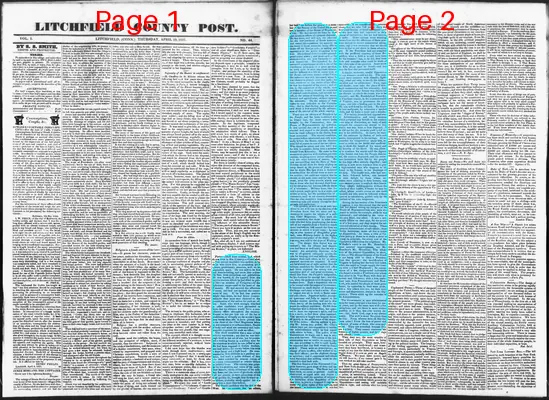
The Litchfield County Post
Litchfield, Litchfield County, Connecticut
What is this article about?
This article concludes a discussion on political parties, describing four 1824 presidential candidates: a deceased second (likely Crawford), military hero Jackson, influential Westerner Clay, and Adams. It details Clay's role in the House election favoring Adams over Jackson, and criticizes the opposition as driven by regional disappointments and personal resentments rather than principles.
Merged-components note: Continuation of the same political article across pages, with sequential reading order and seamless text flow.
Clippings
1 of 2
OCR Quality
Full Text
—The second candidate was spoken of by those who knew him, as possessing good talents, gentlemanly manners, with an independent spirit. He was said to be firm and discriminating, and more than ordinarily free from prejudices and partialities. He was known to the country from the various stations which he had filled in public life—as member of Congress—of the diplomatic corps—and at the head of the Treasury. He had secured the affections of many, and had not excited the resentments of any. If he had less positive weight than some, he had fewer counter-balances than most men elevated to the consideration of the nation for such an office. Some who were strongly attached to other candidates were persuaded to think that his election would have a conciliatory effect throughout the country.
Disease at last put him out of the list of candidates, or virtually so; for would it have been worse than idle to have placed him in the chair of the Chief Magistrate when he was unequal to its arduous duties. Health of body and mind are necessary and indispensable requisites for such an office.
The third candidate was a man of high military reputation; not that he was thorough-bred in the art of war, but he possessed a striking fitness as a military man for the occasions in which he was called to act. He had been engaged in Indian warfare, and had driven the enemy before him with a stout heart and a high hand. He commanded at New-Orleans in a perilous moment, had made a noble defence of that city when attacked by veteran troops of an enemy unaccustomed to retreat before an inferior force. The country was grateful for his services, and some of his ambitious friends, taking advantage of his military fame, and the burst of gratitude which had not passed, as most sensations of this kind quickly do, brought him forward as a candidate, probably much against his expectation a short time before.
The fourth candidate was the idol of the West. He was younger than the others,
He had been before the people as a member of the Senate of the United States, and a member of the House of Representatives. He had earned his fame by bold and incessant efforts of a general character. He had been, and still was, the advocate for the independence of South America, and risked his reputation for sagacity on the event of those countries being able to shake off the foreign yoke, so galling and oppressive to the spirits struggling to be free. His political doctrines were promulgated everywhere; and were such as the administration are now favorable to, and now supporting. Distinguished for the mercurial temperament which is one of the constituent principles of a great speaker, he took part in most important debates, and his influence was felt in every vote of the House, and every section of the Union. His influence was still increased when he was chosen to preside over that body; for then, attentive to the duties of his office, he was not forgetful of his creed: and often, in the committee of the whole, took care that his country should be reminded of internal improvements, and suitable tariffs, as the means of benefiting the manufacturer and agriculturist, without injuring the merchant.
On the subject of State rights he was orthodox to the Constitution; that is, that the true independence of each State is best secured by the advancement of the interest of the whole country. There was no election of President by the People, and the latter candidate was no longer one, the three others being brought, by the Constitution, into the House of Representatives for selection. It was natural that one so gifted, and so situated with regard to the people, should have no small influence in the choice, from those presented. The second candidate, for causes before mentioned, was only nominally before the House, and the election must fall of course on one of the two others. Who should be taken, and who left? was for him to consider, being then a member himself from Kentucky. He came to this momentous question with readiness, yet with caution, weighing every matter relating to it in the exact balances of reason. He was not unwilling that the Hero of New Orleans should write his deeds of glory on every laurel in the groves of fame; and that he might also bow down a thousand branches from the sacred trees to wave on his ovation; but could not consent that he should, at the same time, and for the same cause, wear the civic wreath, which was due to those who had elevated their country by the great, but not less difficult duties of a statesman. Military fame, like Jonah's gourd, might grow up in a night, and wither as soon, but the qualifications of a statesman, such as our country demanded, like the elm, requires a long succession of returning suns and wintry storms for their growth and perfection.
The speaker, as well as those who were about to act with him in the election of the President knew that we were not in a situation to require the talents of a military Chief Magistrate. They were also often reminded, that those in other countries who had been prophesying the downfall of our republic, from a hatred to republican institutions, had named the form and manner in which it would come: by raising, in some moment of thoughtless gratitude, some Military leader to the highest civil honors and power of the State. This, it is true, was said in the days of Washington. The danger then feared was not realized; but his temper and disposition had been so well tried, that he was to be trusted. An exception, however, as he was to all general rules, only proves the rule for keeping civil and military officers distinct from each other, as far as active personal services are required. It could not be winked out of sight neither that the military candidate for this high civil office had twice required the strong arm and matchless skill of one great statesman, to shield him from the People's indignation, for his fondness for martial law; and this, too, when his garlands were dropping with freshest dews. Such a disposition was not to be trusted with the reins of Government. It required no small degree of firmness to discharge one's duty at such a crisis: Every engine was set to work to flatter some and awe others. Impatient malice, prompted ignorance and folly to impute to the Speaker sinister motives, and not to him alone, but to all the leading men who opposed the military candidate. He felt these indignities with a delicate fibre, but opposed to them too vigorous a spirit, and too firm a nerve, to find them often repeated. The question at length was happily decided greatly to the satisfaction of the majority of the nation. Having assisted in putting Mr. Adams into power, Mr. Clay's talents were put into requisition to sustain the Administration which he had joined with others to form. The policy of the Government he knew, and it was in union with his own. The course of the Administration was so nearly, or exactly, like the one preceding it, that it could hardly be expected that any fault would be found with it. There were no proscriptions; no change of men in office, who wished to retain their offices: not the slightest change or agitation; and disappointed individuals were distressed that nothing could be discovered to find fault with.
The first Session of the Nineteenth Congress however, gave signs of deep and implacable resentments. The flame had not burst forth, no cause or pretext could be discovered or urged with any degree of plausibility, until the question of accepting the invitation of the Republics of South America, to join in a General Congress to settle the great rights of free nations, and the intercourse between them. It was but reasonable, if we considered their interest alone, that we, who had taught them the first great lessons of freedom, should send to see how they had improved in their course of instruction: but we had interest at stake. Other nations were worming themselves into the affections of these new-born nations to secure commercial advantages, and it was necessary that we should have an eye to our share in these advantages. If the President had not complied with the proffered courtesy of these Republics, what a field it would have been for his enemies! but, as he did, they must look and consider what could be made of the other side of the question. Some straw to fight about must be found—and this was the first that presented itself.
A simple, moderate, candid Opposition to any measure, would not do. The campaign must commence with thunder, lightning, wind and rain, to terrify the Administration and its adherents. Fury, rage, and slander, must take the place of thorough examination and fair reasoning. And the sanctuary of the Senate was chosen for the theatre on which the drama was to be enacted: and Mr. Randolph, of Roanoke, in Charlotte county, in the commonwealth of Virginia, was to pronounce the prologue, and take a leading part in the play. He was well fitted for the task. By nature he was malignant, by education a spoiled child, and by habit a cynic and a slanderer. For twenty years he had opposed every Administration and every measure which promised any benefit to his country—no man of distinction, no body of men escaped his censure—no matter to him where one was born or how disposed, if he did not for the moment yield a full assent to his infallibility. At times, he amused the audience by flashes of taste and genius, interspersed in his ravings. As he scattered his vituperations about him, he loved to seize on the feeble and unoffending, to show the length of his talons and the ferocity of his heart. He was allowed to continue his course until the dignity of the Senate was lost, the People distressed, the country disgraced, and the reverence heretofore been felt by the people for this high office entirely dispelled; and nothing is now more common than to pity a high-minded man who happens to be found in the Senate, in the discharge of his duty. This leader now, who had never been followed before, was listened to with delight by those whose enmities were rankling in their breasts, and who wanted power to unpluck their hearts. They caught the disposition without the talents of their leader, if leader he may be called, whose erratic course no one could foretell, but who must be followed without system or calculation, guided only by the instinct of his own vengeance.
During the last session of the Nineteenth Congress, it was discovered that the spirit had not abated among his disciples in the House of Representatives, who were disposed to imitate his example, while he was exhausted; and rebuked by the voice of his own State, was silent. It was a miserable failure on their part, for the novelty of it had gone, and they wanted the talents and education of their master. Those general denunciations of individuals; those frothy harangues, make all that is meant by Opposition. At times, a view of Virginia policy is thrust in to make a show of acting on principle, but every one of the Opposition differs from his neighbour. Mr. M'Duffie's creed is not Mr. Hamilton's upon internal improvements, nor Mr. Hamilton's Mr. Mitchell's. The whole then of the present Opposition, in short, is this;—The disappointment of the South in not being able to elect a President from that quarter: the mortification of Virginia in finding that the hour had come, when she could no longer supply the country with a Chief Magistrate; the resentments of a few disappointed individuals who hoped to make a President, over whom they were to be Vice-Roys, with their adherents and followers; with a few ambitious men from Pennsylvania and New-York, who misled the people of those great States, by appealing to their state pride, with a few others who are, by their very nature and dispositions, always in the Opposition: These make up the enemies of the Administration.
The Government is now administered upon the same principle it has been for many years, and by the same men with a few exceptions, and yet there is more violent hostility to it than was ever known before; but, thank God, rage is not always power. The wolf is more ferocious than the lion. From whence does all this violence arise? From the loss of power and influence of some of those who once governed. They are wretched because they are not first. They cannot overcome the firmness of higher powers, and they rage with offended pride. They dare not, the most sensible of them talk of their Opposition as being founded on principle. They must, however, use it as a catch-word; and, sometimes they have hardihood, or honesty enough, to say that the Administration must be put down if it were as pure as Angels in Heaven. We must have power, and we will have it; if we cannot gain it by one method we will take another. That the great States of Pennsylvania and New-York should suffer themselves to be misled by a few and traded off in the shambles of political corruption, at so small a price, is astonishing indeed. These States must, and they will see the want of principle and patriotism which govern the Opposition—and seeing, will maintain what is right, and redeem what has been lost.
What sub-type of article is it?
What keywords are associated?
What entities or persons were involved?
Domestic News Details
Key Persons
Outcome
john quincy adams elected president with henry clay's support in the house; ongoing opposition from disappointed southern and virginia interests, led by figures like randolph, characterized as personal resentments rather than principled critique.
Event Details
The article analyzes the 1824 presidential election candidates, Clay's decision to back Adams over Jackson in the contingent House election, the stability of the Adams administration, and the vehement, unprincipled opposition in the Nineteenth Congress, exemplified by Randolph's Senate attacks and House imitations, rooted in regional and personal disappointments.