Thank you for visiting SNEWPapers!
Sign up free
The New Hampshire Gazette And General Advertiser
Portsmouth, Exeter, Rockingham County, New Hampshire
What is this article about?
An anonymous editorial signed 'SOLICITOR' argues that governments cannot constitutionally alter private contracts, such as forcing creditors to accept goods instead of money, as this violates natural property rights and the civil constitution derived from the people. It warns against such legislative overreach leading to slavery and injustice.
Merged-components note: These two components form a single continuous editorial piece, as the text flows directly from the end of the first to the start of the second without interruption.
Clippings
1 of 2
OCR Quality
Full Text
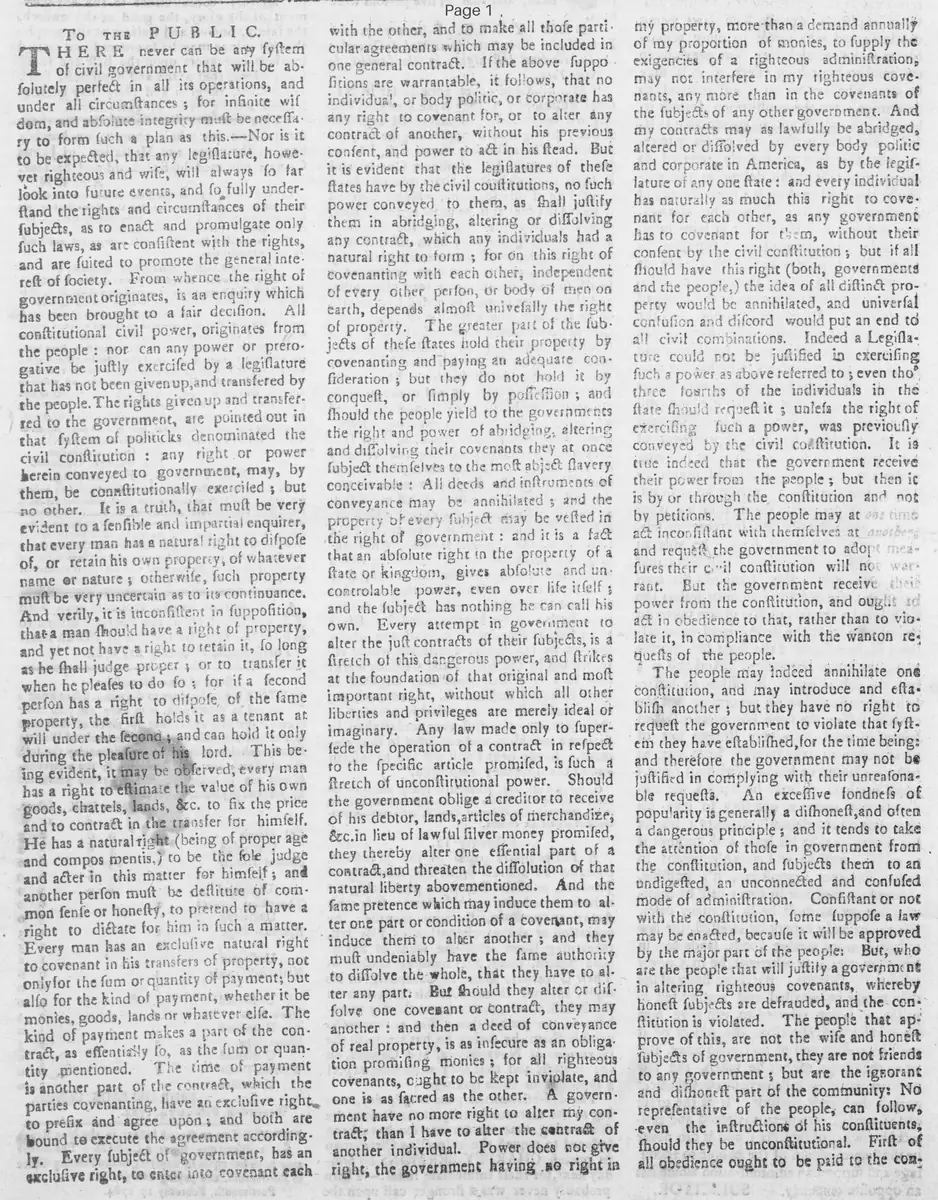
There never can be any system of civil government that will be absolutely perfect in all its operations, and under all circumstances; for infinite wisdom, and absolute integrity must be necessary to form such a plan as this.--Nor is it to be expected, that any legislature, however righteous and wise, will always so far look into future events, and so fully understand the rights and circumstances of their subjects, as to enact and promulgate only such laws, as are consistent with the rights, and are suited to promote the general interest of society. From whence the right of government originates, is an enquiry which has been brought to a fair decision. All constitutional civil power, originates from the people: nor can any power or prerogative be justly exercised by a legislature that has not been given up, and transferred by the people. The rights given up and transferred to the government, are pointed out in that system of politics denominated the civil constitution: any right or power herein conveyed to government, may, by them, be constitutionally exercised: but no other. It is a truth, that must be very evident to a sensible and impartial enquirer, that every man has a natural right to dispose of, or retain his own property, of whatever name or nature; otherwise, such property must be very uncertain as to its continuance. And verily, it is inconsistent in supposition, that a man should have a right of property, and yet not have a right to retain it, so long as he shall judge proper; or to transfer it when he pleases to do so: for if a second person has a right to dispose, of the same property, the first holds it as a tenant at will under the second; and can hold it only during the pleasure of his lord. This being evident, it may be observed, every man has a right to estimate the value of his own goods, chattels, lands, &c. to fix the price and to contract in the transfer for himself. He has a natural right (being of proper age and compos mentis.) to be the sole judge and actor in this matter for himself: and another person must be destitute of common sense or honesty, to pretend to have a right to dictate for him in such a matter. Every man has an exclusive natural right to covenant in his transfers of property, not only for the sum or quantity of payment; but also for the kind of payment, whether it be monies, goods, lands or whatever else. The kind of payment makes a part of the contract, as essentially so, as the sum or quantity mentioned. The time of payment is another part of the contract, which the parties covenanting, have an exclusive right to prefix and agree upon; and both are bound to execute the agreement accordingly. Every subject of government, has an exclusive right, to enter into covenant each with the other, and to make all those particular agreements which may be included in one general contract. If the above suppositions are warrantable, it follows, that no individual, or body politic, or corporate has any right to covenant for, or to alter any contract of another, without his previous consent, and power to act in his stead. But it is evident that the legislatures of these states have by the civil constitutions, no such power conveyed to them, as shall justify them in abridging, altering or dissolving any contract, which any individuals had a natural right to form; for on this right of covenanting with each other, independent of every other person, or body of men on earth, depends almost universally the right of property. The greater part of the subjects of these states hold their property by covenanting and paying an adequate consideration: but they do not hold it by conquest, or simply by possession; and should the people yield to the governments the right and power of abridging, altering and dissolving their covenants they at once subject themselves to the most abject slavery conceivable: All deeds and instruments of conveyance may be annihilated: and the property of every subject may be vested in the right of government: and it is a fact that an absolute right in the property of a state or kingdom, gives absolute and uncontrollable power, even over life itself: and the subject has nothing he can call his own. Every attempt in government to alter the just contracts of their subjects, is a stretch of this dangerous power, and strikes at the foundation of that original and most important right, without which all other liberties and privileges are merely ideal or imaginary. Any law made only to supersede the operation of a contract in respect to the specific article promised, is such a stretch of unconstitutional power. Should the government oblige a creditor to receive of his debtor, lands, articles of merchandise; &c. in lieu of lawful silver money promised, they thereby alter one essential part of a contract, and threaten the dissolution of that natural liberty abovementioned. And the same pretence which may induce them to alter one part or condition of a covenant, may induce them to alter another; and they must undeniably have the same authority to dissolve the whole, that they have to alter any part: But should they alter or dissolve one covenant or contract, they may another: and then a deed of conveyance of real property, is as insecure as an obligation promising monies; for all righteous covenants, ought to be kept inviolate, and one is as sacred as the other. A government have no more right to alter my contract: than I have to alter the contract of another individual. Power does not give right, the government having no right in my property, more than a demand annually of my proportion of monies, to supply the exigencies of a righteous administration, may not interfere in my righteous covenants, any more than in the covenants of the subjects of any other government. And my contracts may as lawfully be abridged, altered or dissolved by every body politic and corporate in America, as by the legislature of any one state: and every individual has naturally as much this right to covenant for each other, as any government has to covenant for them, without their consent by the civil constitution: but if all should have this right (both, governments and the people,) the idea of all distinct property would be annihilated, and universal confusion and discord would put an end to all civil combinations. Indeed a Legislature could not be justified in exercising such a power as above referred to; even tho three fourths of the individuals in the state should request it; unless the right of exercising such a power, was previously conveyed by the civil constitution. It is true indeed that the government receive their power from the people; but then it is by or through the constitution and not by petitions. The people may at one time act inconsistent with themselves at others and request the government to adopt measures their civil constitution will not warrant. But the government receive their power from the constitution, and ought to act in obedience to that, rather than to violate it, in compliance with the wanton requests of the people. The people may indeed annihilate one constitution, and may introduce and establish another: but they have no right to request the government to violate that system they have established, for the time being: and therefore the government may not be justified in complying with their unreasonable requests. An excessive fondness of popularity is generally a dishonest, and often a dangerous principle: and it tends to take the attention of those in government from the constitution, and subjects them to an undirected, an unconnected and confused mode of administration. Consistent or not with the constitution, some suppose a law may be enacted, because it will be approved by the major part of the people: But, who are the people that will justify a government in altering righteous covenants, whereby honest subjects are defrauded, and the constitution is violated. The people that approve of this, are not the wise and honest subjects of government, they are not friends to any government; but are the ignorant and dishonest part of the community: No representative of the people, can follow, even the instructions of his constituents, should they be unconstitutional. First of all obedience ought to be paid to the constitution.
Constitution, and then so far as is consistent with this fundamental law of society, a representative may, and in general ought to obey the instructions of his constituents: but it is doubly unjust to make a law that is unconstitutional (in se) and also retrospective; for a law determining what should have been done, is not binding in legal judgment, or in conscience. A penalty unforeseen could not be avoided; and by the constitution that has lately been accepted, and which will soon operate, all retrospective acts or laws, will be annulled that now exist in the government; for this provides explicitly against such laws being enacted; and why can it be more reasonable to make retrospective laws previous to the constitution taking effect, than it may be after, I believe no man will pretend to determine; for the constitution forbids it, because it is unjust and unwarrantable in itself. But some persons may be ready to reply, that this law particularly referred to above, may relieve the debtor at this particular time, when there is a great scarcity of circulating medium. It may be allowed, that it will relieve the debtor in some cases, and under some circumstances: but then, he has no right to relieve in this way. He has no right to wish for the abatement or dissolution of his own obligation to the injury of his creditor. Principles of honor, and the laws of reason will both oblige him to pay his creditor according to the true intent and spirit of their agreements, whether the statute laws, should be so righteous, as to oblige him to do it, or not. -- The creditor will in general be much injured by being obliged to receive goods, by the appraisement of other persons, in lieu of cash; for he being under a necessity to commit said goods to sale, to procure cash to execute his own business, must part with them, at such a price as they will vend for, be it more or less. And it is not probable he will be able to vend them, for more than the debtor could have done, while they remained his own property: therefore, the creditor suffers the same loss in the sale of said goods taken in lieu of cash, that the debtor must have suffered in the disposal of the same for monies to pay his own obligation. And this is a loss, the debtor ought in justice to suffer, rather than to violate his promises: But the creditor suffers the same loss unjustly. And surely, it must be a very strange sort of good policy to take unjustly from one, to bestow a favour or kindness (without right,) upon another. It may be replied, the creditor is not under a necessity to levy his execution on the debtor's property; but he has liberty to take his body and commit it to prison, until he will make payment in cash. On this supposition, it's possible, the creditor may not in every case be injured: but yet he must be so, in many cases. When the body cannot be arrested, the law obliges him to receive goods, lands &c. in lieu of monies; or otherwise, he may never receive any balance. But if the body of the debtor may be arrested and committed to prison, this law referred to, can give him no relief: and therefore the object of it must be trifling and of no consequence. But when the body cannot be taken, the law operates with its mischievous consequences against the honest creditor. It is the great end of civil government, to defend and protect the rights of subjects; and it can never be the determination of the people to encourage and support an administration which has an opposite tendency.
SOLICITOR.
What sub-type of article is it?
What keywords are associated?
What entities or persons were involved?
Editorial Details
Primary Topic
Opposition To Legislative Alteration Of Private Contracts
Stance / Tone
Strongly Defending Natural Rights To Property And Contracts Against Unconstitutional Government Interference
Key Figures
Key Arguments