Thank you for visiting SNEWPapers!
Sign up free
Editorial
August 27, 1805
Alexandria Daily Advertiser
Alexandria, Virginia
What is this article about?
An editorial critiquing the illusion of popular sovereignty in republics, arguing that a few leaders control the people, with historical examples from England, France, and the recent U.S. presidential election.
Clipping
OCR Quality
95%
Excellent
Full Text
From the Repertory.
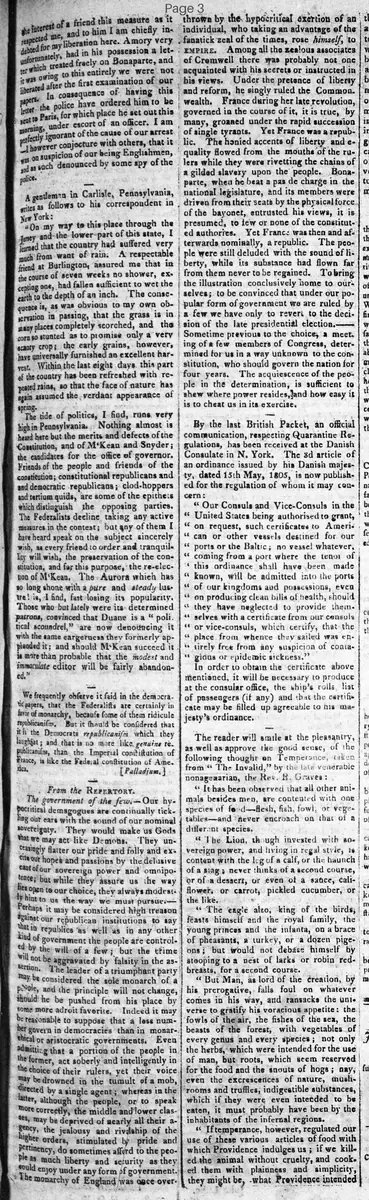
The government of the few. Our hypocritical demagogues are continually tickling our ears with the sound of our nominal sovereignty. They would make us Gods that we may act like Demots. They unceasingly flatter our pride and folly and excite our hopes and passions by the delusive cant of our sovereign power and omnipotence; but while they assure us the way lies open to our choice, they always modestly hint to us the way we must pursue. Perhaps it may be considered high treason against our republican institutions to say that in republics as well as in any other kind of government the people are controlled by the will of a few; but the crime will not be aggravated by falsity in the assertion. The leader of a triumphant party may be considered the sole monarch of a people, and the principle will not change, should he be pushed from his place by some more adroit favorite. Indeed it may be reasonable to suppose that a less number govern in democracies than in monarchical or aristocratic governments. Even admitting that a portion of the people in the former, act soberly and intelligently in the choice of their rulers, yet their voice may be drowned in the tumult of a mob, directed by a single agent; whereas in the latter, although the people, or to speak more correctly, the middle and lower classes, may be deprived of nearly all their agency, the jealousy and rivalship of the higher orders, stimulated by pride and pertinency, do sometimes afford to the people as much liberty and security as they could enjoy under any form of government. The monarchy of England was once overthrown by the hypocritical exertion of an individual, who taking an advantage of the fanatick zeal of the times, rose himself, to EMPIRE. Among all the zealous associates of Cromwell there was probably not one acquainted with his secrets or instructed in his views. Under the pretence of liberty and reform, he singly ruled the Commonwealth. France during her late revolution, governed in the course of it, it is true, by many, groaned under the rapid succession of single tyrants. Yet France was a republic. The honied accents of liberty and equality flowed from the mouths of the rulers while they were rivetting the chains of a gilded slavery upon the people. Bonaparte, when he beat a pas de charge in the national legislature, and its members were driven from their seats by the physical force of the bayonet, entrusted his views, it is presumed, to few or none of the constituted authorities. Yet France was then and afterwards nominally, a republic. The people were still deluded with the sound of liberty, while its substance had flown far from them never to be regained. To bring the illustration conclusively home to ourselves; to be convinced that under our popular form of government we are ruled by a few we have only to revert to the decision of the late presidential election. Sometime previous to the choice, a meeting of a few members of Congress, determined for us in a way unknown to the constitution who should govern the nation for four years. The acquiescence of the people in the determination, is sufficient to shew where power resides, and how easy it is to cheat us in its exercise.
The government of the few. Our hypocritical demagogues are continually tickling our ears with the sound of our nominal sovereignty. They would make us Gods that we may act like Demots. They unceasingly flatter our pride and folly and excite our hopes and passions by the delusive cant of our sovereign power and omnipotence; but while they assure us the way lies open to our choice, they always modestly hint to us the way we must pursue. Perhaps it may be considered high treason against our republican institutions to say that in republics as well as in any other kind of government the people are controlled by the will of a few; but the crime will not be aggravated by falsity in the assertion. The leader of a triumphant party may be considered the sole monarch of a people, and the principle will not change, should he be pushed from his place by some more adroit favorite. Indeed it may be reasonable to suppose that a less number govern in democracies than in monarchical or aristocratic governments. Even admitting that a portion of the people in the former, act soberly and intelligently in the choice of their rulers, yet their voice may be drowned in the tumult of a mob, directed by a single agent; whereas in the latter, although the people, or to speak more correctly, the middle and lower classes, may be deprived of nearly all their agency, the jealousy and rivalship of the higher orders, stimulated by pride and pertinency, do sometimes afford to the people as much liberty and security as they could enjoy under any form of government. The monarchy of England was once overthrown by the hypocritical exertion of an individual, who taking an advantage of the fanatick zeal of the times, rose himself, to EMPIRE. Among all the zealous associates of Cromwell there was probably not one acquainted with his secrets or instructed in his views. Under the pretence of liberty and reform, he singly ruled the Commonwealth. France during her late revolution, governed in the course of it, it is true, by many, groaned under the rapid succession of single tyrants. Yet France was a republic. The honied accents of liberty and equality flowed from the mouths of the rulers while they were rivetting the chains of a gilded slavery upon the people. Bonaparte, when he beat a pas de charge in the national legislature, and its members were driven from their seats by the physical force of the bayonet, entrusted his views, it is presumed, to few or none of the constituted authorities. Yet France was then and afterwards nominally, a republic. The people were still deluded with the sound of liberty, while its substance had flown far from them never to be regained. To bring the illustration conclusively home to ourselves; to be convinced that under our popular form of government we are ruled by a few we have only to revert to the decision of the late presidential election. Sometime previous to the choice, a meeting of a few members of Congress, determined for us in a way unknown to the constitution who should govern the nation for four years. The acquiescence of the people in the determination, is sufficient to shew where power resides, and how easy it is to cheat us in its exercise.
What sub-type of article is it?
Constitutional
Partisan Politics
What keywords are associated?
Republican Government
Nominal Sovereignty
Demagogues
Political Control
Presidential Election
Liberty Pretense
What entities or persons were involved?
Cromwell
Bonaparte
Members Of Congress
Editorial Details
Primary Topic
Government By The Few In Republics
Stance / Tone
Critical Of Nominal Sovereignty And Demagoguery
Key Figures
Cromwell
Bonaparte
Members Of Congress
Key Arguments
People In Republics Are Controlled By The Will Of A Few
Leaders Flatter The People With Illusions Of Sovereignty While Directing Their Choices
Fewer Govern In Democracies Than In Monarchies Or Aristocracies
Historical Examples: Cromwell Ruled England Under Pretense Of Liberty
France's Revolution Led To Single Tyrants Despite Republican Form
Recent U.S. Presidential Election Decided By Few Members Of Congress Unknown To The Constitution