Thank you for visiting SNEWPapers!
Sign up free
Plentywood Herald
Plentywood, Sheridan County, Montana
What is this article about?
C. J. McKee advises Montana farmers to increase flax acreage to the 10-year average for 1927, emphasizing higher yields through good cultural practices on clean ground, early seeding, and avoiding flax-wheat mixtures on non-irrigated land.
Merged-components note: These two components form a single continuous article on flax production and planting methods, split across columns on page 2 with sequential reading order and matching topic.
Clipping
OCR Quality
Full Text
Experiment Station)
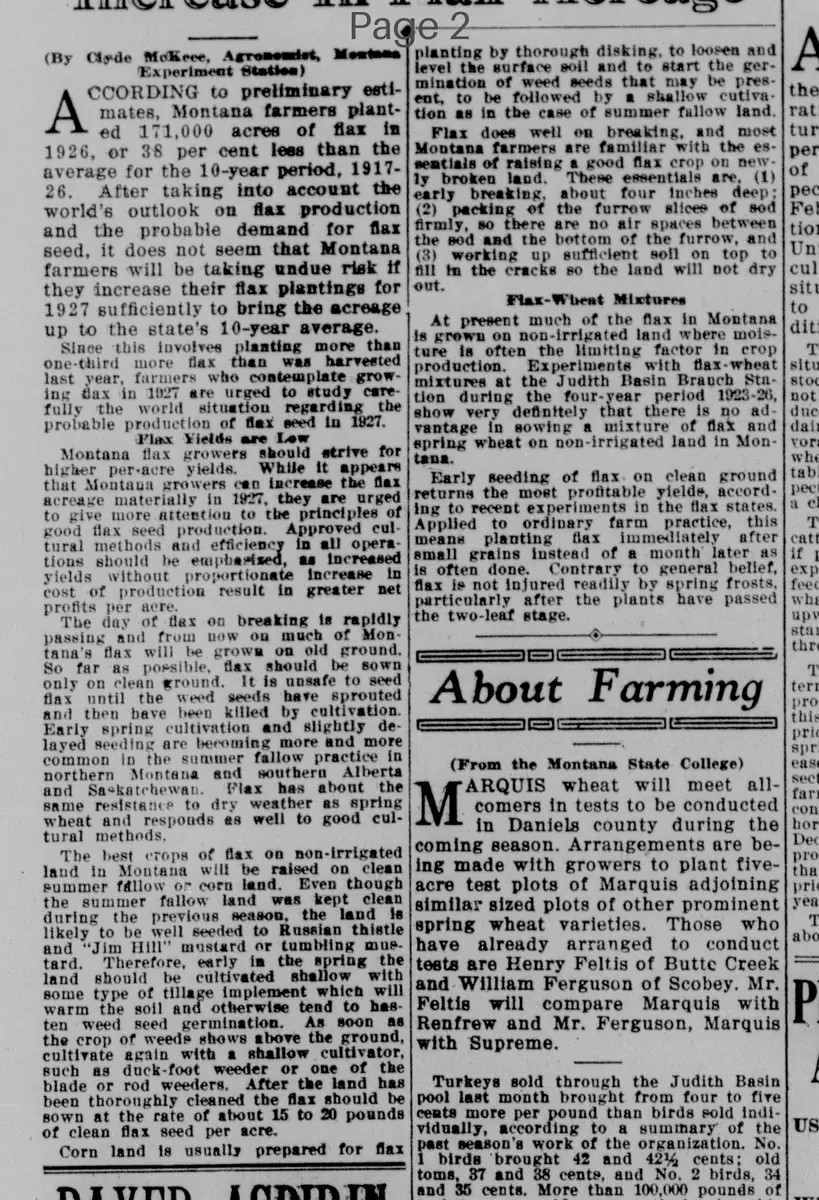
ACCORDING to preliminary estimates, Montana farmers planted 171,000 acres of flax in 1926, or 38 per cent less than the average for the 10-year period, 1917-26. After taking into account the world's outlook on flax production and the probable demand for linseed, it does not seem that Montana farmers will be taking undue risk if they increase their flax plantings for 1927 sufficiently to bring the acreage up to the state's 10-year average.
Since this involves planting more than one-third more flax than was harvested last year, farmers who contemplate growing flax in 1927 are urged to study carefully the world situation regarding the probable production of flax seed in 1927.
Flax Yields are Low
Montana flax growers should strive for higher per-acre yields. While it appears that Montana growers can increase the flax acreage materially in 1927, they are urged to give more attention to the principles of good flax seed production. Approved cultural methods and efficiency in all operations should be emphasized, as increased yields without proportionate increase in cost of production result in greater net profits per acre.
The day of flax on breaking is rapidly passing and from now on much of Montana's flax will be grown on old ground. So far as possible, flax should be sown only on clean ground. It is unsafe to seed flax until the weed seeds have sprouted and then have been killed by cultivation.
Early spring cultivation and slightly delayed seeding are becoming more and more common in the summer fallow practice in northern Montana and southern Alberta and Saskatchewan. Flax has about the same resistance to dry weather as spring wheat and responds as well to good cultural methods.
The best crops of flax on non-irrigated land in Montana will be raised on clean summer fallow or corn land. Even though the summer fallow land was kept clean during the previous season, the land is likely to be well seeded to Russian thistle and "Jim Hill" mustard or tumbling mustard. Therefore, early in the spring the land should be cultivated shallow with some type of tillage implement which will warm the soil and otherwise tend to hasten weed seed germination. As soon as the crop of weeds shows above the ground, cultivate again with a shallow cultivator, such as duck-foot weeder or one of the blade or rod weeders. After the land has been thoroughly cleaned the flax should be sown at the rate of about 15 to 20 pounds of clean flax seed per acre.
Corn land is usually prepared for flax
planting by thorough disking, to loosen and level the surface soil and to start the germination of weed seeds that may be present, to be followed by a shallow cultivation as in the case of summer fallow land.
Flax does well on breaking, and most Montana farmers are familiar with the essentials of raising a good flax crop on newly broken land. These essentials are: (1) early breaking, about four inches deep; (2) packing of the furrow slices of sod firmly, so there are no air spaces between the sod and the bottom of the furrow, and (3) working up sufficient soil on top to fill in the cracks so the land will not dry out.
Far-Wheat Mixtures
At present much of the flax in Montana is grown on non-irrigated land where moisture is often the limiting factor in crop production. Experiments with flax-wheat mixtures at the Judith Basin Branch Station during the four-year period 1923-26, show very definitely that there is no advantage in sowing a mixture of flax and spring wheat on non-irrigated land in Montana.
Early seeding of flax on clean ground returns the most profitable yields, according to recent experiments in the flax states. Applied to ordinary farm practice, this means planting flax immediately after small grains instead of a month later as is often done. Contrary to general belief flax is not injured readily by spring frosts, particularly after the plants have passed the two-leaf stage.
What sub-type of article is it?
What keywords are associated?
What entities or persons were involved?
Where did it happen?
Story Details
Key Persons
Location
Montana
Event Date
1927
Story Details
Advises increasing flax acreage to 10-year average, focusing on higher yields via clean ground preparation, early seeding, weed control, and avoiding flax-wheat mixtures on non-irrigated land.