Thank you for visiting SNEWPapers!
Sign up free
Story
March 28, 1860
Cincinnati Daily Press
Cincinnati, Hamilton County, Ohio
What is this article about?
In a 1857 lecture, Charles Kingsley vividly describes the 1830 destruction by fire of Bristol Jail during riots, likening it to Dante's Inferno, and a subsequent scene of corpse fragments amid ruins, reflecting on human horror and moral lessons.
Clipping
OCR Quality
98%
Excellent
Full Text
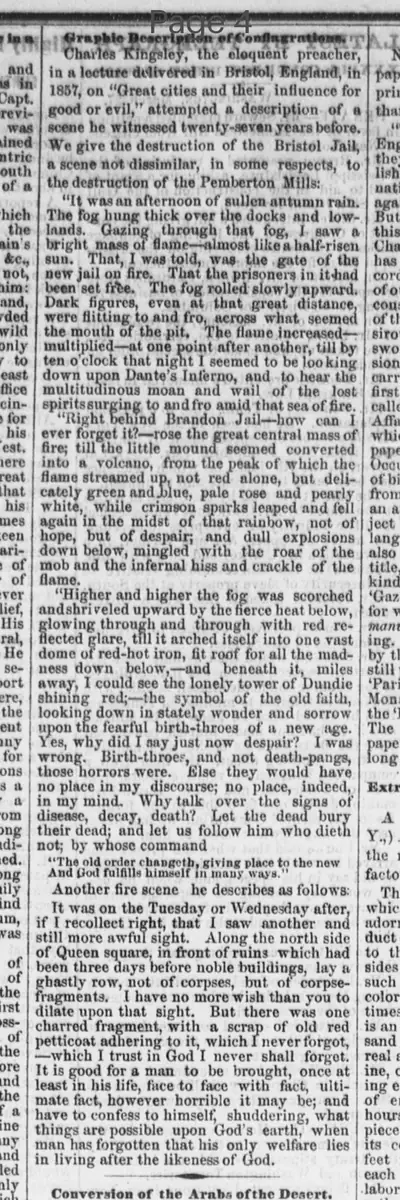
Graphic Description of Conflagrations.
Charles Kingsley, the eloquent preacher, in a lecture delivered in Bristol, England, in 1857, on "Great cities and their influence for good or evil," attempted a description of a scene he witnessed twenty-seven years before. We give the destruction of the Bristol Jail, a scene not dissimilar, in some respects, to the destruction of the Pemberton Mills:
"It was an afternoon of sullen autumn rain. The fog hung thick over the docks and low-lands. Gazing through that fog, I saw a bright mass of flame—almost like a half-risen sun. That, I was told, was the gate of the new jail on fire. That the prisoners in it—had been set free. The fog rolled slowly upward. Dark figures, even at that great distance, were flitting to and fro, across what seemed the mouth of the pit. The flame increased—multiplied—at one point after another, till by ten o'clock that night I seemed to be looking down upon Dante's Inferno, and to hear the multitudinous moan and wail of the lost spirits surging to and fro amid that sea of fire.
"Right behind Brandon Jail—how can I ever forget it?—rose the great central mass of fire; till the little mound seemed converted into a volcano, from the peak of which the flame streamed up, not red alone, but delicately green and blue, pale rose and pearly white, while crimson sparks leaped and fell again in the midst of that rainbow, not of hope, but of despair; and dull explosions down below, mingled with the roar of the mob and the infernal hiss and crackle of the flame.
"Higher and higher the fog was scorched and shriveled upward by the fierce heat below, glowing through and through with red reflected glare, till it arched itself into one vast dome of red-hot iron, fit roof for all the madness down below,—and beneath it, miles away, I could see the lonely tower of Dundry shining red;—the symbol of the old faith, looking down in stately wonder and sorrow upon the fearful birth-throes of a new age.
Yes, why did I say just now despair? I was wrong. Birth-throes, and not death-pangs, those horrors were. Else they would have no place in my discourse; no place, indeed, in my mind. Why talk over the signs of disease, decay, death? Let the dead bury their dead; and let us follow him who dieth not; by whose command
Another fire scene he describes as follows:
It was on the Tuesday or Wednesday after, if I recollect right, that I saw another and still more awful sight. Along the north side of Queen square, in front of ruins which had been three days before noble buildings, lay a ghastly row, not of corpses, but of corpse-fragments. I have no more wish than you to dilate upon that sight. But there was one charred fragment, with a scrap of old red petticoat adhering to it, which I never forgot, which I trust in God I never shall forget. It is good for a man to be brought, once at least in his life, face to face with fact, ultimate fact, however horrible it may be; and have to confess to himself, shuddering, what things are possible upon God's earth, when man has forgotten that his only welfare lies in living after the likeness of God.
Charles Kingsley, the eloquent preacher, in a lecture delivered in Bristol, England, in 1857, on "Great cities and their influence for good or evil," attempted a description of a scene he witnessed twenty-seven years before. We give the destruction of the Bristol Jail, a scene not dissimilar, in some respects, to the destruction of the Pemberton Mills:
"It was an afternoon of sullen autumn rain. The fog hung thick over the docks and low-lands. Gazing through that fog, I saw a bright mass of flame—almost like a half-risen sun. That, I was told, was the gate of the new jail on fire. That the prisoners in it—had been set free. The fog rolled slowly upward. Dark figures, even at that great distance, were flitting to and fro, across what seemed the mouth of the pit. The flame increased—multiplied—at one point after another, till by ten o'clock that night I seemed to be looking down upon Dante's Inferno, and to hear the multitudinous moan and wail of the lost spirits surging to and fro amid that sea of fire.
"Right behind Brandon Jail—how can I ever forget it?—rose the great central mass of fire; till the little mound seemed converted into a volcano, from the peak of which the flame streamed up, not red alone, but delicately green and blue, pale rose and pearly white, while crimson sparks leaped and fell again in the midst of that rainbow, not of hope, but of despair; and dull explosions down below, mingled with the roar of the mob and the infernal hiss and crackle of the flame.
"Higher and higher the fog was scorched and shriveled upward by the fierce heat below, glowing through and through with red reflected glare, till it arched itself into one vast dome of red-hot iron, fit roof for all the madness down below,—and beneath it, miles away, I could see the lonely tower of Dundry shining red;—the symbol of the old faith, looking down in stately wonder and sorrow upon the fearful birth-throes of a new age.
Yes, why did I say just now despair? I was wrong. Birth-throes, and not death-pangs, those horrors were. Else they would have no place in my discourse; no place, indeed, in my mind. Why talk over the signs of disease, decay, death? Let the dead bury their dead; and let us follow him who dieth not; by whose command
Another fire scene he describes as follows:
It was on the Tuesday or Wednesday after, if I recollect right, that I saw another and still more awful sight. Along the north side of Queen square, in front of ruins which had been three days before noble buildings, lay a ghastly row, not of corpses, but of corpse-fragments. I have no more wish than you to dilate upon that sight. But there was one charred fragment, with a scrap of old red petticoat adhering to it, which I never forgot, which I trust in God I never shall forget. It is good for a man to be brought, once at least in his life, face to face with fact, ultimate fact, however horrible it may be; and have to confess to himself, shuddering, what things are possible upon God's earth, when man has forgotten that his only welfare lies in living after the likeness of God.
What sub-type of article is it?
Disaster
Historical Event
Extraordinary Event
What themes does it cover?
Catastrophe
Misfortune
Moral Virtue
What keywords are associated?
Bristol Jail Fire
Conflagration
Riots
Corpse Fragments
Moral Reflection
Dante Inferno
Birth Throes
What entities or persons were involved?
Charles Kingsley
Where did it happen?
Bristol, England
Story Details
Key Persons
Charles Kingsley
Location
Bristol, England
Event Date
Twenty Seven Years Before 1857
Story Details
Charles Kingsley recounts witnessing the fiery destruction of Bristol Jail amid riots, with vivid imagery of flames, mob, and fog, followed by a scene of corpse fragments in Queen Square ruins, emphasizing moral reflection on human depravity and divine likeness.