Thank you for visiting SNEWPapers!
Sign up free
The Enquirer
Richmond, Henrico County, Virginia
What is this article about?
In the British House of Commons on March 12, 1810, Mr. Brougham moved for copies of correspondence between the Foreign Secretary and foreign ministers in London regarding the slave trade. He discussed illicit slave trading by Sweden (St. Bartholomew's), Portugal (15-16,000 slaves annually from one African district), Spain (two-thirds of Portugal's trade, via Cuba and Havana), and America (under Swedish flags).
Clipping
OCR Quality
Full Text
HOUSE OF COMMONS.
March 12, 1810.
SLAVE TRADE
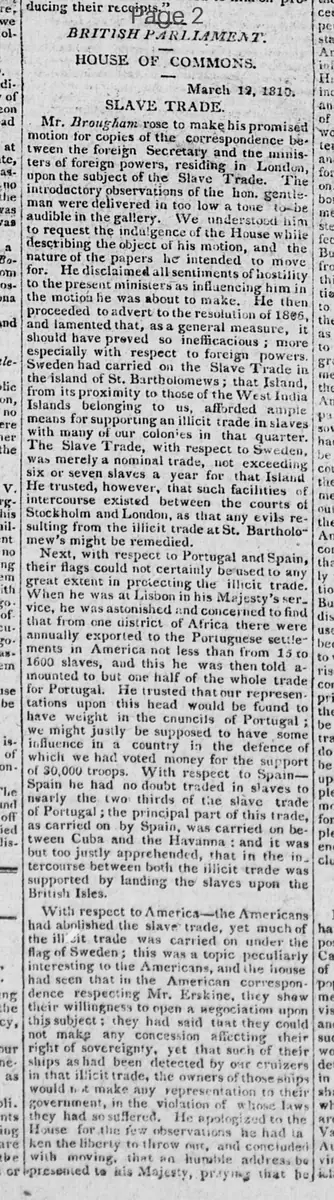
Mr. Brougham rose to make his promised motion for copies of the correspondence between the foreign Secretary and the ministers of foreign powers, residing in London, upon the subject of the Slave Trade. The introductory observations of the hon. gentleman were delivered in too low a tone to be audible in the gallery. We understood him to request the indulgence of the House while describing the object of his motion, and the nature of the papers he intended to move for. He disclaimed all sentiments of hostility to the present ministers as influencing him in the motion he was about to make. He then proceeded to advert to the resolution of 1806, and lamented that, as a general measure, it should have proved so inefficacious; more especially with respect to foreign powers. Sweden had carried on the Slave Trade in the island of St. Bartholomews; that Island, from its proximity to those of the West India Islands belonging to us, afforded ample means for supporting an illicit trade in slaves with many of our colonies in that quarter. The Slave Trade, with respect to Sweden, was merely a nominal trade, not exceeding six or seven slaves a year for that Island He trusted, however, that such facilities of intercourse existed between the courts of Stockholm and London, as that any evils resulting from the illicit trade at St. Bartholomew's might be remedied.
Next, with respect to Portugal and Spain, their flags could not certainly be used to any great extent in protecting the illicit trade. When he was at Lisbon in his Majesty's service, he was astonished and concerned to find that from one district of Africa there were annually exported to the Portuguese settlements in America not less than from 15 to 16000 slaves, and this he was then told amounted to but one half of the whole trade for Portugal. He trusted that our representations upon this head would be found to have weight in the councils of Portugal; we might justly be supposed to have some influence in a country in the defence of which we had voted money for the support of 30,000 troops. With respect to Spain—Spain he had no doubt traded in slaves to nearly the two thirds of the slave trade of Portugal; the principal part of this trade, as carried on by Spain, was carried on between Cuba and the Havanna: and it was but too justly apprehended, that in the intercourse between both the illicit trade was supported by landing the slaves upon the British Isles.
With respect to America—the Americans had abolished the slave trade, yet much of the illicit trade was carried on under the flag of Sweden; this was a topic peculiarly interesting to the Americans, and the house had seen that in the American correspondence respecting Mr. Erskine, they shew their willingness to open a negociation upon this subject; they had said that they could not make any concession affecting their right of sovereignty, yet that such of their ships as had been detected by our cruizers in that illicit trade, the owners of those ships would not make any representation to their government, in the violation of whose laws they had so suffered. He apologized to the House for the few observations he had taken the liberty to throw out, and concluded with moving, that an humble address, be presented to his Majesty, praying that he would be graciously pleased to order, that there be laid before the house, copies of all communications made by his Majesty's Secretary of State for Foreign affairs, to the Ministers of foreign powers resident in London, with their answers thereunto.
What sub-type of article is it?
What keywords are associated?
What entities or persons were involved?
Where did it happen?
Foreign News Details
Primary Location
London
Event Date
March 12, 1810
Key Persons
Outcome
motion for an humble address to his majesty requesting copies of correspondence on the slave trade with foreign ministers in london.
Event Details
Mr. Brougham addressed the House of Commons, lamenting the inefficacy of the 1806 resolution against the slave trade, particularly with foreign powers. He highlighted illicit trade by Sweden at St. Bartholomew's (nominal, 6-7 slaves/year, near British West Indies), Portugal (15,000-16,000 slaves annually from one African district to America, half of total trade), Spain (two-thirds of Portugal's trade volume, mainly between Cuba and Havana, possibly landing on British Isles), and America (abolished trade but illicit under Swedish flags; Americans open to negotiation per Mr. Erskine correspondence). He moved for copies of Foreign Secretary's communications with foreign ministers in London.