Thank you for visiting SNEWPapers!
Sign up free
Fowle's New Hampshire Gazette And General Advertiser
Portsmouth, Rockingham County, New Hampshire
What is this article about?
In Vienna, Prince Frederick (traveling as Comte de Hoya), son of the King of Great Britain, danced with a colonel's wife at a ball after a military review, sparking jealousy and a challenge from the ill-informed husband. The prince graciously defused the situation, leading to the colonel's reinstatement after imperial dismissal.
Merged-components note: Continuation of the extract from the letter from Vienna across the page break.
Clippings
1 of 2
OCR Quality
Full Text
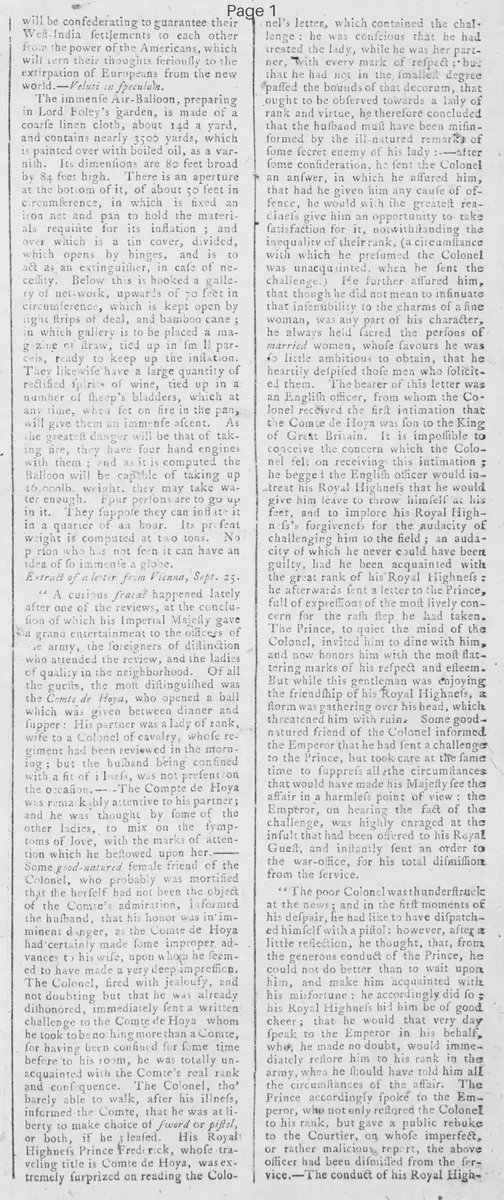
"A curious fracas happened lately after one of the reviews, at the conclusion of which his Imperial Majesty gave a grand entertainment to the officers of the army, the foreigners of distinction who attended the review, and the ladies of quality in the neighborhood. Of all the guests, the most distinguished was the Comte de Hoya, who opened a ball which was given between dinner and supper: His partner was a lady of rank, wife to a Colonel of cavalry, whose regiment had been reviewed in the morning: but the husband being confined with a fit of illness, was not present on the occasion.--The Comte de Hoya was remarkably attentive to his partner; and he was thought by some of the other ladies, to mix on the symptoms of love, with the marks of attention which he bestowed upon her.--Some good-natured female friend of the Colonel, who probably was mortified that herself had not been the object of the Comte's admiration, informed the husband, that his honor was in imminent danger, as the Comte de Hoya had certainly made some improper advances to his wife, upon whom he seemed to have made a very deep impression.
The Colonel, fired with jealousy, and not doubting but that he was already dishonored, immediately sent a written challenge to the Comte de Hoya whom he took to be nothing more than a Comte, for having been confined for some time before to his room, he was totally unacquainted with the Comte's real rank and consequence. The Colonel, tho' barely able to walk, after his illness, informed the Comte, that he was at liberty to make choice of sword or pistol, or both, if he pleased. His Royal Highness Prince Frederick, whose traveling title is Comte de Hoya, was extremely surprised on reading the Colonel's letter, which contained the challenge: he was conscious that he had treated the lady, while he was her partner, with every mark of respect; but that he had not in the smallest degree passed the bounds of that decorum, that ought to be observed towards a lady of rank and virtue, he therefore concluded that the husband must have been misinformed by the ill-natured remarks of some secret enemy of his lady:--after some consideration, he sent the Colonel an answer, in which he assured him, that had he given him any cause of offence, he would with the greatest readiness give him an opportunity to take satisfaction for it, notwithstanding the inequality of their rank. (a circumstance with which he presumed the Colonel was unacquainted, when he sent the challenge.) He further assured him, that though he did not mean to insinuate that insensibility to the charms of a fine woman, was any part of his character, he always held sacred the persons of married women, whose favours he was so little ambitious to obtain, that he heartily despised those men who solicited them. The bearer of this letter was an English officer, from whom the Colonel received the first intimation that the Comte de Hoya was son to the King of Great Britain. It is impossible to conceive the concern which the Colonel felt on receiving this intimation; he begged the English officer would entreat his Royal Highness that he would give him leave to throw himself at his feet, and to implore his Royal Highness's forgiveness for the audacity of challenging him to the field: an audacity of which he never could have been guilty, had he been acquainted with the great rank of his Royal Highness: he afterwards sent a letter to the Prince, full of expressions of the most lively concern for the rash step he had taken.
The Prince, to quiet the mind of the Colonel, invited him to dine with him, and now honors him with the most flattering marks of his respect and esteem. But while this gentleman was enjoying the friendship of his Royal Highness, a storm was gathering over his head, which threatened him with ruin, Some good-natured friend of the Colonel informed the Emperor that he had sent a challenge to the Prince, but took care at the same time to suppress all the circumstances that would have made his Majesty see the affair in a harmless point of view: the Emperor, on hearing the fact of the challenge, was highly enraged at the insult that had been offered to his Royal Guest, and instantly sent an order to the war-office, for his total dismission from the service.
The poor Colonel was thunderstruck at the news: and in the first moments of his despair, he had like to have dispatched himself with a pistol: however, after a little reflection, he thought, that, from the generous conduct of the Prince, he could not do better than to wait upon him, and make him acquainted with his misfortune: he accordingly did so; his Royal Highness bid him be of good cheer: that he would that very day speak to the Emperor in his behalf, who, he made no doubt, would immediately restore him to his rank in the army, when he should have told him all the circumstances of the affair. The Prince accordingly spoke to the Emperor, who not only restored the Colonel to his rank, but gave a public rebuke to the Courtier, on whose imperfect, or rather malicious, report, the above officer had been dismissed from the service.--The conduct of his Royal Highness, in this affair, does him honor."
His conduct through the whole of this business, has raised him higher, if possible, than he stood before in the opinion of the Emperor; and has endeared him to all ranks of people. The King of England may certainly rejoice in being the father of so promising a Prince; and the English nation may look forward with the most pleasing hopes to that support, which his father's crown is likely to derive from the abilities of a person, who is every day qualifying himself in the best school to form heroes and statesmen.
What sub-type of article is it?
What keywords are associated?
What entities or persons were involved?
Where did it happen?
Foreign News Details
Primary Location
Vienna
Event Date
Lately Before September 25
Key Persons
Outcome
colonel challenged prince, apologized upon learning his rank, was dismissed from service but reinstated by emperor at prince's request; courtier rebuked for malicious report.
Event Details
At a grand entertainment after a military review, Prince Frederick (as Comte de Hoya) danced with a colonel's wife, leading to jealousy-fueled challenge from the absent husband. Prince responded graciously, revealing his rank; colonel apologized. Emperor dismissed colonel on partial report but restored him after Prince's intervention.