Thank you for visiting SNEWPapers!
Sign up free
The Enquirer
Richmond, Henrico County, Virginia
What is this article about?
William Cobbett's commentary critiques the Austrian Emperor's manifesto for hypocrisy in diplomatic claims, highlighting contradictions in his alliance with Napoleon via marriage, concerns over conquests, and preparations for war, while referencing treaties like Tilsit and historical partitions.
Merged-components note: Continuation of the same article on the Austrian Manifesto, with apparent OCR duplication in the second component.
Clipping
OCR Quality
Full Text
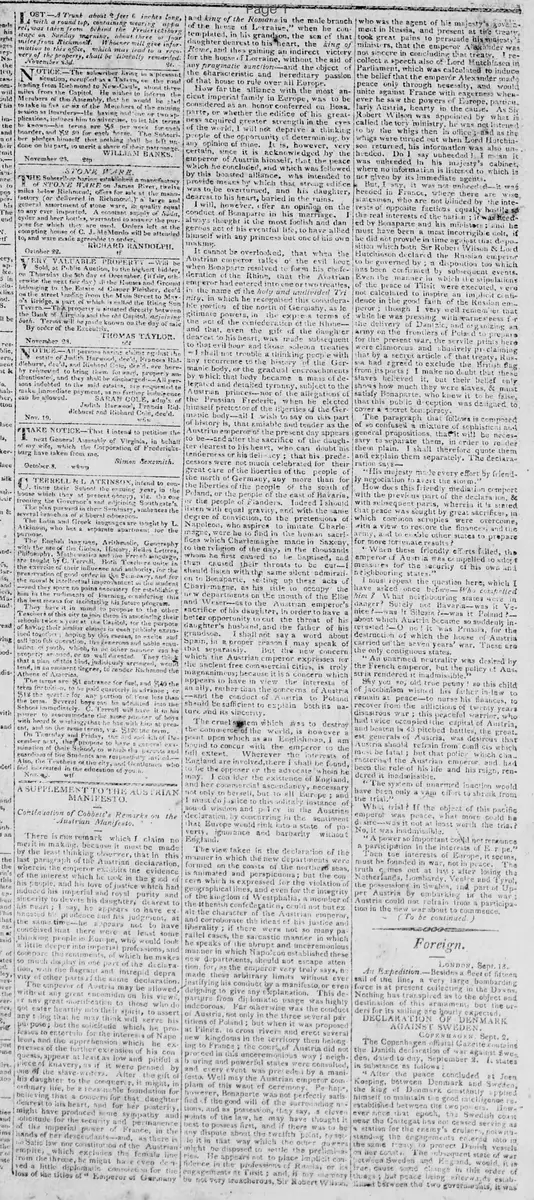
Continuation of Cobbett's Remarks on the Austrian Manifesto.
There is one remark which I claim no merit in making, because it must be made by the least thinking observer, that in this last paragraph of the Austrian declaration, wherein the emperor exhibits the evidence of the interest which he took in the good of his people, and his love of justice which had induced his imperial and royal purity and sincerity to devote his daughter, dearest to his heart; I say, he appears to have exhausted his prudence and his judgment, at the same time—he appears not to have conceived that there were at least some thinking people in Europe, who would look a little deeper into imperial professions, and compare the sentiments, of which he makes so much display in one part of the declaration, with the flagrant and intrepid depravity of other parts of the same declaration.
The emperor of Austria may be allowed, without any great encomium on his views, or any great mortification to those who do not enter heartily into their spirit, to assert any thing that he may think will serve his purpose; but the solicitude which he professes to entertain for the interests of Napoleon, and the apprehension which he expresses of the further extension of his conquests, appear at least as low and pitiful a piece of knavery, as if it were penned by one of the slave waiters. After the gift of his daughter to the conqueror, it might, in ordinary life, be a seasonable foundation for believing that a concern for that daughter dearest to his heart, and for her posterity, might have produced some sympathy and solicitude for the security and permanence of the imperial power of France, in the hands of her descendants—and, as there is no Salic law nor constitution of the Austrian empire, which excludes the female line from the throne, he might have even derived a little diplomatic consolation, on for the loss of the titles of "Emperor of Germany and king of the Romans in the male branch of the house of Lorraine." when he contemplated, in his grandson, the son of that daughter dearest to his heart, the king of Rome, and thus gaining an indirect victory for the house of Lorraine, without the aid of any pragmatic sanction—and the object of the characteristic and hereditary passion of that house to rule over all Europe.
How far the alliance with the most ancient imperial family in Europe, was to be considered as an honor conferred on Bonaparte, or whether the edifice of his greatness acquired greater strength in the eyes of the world, I will not deprive a thinking people of the opportunity of determining, by any opinion of mine. It is, however, very certain, since it is acknowledged by the emperor of Austria himself, that the peace which he concluded, and which was followed by this boasted alliance, was intended to provide means by which that strange edifice was to be overturned, and his daughter, dearest to his heart, buried in the ruins.
I will, however, offer an opinion on the conduct of Bonaparte in his marriage. I always thought it the most foolish and dangerous act of his eventful life, to have allied himself with any princess but one of his own making.
It cannot be overlooked, that when the Austrian emperor talks of the evil hour when Bonaparte resolved to form his confederation of the Rhine, that the Austrian emperor had entered into one or two treaties, in the name of the holy and undivided Trinity, in which he recognised this considerable portion of the north of Germany, as legitimate powers, in the express terms of the act of the confederation of the Rhine—and that, even the gift of the daughter dearest to his heart, was made subsequent to that evil hour and those solemn treaties—I shall not trouble a thinking people with any recurrence to the history of the Germanic body, or the gradual encroachments by which that body became a mass of delegated and detailed tyranny, subject to the Austrian princes—nor of the allegations of the Prussian Frederic, when he elected himself protector of the liberties of the Germanic body—all I wish to say on this part of history is, that amiable and tender as the Austrian emperor of the present day appears to be—and after the sacrifice of the daughter dearest to his heart, who can doubt his tenderness or his delicacy : that his predecessors were not much celebrated for their great care of the liberties of the people of the north of Germany, any more than for the liberties of the people of the south of Poland, or the people of the east of Bavaria, or the people of Flanders. Indeed I should listen with equal gravity, and with the same degree of conviction, to the pretensions of Napoleon, who aspires to imitate Charlemagne, were he to find in the human sacrifices which Charlemagne made in Saxony, to the religion of the day, in the thousands whom he first caused to be baptised, and then caused their throats to be cut—I should listen with the same silent admiration to Bonaparte, setting up these acts of Charlemagne, as his title to occupy the new departments on the mouth of the Elbe and Weser—as to the Austrian emperor's sacrifice of his daughter, in order to have a better opportunity to cut the throat of his daughter's husband, and the father of his grandson. I shall not say a word about Spain, in a proper season I may speak of that separately.
But the new concern which the Austrian emperor expresses for the ancient free commercial cities, is truly magnanimous; because it is a concern which appears to have in view the interests of an ally, rather than the concerns of Austria—and the conduct of Austria to Poland should be sufficient to explain both its nature and its sincerity.
The cruel system which was to destroy the commerce of the world, is however a point upon which as an Englishman, I am bound to concur with the emperor to the full extent. Wherever the interests of England are involved, there I shall be found, to be the opposer or the advocate whom he may. I consider the existence of England, and her commercial ascendancy, necessary not only to herself, but to all Europe; and I must do justice to this solitary instance of sound wisdom and policy in the Austrian declaration, by concurring in the sentiment that Europe would sink into a state of poverty, ignorance and barbarity without England.
The view taken in the declaration of the manner in which the new departments were formed on the coasts of the northern seas, is animated and perspicuous; but the concern which is expressed for the violation of geographical lines, and even for the integrity of the kingdom of Westphalia, a member of the Rhenish confederation, could not but exalt the character of the Austrian emperor, and corroborate the ideas of his justice and liberality; if there were not so many parallel cases, the sarcastic manner in which he speaks of the abrupt and unceremonious manner in which Napoleon established these new departments, should not escape attention. for, as the emperor very truly says, he made those arbitrary limits without ever justifying his conduct by a manifesto, or even deigning to give any explanation. This departure from diplomatic usage was highly indecorous. Far otherwise was the conduct of Austria, not only in the three several partitions of Poland; but when it was proposed at Pilnitz, to cross rivers and erect several new kingdoms in the territory then belonging to France; the court of Austria did not proceed in this unceremonious way; neighbouring and powerful states were consulted, and every event was preceded by a manifesto. Well may the Austrian emperor complain of this want of ceremony. Perhaps however, Bonaparte was not perfectly satisfied of the good will of the surrounding nations, and as possession, they say, is eleven points of the law, he may have thought it best to possess first, and if there was to be any dispute about the twelfth point, to settle it in that way which the other powers might be disposed to settle the preliminaries. He appears not to place implicit confidence in the professions of Russia, or its engagements at Tilsit; and, if my memory be not very treacherous, Sir Robert Wilson, who was the agent of his majesty's Government in Russia, and present at the treaty, took great pains to persuade his majesty's ministers, that the emperor Alexander was not sincere in concluding that treaty. I recollect a speech also of Lord Hutchinson in Parliament, which was calculated to induce the belief that the emperor Alexander made peace only through necessity, and would unite against France with eagerness whenever he saw the powers of Europe, particularly Austria, hearty in the cause. As Sir Robert Wilson was appointed by what is called the tory ministry, he was not listened to by the whigs then in office; and as the whigs were turned out when Lord Hutchinson returned, his information was also unheeded, Do I say unheeded! I mean it was unheeded in his majesty's cabinet, where no information is listened to which is not given by its immediate agents. But, I say, it was not unheeded it was heeded in France, where there are wise statesmen, who are not blinded by the interests of opposite factions equally hostile to the real interests of the nation; it was heeded by Bonaparte and his ministers; and he must have been a most incorrigible dolt, if he did not provide in time against that disposition which both Sir Robert Wilson & Lord Hutchinson declared the Russian emperor to be governed by; a disposition too which has been confirmed by subsequent events.
Even the manner in which the stipulations of the peace of Tilsit were executed, were not calculated to inspire an implicit confidence in the good faith of the Russian emperor; though I very well remember that while he was pressing with earnestness for the delivery of Dantzic, and organizing an army on the frontiers of Poland to prepare for the present war, the servile prints here were clamorous and abusively proclaiming that by a secret article of that treaty, Russia had agreed to exclude the British flag from its ports; I make no doubt that these slaves believed it, but their belief only shows how much they were slaves, & must satisfy Bonaparte, who knew it to be false, that this public deception was designed to cover a secret conspiracy.
The paragraph that follows is composed of so confused a mixture of sophistical and general propositions, that it will be necessary to separate them, in order to render them plain. I shall therefore quote them and explain them separately. The declaration says—
"His majesty made every effort by friendly negociation to avert the storm."
How does this friendly mediation comport with the previous part of the declaration, & with subsequent parts, wherein it's stated that peace was sought by great sacrifices, in which common scruples were overcome, with a view to restore the finances, and the army, and to enable other states to prepare for more fortunate results?
"When these friendly efforts failed, the emperor of Austria was compelled to adopt measures for the security of his own and neighbouring states."
I must repeat the question here; which I have asked once before—Who compelled him? What neighbouring states were in danger? Surely not Bavaria—was it Venice?—was it Silesia—was it Poland?—about which Austria became so suddenly interested—O no! it was Prussia, for the destruction of which the house of Austria carried on the seven years' war. These are the only contiguous states.
"An unarmed neutrality was desired by the French emperor, but the policy of Austria rendered it inadmissible."
Say you so, old true penny! so this child of jacobinism wished his father in-law to remain at peace—to nurse his finances, to recover from the afflictions of twenty years disastrous war; this peaceful warrior, who had twice occupied the capital of Austria, and beaten in 43 pitched battles, the greatest generals of Austria, was desirous that Austria should refrain from conflicts which must be fatal; but that policy which characterized the Austrian emperor, and had been the rule of his life and his reign, rendered it inadmissible.
"The system of unarmed inaction would have been only a vain effort to shrink from the trial."
What trial? If the object of this pacific emperor was peace, what more could he desire—was it not at least worth the trial? No, it was inadmissible.
"A power so important could not renounce a participation in the interests of Europe."
Then the interests of Europe, it seems, must be founded in war, not in peace. The truth comes out at last; after losing the Netherlands, Lombardy, Venice and Tyrol, the possessions in Swabia, and part of Upper Austria by embarking in the war: Austria could not refrain from a participation in the new war about to commence.
(To be continued.)
What sub-type of article is it?
What keywords are associated?
What entities or persons were involved?
Where did it happen?
Foreign News Details
Primary Location
Austria
Key Persons
Outcome
diplomatic preparations for war against france, critique of insincere treaties and alliances including marriage and treaty of tilsit
Event Details
Cobbett analyzes the Austrian Manifesto's contradictions, mocking the Emperor's professed concern for Napoleon after marrying his daughter, referencing historical encroachments, Russian insincerity at Tilsit, and Austria's war preparations despite neutrality claims.