Thank you for visiting SNEWPapers!
Sign up free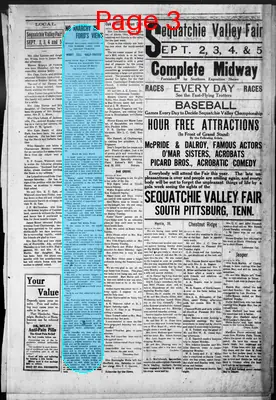
Sequachee Valley News
Sequatchie, Marion County, Tennessee
What is this article about?
In Henry Ford's $1,000,000 libel suit against the Chicago Tribune for labeling him an 'anarchist,' Episcopal Bishop Charles D. Williams and Columbia Prof. William A. Dunning provide rebuttal testimony in Mt. Clemens, Michigan, asserting that Ford's views on peace, cosmopolitanism, and human goodness are Christian, commonplace, and not anarchistic.
Clipping

OCR Quality
Full Text
BISHOP WILLIAMS TESTIFIES IN THE $1,000,000 LIBEL CASE AGAINST TRIBUNE.
WON'T TELL "HALF-TRUTHS"
Noted Divine Says If Manufacturer's Theories Are Anarchistic Then He Is In Danger Of Becoming Anarchist Himself.
Mt. Clemens, Mich.—The Chicago Tribune rested its defense in the $1,000,000 libel suit which Henry Ford has brought against it after spending seven weeks and two days in attempting to prove that it was justified in calling the manufacturer an "anarchist." The 12th week of the trial opened with Ford counsel offering rebuttal testimony against The Tribune's defense.
The first witness for Mr. Ford was the Rt. Rev. Charles D. Williams, D.D., Episcopal bishop of Michigan, who appeared on the stand in rebuttal of the testimony of Prof. J. S. Reeves, professor of political science in the University of Michigan who had previously testified that Henry Ford's views were distinctly anarchistic.
Bishop Williams said that Mr. Ford's views were far from being anarchistic and were, in fact, Christian, common and often commonplace.
The Bishop refused to be led by Tribune counsel in his answers and insisted on telling "the whole truth."
Asked whether he thought Henry Ford's declaration that all armies should be disbanded, all navies destroyed and all material of war converted into commercial implements was anarchistic, the witness answered:
Would Be Good World.
"I could quote a half-dozen passages from Scripture that express almost that idea, I should say that the main theme of these statements by Henry Ford are distinctly Christian, commonly preached in Christian pulpits and that if they were lived up to this would be a pretty good Christian world."
"Bishop," asked Tribune counsel, "do you believe that Mr. Ford has quoted patriotism is the last resort of a scoundrel.'"
"I have often said so," responded the witness. I have often seen it so."
Concerning the doctrine of non-resistance Bishop Williams declared he did not believe in such a theory but that many Christians did.
"It is the belief of anarchists," said Tribune counsel.
"Yes and the belief of Christians."
"Will you be good enough to answer the question," retorted counsel.
"Anarchists say that and Christians say that. I am afraid I am going to tell the whole truth."
"Now Bishop"
Would Tell Whole Truth.
I am going to tell the whole truth."
"You are telling something I have not asked you to tell."
"You have not asked me for the whole truth. I have to follow my conscience. I am a simple man."
"I am afraid," continued the Bishop, "that if this is anarchy I agree with it mostly."
Ford counsel then called William A. Dunning, professor of history and political philosophy in Columbia University, to testify concerning Mr. Ford's theories and utterances.
"When Henry Ford," said counsel "said that we should stop talking about one factory, one state and one country and begin to talk about the world, was he preaching the doctrine of anarchy?"
"No that is the general thought of cosmopolitanism—human inclusiveness; it has permeated all speculation on political philosophy ever since there was such a philosophy."
"Is there anything peculiarly anarchistic about it?"
"No."
"Is it in any way essential to anarchism?"
"No."
"Mr. Ford also said that he believed humanity could make mistakes but could do nothing worse; he said he believed everything tended toward the good, and that even the terrible world war would result in blessing to the world. Is there anything anarchistic about those ideas?"
"They were commonplace before an anarchist was ever heard of. The idea that man is naturally good is the basis of Platonic morals. It has permeated moral philosophy ever since."
Prof. Dunning was then asked to run through the articles and interviews sponsored by Henry Ford and indicate the portions which would convince a critical examiner that Mr. Ford was not an anarchist.
The witness promptly pointed out numerous references to the government and to the use of the ballot which showed, he said, that Mr. Ford believed in the orderly processes of government and therefore could not be an anarchist. In no writing or interview, he said, could he find a single indication that Mr. Ford was an anarchist, either in the common or philosophical conception of that term.
What sub-type of article is it?
What themes does it cover?
What keywords are associated?
What entities or persons were involved?
Where did it happen?
Story Details
Key Persons
Location
Mt. Clemens, Mich.
Story Details
Bishop Williams testifies that Ford's pacifist and cosmopolitan views are Christian and commonplace, not anarchistic, refusing to give half-truths. Prof. Dunning confirms Ford's ideas align with historical philosophy and support for government, refuting anarchy claims in the libel trial.