Thank you for visiting SNEWPapers!
Sign up free
The Kentucky Gazette
Lexington, Fayette County, Kentucky
What is this article about?
Anthropological overview of Native American religious beliefs, including duality of God, animal manitous, nature deification, sacrifices, deluge traditions, superstitions, and detailed funeral ceremonies indicating soul immortality.
Clipping
OCR Quality
Full Text
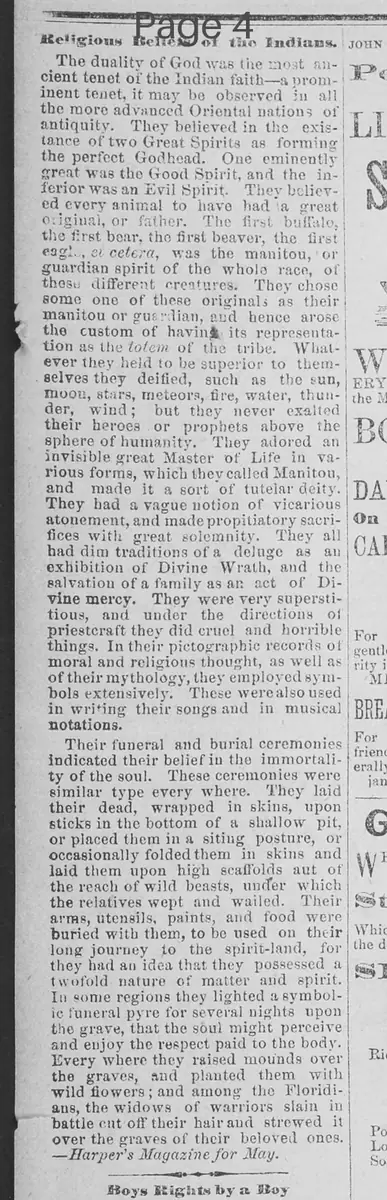
The duality of God was the most ancient tenet of the Indian faith—a prominent tenet, it may be observed in all the more advanced Oriental nations of antiquity. They believed in the existence of two Great Spirits as forming the perfect Godhead. One eminently great was the Good Spirit, and the inferior was an Evil Spirit. They believed every animal to have had a great original, or father. The first buffalo, the first bear, the first beaver, the first eagle, et cetera, was the manitou, or guardian spirit of the whole race, of these different creatures. They chose some one of these originals as their manitou or guardian, and hence arose the custom of having its representation as the totem of the tribe. Whatever they held to be superior to themselves they deified, such as the sun, moon, stars, meteors, fire, water, thunder, wind; but they never exalted their heroes or prophets above the sphere of humanity. They adored an invisible great Master of Life in various forms, which they called Manitou, and made it a sort of tutelar deity. They had a vague notion of vicarious atonement, and made propitiatory sacrifices with great solemnity. They all had dim traditions of a deluge as an exhibition of Divine Wrath, and the salvation of a family as an act of Divine mercy. They were very superstitious, and under the directions of priestcraft they did cruel and horrible things. In their pictographic records of moral and religious thought, as well as of their mythology, they employed symbols extensively. These were also used in writing their songs and in musical notations.
Their funeral and burial ceremonies indicated their belief in the immortality of the soul. These ceremonies were similar type everywhere. They laid their dead, wrapped in skins, upon sticks in the bottom of a shallow pit, or placed them in a sitting posture, or occasionally folded them in skins and laid them upon his scaffolds out of the reach of wild beasts, under which the relatives wept and wailed. Their arms, utensils, paint, and food were buried with them, to be used on their long journey to the spirit-land, for they had an idea that they possessed a twofold nature of matter and spirit. In some regions they lighted a symbolic funeral pyre for several nights upon the grave, that the soul might perceive and enjoy the respect paid to the body. Everywhere they raised mounds over the graves, and planted them with wild flowers; and among the Floridians, the widows of warriors slain in battle cut off their hair and strewed it over the graves of their beloved ones.
—Harper's Magazine for May
What sub-type of article is it?
What themes does it cover?
What keywords are associated?
Story Details
Story Details
Native Americans believed in dual Great Spirits (Good and Evil), animal manitous as guardians leading to totems, deification of natural elements, an invisible Master of Life (Manitou), vicarious atonement via sacrifices, deluge traditions, superstitions influenced by priests, and symbolic pictographs. Funeral rites reflected soul immortality, involving burial with possessions, scaffolds, pyres, mounds, and mourning rituals like Floridian widows strewing hair.