Thank you for visiting SNEWPapers!
Sign up free
Virginia Argus
Richmond, Virginia
What is this article about?
Detailed account of the 1809 Franco-Austrian War, including recap of 1805 Austerlitz campaign and Presburg Treaty, early 1809 battles in Bavaria, and latest English reports from May 1809 contradicting French bulletins.
Merged-components note: Sequential components on the Austrian war, with the first providing historical context and the second latest updates from England, forming a single focused foreign news article.
Clipping
OCR Quality
Full Text
RICHMOND.
TUESDAY, JULY 11, 1809.
FOR THE ARGUS.
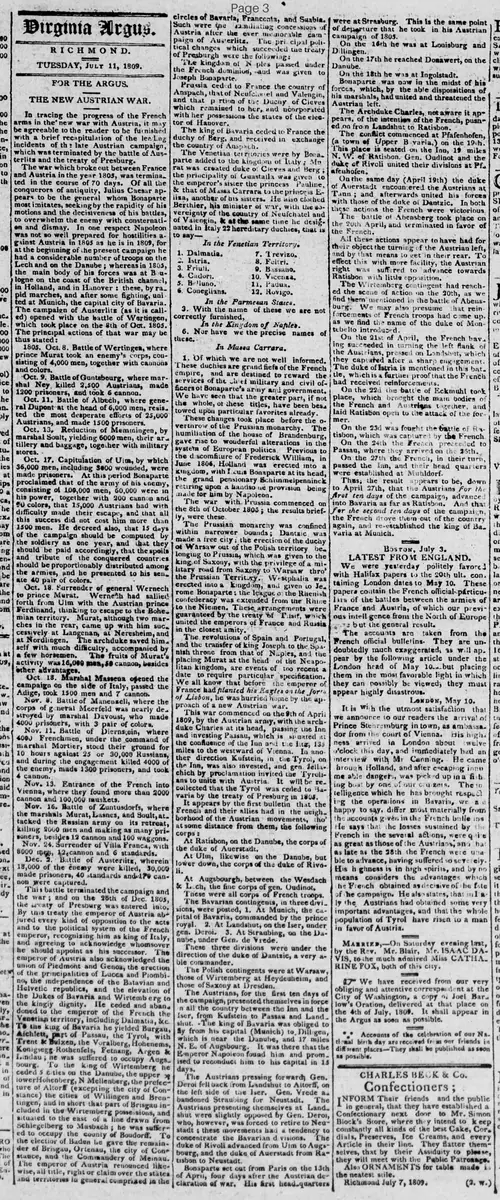
THE NEW AUSTRIAN WAR.
In tracing the progress of the French arms in the new war with Austria, it may be agreeable to the reader to be furnished with a brief recapitulation of the leading incidents of the late Austrian campaign, which was terminated by the battle of Austerlitz and the treaty of Presburg.
The war which broke out between France and Austria in the year 1805, was terminated in the course of 70 days. Of all the conquerors of antiquity, Julius Caesar appears to be the general whom Bonaparte most imitates, seeking by the rapidity of his motions and the decisiveness of his battles, to overwhelm the enemy with consternation and dismay. In one respect Napoleon was not so well prepared for hostilities against Austria in 1805 as he is in 1809, for at the beginning of the present campaign he had a considerable number of troops on the Lech and on the Danube; whereas in 1805, the main body of his forces was at Boulogne on the coast of the British channel, in Holland, and in Hanover: these, by rapid marches, and after some fighting, united at Munich, the capital city of Bavaria.
The campaign of Austerlitz (as it is called) opened with the battle of Wertingen, which took place on the 8th of Oct. 1805.
The principal actions of that war may be thus stated:
1805. Oct. 8. Battle of Wertingen, where prince Murat took an enemy's corps, consisting of 4,000 men, together with cannons and colors.
Oct. 9. Battle of Guntsbourg, where marshal Ney killed 2,500 Austrians, made 1200 prisoners, and took 6 cannon.
Oct. 11. Battle of Elchingen, where general Dupont at the head of 6,000 men, resisted the most desperate efforts of 25,000 Austrians, and made 1500 prisoners.
Oct. 13, Reduction of Memmingen, by marshal Soult, yielding 6000 men, their artillery and baggage, together with military stores.
Oct. 17. Capitulation of Ulm, by which 36,000 men, including 8000 wounded, were made prisoners. At this period Bonaparte proclaimed that of the army of his enemy, consisting of 100,000 men, 60,000 were in his power, together with 200 cannon and 50 colors, that 15,000 Austrians had with difficulty made their escape, and that all this success did not cost him more than 1500 men. He decreed also, that 15 days of the campaign should be computed by the soldiery as one year, and that they should be paid accordingly, that the spoils and tribute of the conquered countries should be proportionably distributed among the armies, and he presented to his senate 40 pair of colors.
Oct. 18. Surrender of general Werneck to prince Murat. Werneck had sallied forth from Ulm with the Austrian prince Ferdinand, thinking to escape to the Bohemian territory. Murat, although two marches in the rear, came up with him successively at Langenau, at Neresheim, and at Nordlingen. The archduke saved himself with much difficulty, accompanied by a few horsemen. The fruits of Murat's activity was 16,000 men, 59 cannon, besides other advantages.
Oct. 18. Marshal Massena opened the campaign on the side of Italy, passed the Adige, took 1500 men and 7 cannon.
Nov. 8. Battle of Caldiero, where the corps of general Meerfeldt was nearly destroyed by marshal Davoust, who made 4000 prisoners, with 3 pair of colors.
Nov. 11. Battle of Dürnstein, where 4000 Frenchmen, under the command of marshal Mortier, stood their ground for 10 hours against 25 or 30,000 Russians, and during the engagement killed 4000 of the enemy, made 1300 prisoners, and took cannon.
Nov. 13. Entrance of the French into Vienna, where they found more than 2000 cannon and 100,000 muskets.
Nov. 16. Battle of Hollabrunn, where the marshals Murat, Lannes, and Soult, attacked the Russian army on its retreat, killing 2000 men and making as many prisoners, besides 12 cannon and 100 waggons.
Nov. 24. Surrender of Villa Franca, with 8000 men, 12 cannon and 6 standards.
Dec. 2. Battle of Austerlitz, wherein 18,000 of the enemy were killed, 30,000 made prisoners, 40 standards and 180 cannon were captured.
This battle terminated the campaign and the war; and on the 26th of Dec. 1805, the treaty of Presburg was entered into.
By this treaty the emperor of Austria abjured every kind of opposition to the acts and to the political system of the French emperor, recognizing him as king of Italy, and agreeing to acknowledge whomsoever he should appoint as his successor. The emperor of Austria also acknowledged the union of Piedmont and Genoa, the erection of the principalities of Lucca and Piombino, the independence of the Batavian and Helvetic republics, and the elevation of the Dukes of Bavaria and Wirtemberg to the kingly dignity. He ceded and abandoned to the emperor of the French the Venetian territory, including Dalmatia, &c. To the king of Bavaria he yielded Burgau, Aichach, part of Passau, the Tyrol, with Trent & Brixen, the Vorarlberg, Hohenems, Königsegg-Rothenfels, Feldkirch, Argen & Lindau; he was suffered to occupy Augsburg. To the king of Wirtemberg he ceded 5 cities on the Danube, the upper & lower Hoheoberg, Nellenberg, the prefecture of Altdorf (excepting the city of Constance) the cities of Willingen and Brentingen, and in short that part of Brisgau included in the Wirtemberg possessions, and situated to the east of a line drawn from Schlegelberg to Masbach; he was suffered to occupy the county of Bonndorf. To the elector of Baden he gave the remainder of Brisgau, Ortenau, the city of Constance, and the Commandery of Meinau. The emperor of Austria renounced likewise, all title, right or claim over the states and territories in general comprised in the circles of Bavaria, Franconia, and Suabia.
Such were the humiliating concessions of Austria after the ever memorable campaign of Austerlitz. The principal political changes which succeeded the treaty of Presburg were the following:
The kingdom of Naples passed under the French dominion, and was given to Joseph Bonaparte.
Prussia ceded to France the country of Anspach, that of Neufchâtel and Valangin, and that portion of the Duchy of Cleves which remained to her, and incorporated with her possessions the states of the elector of Hanover.
The king of Bavaria ceded to France the duchy of Berg, and received in exchange the country of Anspach.
The Venetian territories were by Bonaparte added to the kingdom of Italy; Murat was created duke of Cleves and Berg; the principality of Guastalla was given to the emperor's sister the princess Pauline, & that of Massa Carrara to the princess Elisa, another of his sisters. He also clothed Berthier, his minister of war, with the sovereignty of the country of Neufchâtel and of Valangin, and at the same time he designated in Italy 22 hereditary duchies, that is to say
In the Venetian Territory.
1. Dalmatia. 7. Treviso.
Istria. 8. Feltre.
3. Friuli. 9. Bassano.
4. Cadore. 10. Vicenza.
5. Belluno. 11. Padua.
Conegliano. 12. Rovigo.
In the Parmesan States.
With the name of these we are not correctly furnished,
In the Kingdom of Naples.
Nor have we the precise names of these.
In Massa Carrara.
Of which we are not well informed.
These duchies are grand fiefs of the French empire, and are destined to reward the services of the chief military and civil officers of Bonaparte's army and government.
We have seen that the greater part, if not the whole, of these titles, have been bestowed upon particular favorites already.
These changes took place before the overthrow of the Prussian monarchy. The humiliation of the house of Brandenburg, gave rise to wonderful alterations in the system of European politics. Previous to the discomfiture of Frederick William, in June 1806, Holland was erected into a kingdom, with Louis Bonaparte at its head, the grand pensionary Schimmelpenninck retiring upon a handsome provision being made for him by Napoleon.
The war with Prussia commenced on the 8th of October 1806: the results briefly, were these.
The Prussian monarchy was confined within narrower bounds; Dantzic, was made a free city: the erection of the duchy of Warsaw out of the Polish territory belonging to Prussia, which was given to the king of Saxony, with the privilege of a military road from Saxony to Warsaw thro' the Prussian Territory.: Westphalia was erected into a kingdom, and given to Jerome Bonaparte: the league of the Rhenish confederacy was extended from the Rhine to the Niemen. These arrangements were guaranteed by the treaty of Tilsit, which united the emperors of France and Russia in the closest amity.
The revolutions of Spain and Portugal, and the transfer of king Joseph to the Spanish throne from that of Naples, and the placing Murat at the head of the Neapolitan kingdom, are events of too recent a date to require particular specification.
We all know that before the emperor of France had planted his Eagles on the forts of Lisbon, he was hurried home by the approach of a new Austrian war.
This war commenced on the 9th of April 1809, by the Austrian army, with the archduke Charles at its head, passing the Inn and investing Passau, which is situated at the confluence of the Inn and the Ilz, 135 miles to the westward of Vienna. In another direction Kufstein, in the Tyrol, on the Inn, was also invested, and gen. Jellachich by proclamation invited the Tyrolians to unite with Austria. It will be recollected that the Tyrol was ceded to Bavaria by the treaty of Presburg in 1805.
It appears by the first bulletin that the French and their allies had in the neighborhood of the Austrian movements, tho at some distance from them, the following corps:
At Ratisbon, on the Danube, the corps of the duke of Auerstadt.
At Ulm, likewise on the Danube, but lower down, the corps of the duke of Rivoli.
At Augsburgh, between the Weser & Lech, the fine corps of gen. Oudinot,
These were all corps of French troops.
The Bavarian contingents, in three divisions, were posted, 1. At Munich, the Capital of Bavaria, commanded by the prince royal. 2. At Landshut, on the Isar, under gen. Deroy. 3. At Straubing, on the Danube, under Gen. de Vreede.
These three divisions were under the direction of the duke of Dantzic, a very able commander.
The Polish contingents were at Warsaw, those of Wirtemberg at Heydenheim, and those of Saxony at Dresden.
The Austrians, for the first ten days of the campaign, presented themselves in force in all the country between the Inn and the Isar, from Kufstein to Passau and Landshut. -The king of Bavaria was obliged to fly from his capital (Munich) to Dillingen, which is near the Danube, and 17 miles N. E. of Augsbourg. It was there that the Emperor Napoleon found him and promised to reconduct him to his capital in 15 days.
The Austrians pressing forward Gen. Deroy fell back from Landshut to Abensberg, on the left side of the Isar. Gen. Vreede abandoned Straubing for Neustadt. The Austrians presenting themselves at Landshut were slightly opposed by Gen. Deroy, who, however, was forced to retire to Neustadt: these movements had a tendency to concentrate the Bavarian divisions. The duke of Rivoli advanced from Ulm to Augsburg, and the duke of Auerstadt from Ratisbon to Neustadt.
Bonaparte set out from Paris on the 13th of April, four days after the Austrian declaration of war, His first head-quarters were at Strasburg. This is the same point of departure that he took in his Austrian campaign of 1805.
On the 16th he was at Ludwigsburg and Dillingen..
On the 17th he reached Donawert, on the Danube.
On the 18th he was at Ingolstadt.
Bonaparte, was now in the midst of his forces, which, by the able dispositions of his marshals, had united and threatened the Austrian left.
The Archduke Charles, not aware it appears, of the intention of the French, pushed on from Landshut to Ratisbon.
The conflict commenced at Pfaffenhofen, (a town of Upper Bavaria,) on the 19th.
This place is seated on the Ilm, 19 miles N. W. of Ratisbon. Gen. Oudinot and the duke of Rivoli united their divisions at Pfaffenhofen.
On the same day (April 19th) the duke of Auerstadt encountered the Austrians at Tann: and afterwards united his forces with those of the duke of Dantzic. In both these actions the French were victorious
The battle of Abensberg took place on the 20th April, and terminated in favor of the French.
All these actions appear to have had for their object the turning of the Austrian left, and by that means to get in their rear. To effect this with more facility, the Austrian right was suffered to advance towards Ratisbon with little opposition.
The Wirtemberg Contingent had reached the scene of action on the 20th, as we find them mentioned in the battle of Abensberg. We may also presume that reinforcements of French troops had come up. as we find the name of the duke of Montebello introduced.
On the 21st of April, the French having succeeded in turning the left flank of the Austrians. pressed on Landshut, which they captured after a sharp engagement.
The duke of Istria is mentioned in this battle, which is a further proof that the French had received reinforcements.
On the 22d the battle of Eckmuhl took place, which brought the main bodies of the French and Austrians together, and laid Ratisbon open to the attack of the former.
On the 23d was fought the battle of Ratisbon, which was captured by the French.
On the 24th the French proceeded to Passau, where they arrived on the 26th.
On the 27th the French, in their turn, passed the Inn, and their head quarters were established at Muhldorf.
Thus: the result appears to be, down to April 27th, that the Austrians For the first ten days of the campaign, advanced into Bavaria as far as Ratisbon. And that for the second ten days of the campaign, the French drove them out of the country again, and re-established the king of Bavaria at Munich.
Boston, July 3.
LATEST FROM ENGLAND.
We were yesterday politely favored with Halifax papers to the 20th ult. containing London dates to May 10. These papers contain the French official particulars of the battles between the armies of France and Austria, of which our previous intelligence from the North of Europe gave but the general result.
The accounts are taken from the French official bulletins. They are undoubtedly much exaggerated, as will appear by the following article under the London head of May 10. but placing them in the most favorable light in which they can possibly be viewed; they must appear highly disastrous.
London, May 10.
It is with the utmost satisfaction that we announce to our readers the arrival of Prince Stephenburg in town, as ambassador from the court of Vienna. His highness arrived in London about twelve o'clock this day, and immediately had an interview with Mr. Canning. He came through Holland, and after escaping innumerable dangers, was picked up in a fishing boat by one of our cruisers. The intelligence which he has brought respecting the operations in Bavaria, we are happy to say, differ most materially from the accounts given in the French bulletins He says that the losses sustained by the French in the several actions, were quite as great as those of the Austrians, and that as late as the 28th the French were unable to advance, having suffered so severely. His highness is in high spirits, and by no means considers the advantages which the French obtained as decisive of the fate of the campaign. He also states, that in Italy the Austrians had obtained some very important advantages, and that the whole population of Tyrol have risen to a man in favor of Austria.
What sub-type of article is it?
What keywords are associated?
What entities or persons were involved?
Where did it happen?
Foreign News Details
Primary Location
Bavaria
Event Date
April 9, 1809 To May 10, 1809
Key Persons
Outcome
french victories in battles including abensberg, eckmuhl, ratisbon; austrians advanced into bavaria then driven out; french bulletins claim heavy austrian losses; austrian ambassador reports equal french losses and ongoing campaign as of april 28, 1809; tyrol uprising for austria; advantages for austrians in italy.
Event Details
Recap of 1805 Franco-Austrian War ending in Austerlitz battle and Presburg Treaty with territorial cessions; 1809 war starts April 9 with Austrian invasion of Bavaria; French forces under Napoleon counterattack from April 13, winning battles at Pfaffenhofen, Tann, Abensberg, Landshut, Eckmuhl, Ratisbon; French cross Inn by April 27, restoring Bavarian king; English report from May 10 via Prince Stephenburg contradicts French claims, stating heavy French losses and Austrian successes in Italy and Tyrol.