Thank you for visiting SNEWPapers!
Sign up free
Literary
July 13, 1891
Evening Capital
Annapolis, Anne Arundel County, Maryland
What is this article about?
In Auvergne, orphan cobbler Darazou, infatuated with Marie Antoinette, crafts ornate sabots inscribed with 'T.T.L.V.' (Je t'aimerai toute la vie) and sends them via Lafayette. Touched, the queen rewards him with gold-filled sabots. During the Revolution, Darazou journeys to Paris to rescue her but is slain by a mob on October 17, 1793.
Merged-components note: These two components continue the same serialized literary story 'The Sabots' sequentially in reading order and spatial position.
Clipping
OCR Quality
95%
Excellent
Full Text
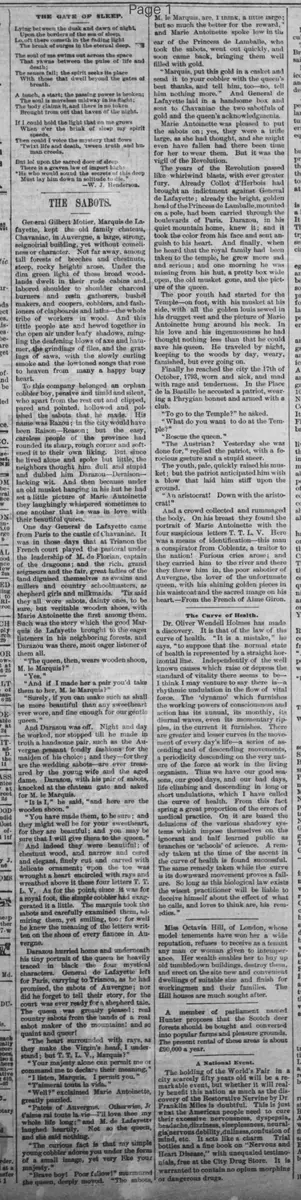
THE SABOTS.
General Gilbert Motier, Marquis de Lafayette, kept the old family chateau, Chavaniac, in Auvergne, a large, strong seignorial building, yet without comeliness or character. Not far away, among tall forests of beeches and chestnuts, steep, rocky heights arose. Under the dim green light of these broad woodlands dwelt in their rude cabins and labored shoulder to shoulder charcoal burners and resin gatherers, bushel makers, and coopers, cobblers, and fashioners of clapboards and laths--the whole tribe of workers in wood. And this little people ate and hewed together in the open air under leafy shadows, mingling the deafening blows of axe and hammer, the grindings of files, and the gratings of saws, with the slowly curling smoke and the low-toned songs that rose to heaven from many a happy busy heart.
To this company belonged an orphan cobbler boy, pensive and timid and silent, who apart from the rest cut and clipped, pared and pointed, hollowed and polished the sabots that he made. His name was Razou; in the city would have been Raison--Reason: but the easy, careless people of the province had rounded its sharp, rough corner and softened it to their own liking. But since he lived alone and spoke but little, the neighbors thought him dull and stupid and dubbed him Darazou--Deraison--lacking wit. And then because under an old musket hanging in his hut he had set a little picture of Marie Antoinette they laughingly whispered sometimes to one another that he was in love with their beautiful queen.
One day General de Lafayette came from Paris to the castle of Chavaniac. It was in those days that at Trianon the French court played the pastoral under the leadership of M. de Florian, captain of the dragoons; and the rich, grand seigneurs and the fair, great ladies of the land disguised themselves as swains and millers and country schoolmasters, as shepherd girls and milkmaids. 'Tis said they all wore sabots, dainty ones, to be sure, but veritable wooden shoes, with Marie Antoinette the first among them. Such was the story which the good Marquis de Lafayette brought to the eager listeners in his neighboring forests, and Darazou was there, most eager listener of them all.
"The queen, then, wears wooden shoon, M. le Marquis?"
"Yes."
"And if I made her a pair you'd take them to her, M. le Marquis?"
"Surely, if you can make such as shall be more beautiful than any sweetheart ever wore, and fine enough for our gentle queen."
And Darazou was off. Night and day he worked, nor stopped till he made in truth a handsome pair, such as the Auvergne peasant fondly fashions for the maiden of his choice; and they--for they are the wedding sabots--are ever treasured by the young wife and the aged dame. Darazou, with his pair of sabots, knocked at the chateau gate and asked for M. le Marquis.
"It is I," he said, "and here are the wooden shoon."
"You have made them, to be sure; and they might well be for your sweetheart, for they are beautiful; and you may be sure that I will give them to the queen."
And indeed they were beautiful; of chestnut wood, and narrow and waxed and elegant, finely cut and carved with delicate ornament; upon the toe was wrought a heart encircled with rays and wreathed above it these four letters T. T. L. V. As for the point, since it was for a royal foot, the simple cobbler had exaggerated it a little. The marquis took the sabots and carefully examined them, admiring them, yet smiling, too; for well he knew the meaning of the letters written on the shoes of every fiancee in Auvergne.
Darazou hurried home and underneath his tiny portrait of the queen he heavily traced in black the four mystical characters. General de Lafayette left for Paris, carrying to Trianon, as he had promised, the sabots of Auvergne; nor did he forget to tell their story, for the court was ever ready for a shepherd tale. The queen was greatly pleased; real country sabots from the hands of a real sabot maker of the mountains! and so quaint and queer!
*The heart surrounded with rays, as they make the Virgin's head, I understand; but T. T. L. V., Marquis?"
"Your majesty alone can permit me or command me to declare their meaning."
"I listen, Marquis. I permit you."
"Je t'aimerai toute la vie."
"Well?" exclaimed Marie Antoinette, greatly puzzled.
"Patois of Auvergne. Otherwise, Je t'aimerai toute la vie--I'll love thee my whole life long;" and M. de Lafayette laughed heartily. Not so the queen, and she said nothing.
"The curious fact is that my simple young cobbler adores you under the form of a small image, yet very like your majesty."
"Brave boy! Poor fellow!" murmured the queen, deeply moved. "The sabots, M. le Marquis, are, I think, a little large: but so much the better for the reward." And Marie Antoinette spoke low in the ear of the Princess de Lamballe, who took the sabots, went out quickly, and soon came back, bringing them well filled with gold. "Marquis, put this gold in a casket and send it to your cobbler with the queen's best thanks, and tell him, too, tell him nothing more." And General de Lafayette laid it in a handsome box and sent to Chavaniac the two sabotfuls of gold and the queen's acknowledgments. Marie Antoinette was pleased to put the sabots on: yes, they were a trifle large, as she had thought, and she might even have fallen had there been time for her to wear them. But it was the vigil of the Revolution. The years of the Revolution passed like whirlwind blasts, with ever greater fury. Already Collot d'Herbois had brought an indictment against General de Lafayette: already the bright, golden head of the Princess de Lamballe, mounted on a pole, had been carried through the boulevards of Paris. Darazou, in his quiet mountain home, knew it: and it took the color from his face and sent anguish to his heart. And finally, when he heard that the royal family had been taken to the Temple, he grew more sad and serious; and one morning he was missing from his hut, a pretty box wide open, the old musket gone, and the picture of the queen. The poor youth had started for the Temple on foot, with his musket at his side, with all the golden louis sewed in his drugget vest and the picture of Marie Antoinette hung around his neck. In his love and his ingenuousness he had thought nothing less than that he could save his queen. He traveled by night, keeping to the woods by day, weary, famished, but ever going on. Finally he reached the city the 17th of October, 1793, worn and sick, and mad with rage and tenderness. In the Place de la Bastille he accosted a patriot, wearing a Phrygian bonnet and armed with a club. "To go to the Temple?" he asked. "What do you want to do at the Temple?" "Rescue the queen." "The Austrian? Yesterday she was done for," replied the patriot, with a ferocious gesture and a stupid sneer. The youth, pale, quickly raised his musket: but the patriot anticipated him with a blow that laid him stiff upon the ground. "An aristocrat! Down with the aristocrat!" And a crowd collected and rummaged the body. On his breast they found the portrait of Marie Antoinette with the four suspicious letters T. T. L. V. Here was a means of identification--this man a conspirator from Coblentz, a traitor to the nation! Furious cries arose: and they carried him to the river and there they threw him in, the poor sabotier of Auvergne, the lover of the unfortunate queen, with his shining golden pieces in his waistcoat and the sacred image on his heart.--From the French of Aime Giron.
General Gilbert Motier, Marquis de Lafayette, kept the old family chateau, Chavaniac, in Auvergne, a large, strong seignorial building, yet without comeliness or character. Not far away, among tall forests of beeches and chestnuts, steep, rocky heights arose. Under the dim green light of these broad woodlands dwelt in their rude cabins and labored shoulder to shoulder charcoal burners and resin gatherers, bushel makers, and coopers, cobblers, and fashioners of clapboards and laths--the whole tribe of workers in wood. And this little people ate and hewed together in the open air under leafy shadows, mingling the deafening blows of axe and hammer, the grindings of files, and the gratings of saws, with the slowly curling smoke and the low-toned songs that rose to heaven from many a happy busy heart.
To this company belonged an orphan cobbler boy, pensive and timid and silent, who apart from the rest cut and clipped, pared and pointed, hollowed and polished the sabots that he made. His name was Razou; in the city would have been Raison--Reason: but the easy, careless people of the province had rounded its sharp, rough corner and softened it to their own liking. But since he lived alone and spoke but little, the neighbors thought him dull and stupid and dubbed him Darazou--Deraison--lacking wit. And then because under an old musket hanging in his hut he had set a little picture of Marie Antoinette they laughingly whispered sometimes to one another that he was in love with their beautiful queen.
One day General de Lafayette came from Paris to the castle of Chavaniac. It was in those days that at Trianon the French court played the pastoral under the leadership of M. de Florian, captain of the dragoons; and the rich, grand seigneurs and the fair, great ladies of the land disguised themselves as swains and millers and country schoolmasters, as shepherd girls and milkmaids. 'Tis said they all wore sabots, dainty ones, to be sure, but veritable wooden shoes, with Marie Antoinette the first among them. Such was the story which the good Marquis de Lafayette brought to the eager listeners in his neighboring forests, and Darazou was there, most eager listener of them all.
"The queen, then, wears wooden shoon, M. le Marquis?"
"Yes."
"And if I made her a pair you'd take them to her, M. le Marquis?"
"Surely, if you can make such as shall be more beautiful than any sweetheart ever wore, and fine enough for our gentle queen."
And Darazou was off. Night and day he worked, nor stopped till he made in truth a handsome pair, such as the Auvergne peasant fondly fashions for the maiden of his choice; and they--for they are the wedding sabots--are ever treasured by the young wife and the aged dame. Darazou, with his pair of sabots, knocked at the chateau gate and asked for M. le Marquis.
"It is I," he said, "and here are the wooden shoon."
"You have made them, to be sure; and they might well be for your sweetheart, for they are beautiful; and you may be sure that I will give them to the queen."
And indeed they were beautiful; of chestnut wood, and narrow and waxed and elegant, finely cut and carved with delicate ornament; upon the toe was wrought a heart encircled with rays and wreathed above it these four letters T. T. L. V. As for the point, since it was for a royal foot, the simple cobbler had exaggerated it a little. The marquis took the sabots and carefully examined them, admiring them, yet smiling, too; for well he knew the meaning of the letters written on the shoes of every fiancee in Auvergne.
Darazou hurried home and underneath his tiny portrait of the queen he heavily traced in black the four mystical characters. General de Lafayette left for Paris, carrying to Trianon, as he had promised, the sabots of Auvergne; nor did he forget to tell their story, for the court was ever ready for a shepherd tale. The queen was greatly pleased; real country sabots from the hands of a real sabot maker of the mountains! and so quaint and queer!
*The heart surrounded with rays, as they make the Virgin's head, I understand; but T. T. L. V., Marquis?"
"Your majesty alone can permit me or command me to declare their meaning."
"I listen, Marquis. I permit you."
"Je t'aimerai toute la vie."
"Well?" exclaimed Marie Antoinette, greatly puzzled.
"Patois of Auvergne. Otherwise, Je t'aimerai toute la vie--I'll love thee my whole life long;" and M. de Lafayette laughed heartily. Not so the queen, and she said nothing.
"The curious fact is that my simple young cobbler adores you under the form of a small image, yet very like your majesty."
"Brave boy! Poor fellow!" murmured the queen, deeply moved. "The sabots, M. le Marquis, are, I think, a little large: but so much the better for the reward." And Marie Antoinette spoke low in the ear of the Princess de Lamballe, who took the sabots, went out quickly, and soon came back, bringing them well filled with gold. "Marquis, put this gold in a casket and send it to your cobbler with the queen's best thanks, and tell him, too, tell him nothing more." And General de Lafayette laid it in a handsome box and sent to Chavaniac the two sabotfuls of gold and the queen's acknowledgments. Marie Antoinette was pleased to put the sabots on: yes, they were a trifle large, as she had thought, and she might even have fallen had there been time for her to wear them. But it was the vigil of the Revolution. The years of the Revolution passed like whirlwind blasts, with ever greater fury. Already Collot d'Herbois had brought an indictment against General de Lafayette: already the bright, golden head of the Princess de Lamballe, mounted on a pole, had been carried through the boulevards of Paris. Darazou, in his quiet mountain home, knew it: and it took the color from his face and sent anguish to his heart. And finally, when he heard that the royal family had been taken to the Temple, he grew more sad and serious; and one morning he was missing from his hut, a pretty box wide open, the old musket gone, and the picture of the queen. The poor youth had started for the Temple on foot, with his musket at his side, with all the golden louis sewed in his drugget vest and the picture of Marie Antoinette hung around his neck. In his love and his ingenuousness he had thought nothing less than that he could save his queen. He traveled by night, keeping to the woods by day, weary, famished, but ever going on. Finally he reached the city the 17th of October, 1793, worn and sick, and mad with rage and tenderness. In the Place de la Bastille he accosted a patriot, wearing a Phrygian bonnet and armed with a club. "To go to the Temple?" he asked. "What do you want to do at the Temple?" "Rescue the queen." "The Austrian? Yesterday she was done for," replied the patriot, with a ferocious gesture and a stupid sneer. The youth, pale, quickly raised his musket: but the patriot anticipated him with a blow that laid him stiff upon the ground. "An aristocrat! Down with the aristocrat!" And a crowd collected and rummaged the body. On his breast they found the portrait of Marie Antoinette with the four suspicious letters T. T. L. V. Here was a means of identification--this man a conspirator from Coblentz, a traitor to the nation! Furious cries arose: and they carried him to the river and there they threw him in, the poor sabotier of Auvergne, the lover of the unfortunate queen, with his shining golden pieces in his waistcoat and the sacred image on his heart.--From the French of Aime Giron.
What sub-type of article is it?
Prose Fiction
What themes does it cover?
Love Romance
Political
Death Mortality
What keywords are associated?
Sabot Maker
Marie Antoinette
Lafayette
Auvergne
French Revolution
T.T.L.V.
Trianon
Temple Prison
What entities or persons were involved?
From The French Of Aime Giron.
Literary Details
Title
The Sabots.
Author
From The French Of Aime Giron.
Key Lines
"Je T'aimerai Toute La Vie."
"I'll Love Thee My Whole Life Long;"
"Brave Boy! Poor Fellow!" Murmured The Queen, Deeply Moved.
The Poor Sabotier Of Auvergne, The Lover Of The Unfortunate Queen, With His Shining Golden Pieces In His Waistcoat And The Sacred Image On His Heart.