Thank you for visiting SNEWPapers!
Sign up free
Editorial
December 6, 1939
United Automobile Worker
Detroit, Wayne County, Michigan
What is this article about?
Joint statement by UAW-CIO President R. J. Thomas and CIO Vice President Philip Murray celebrating the new contract with Chrysler Corporation, detailing wage increases totaling $5.6-6 million annually for 57,000 workers, improved grievance procedures with equal union voice, exclusive bargaining rights, reinstatement of discharged workers, and enhanced seniority and overtime provisions.
Clipping
OCR Quality
98%
Excellent
Full Text
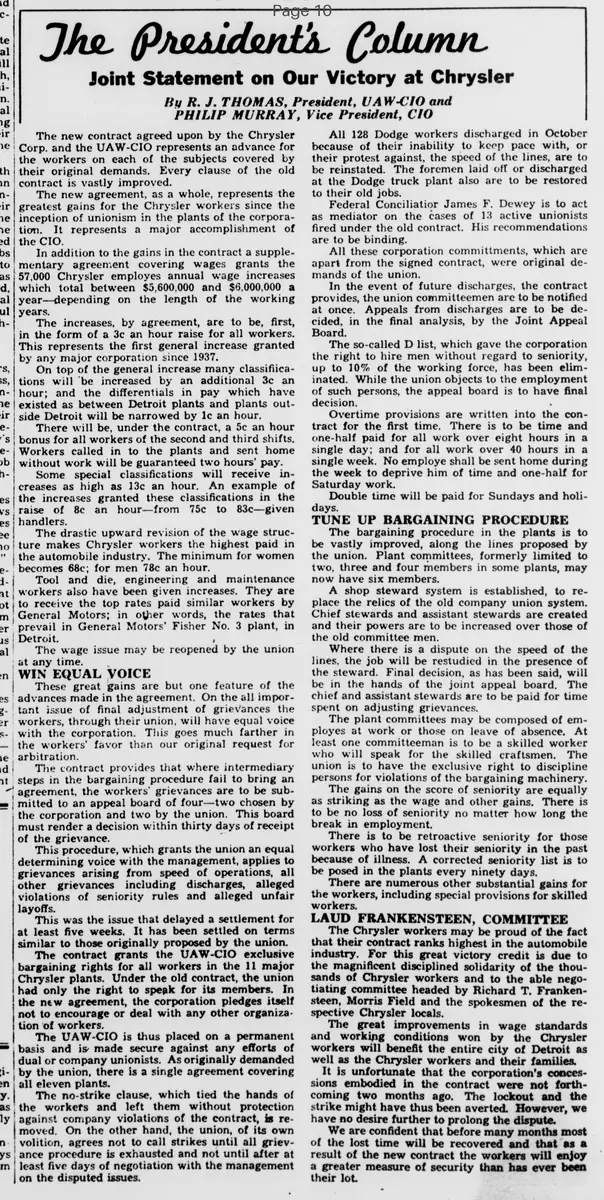
The President's Column
Joint Statement on Our Victory at Chrysler
By R. J. THOMAS, President, UAW-CIO and PHILIP MURRAY, Vice President, CIO
The new contract agreed upon by the Chrysler Corp. and the UAW-CIO represents an advance for the workers on each of the subjects covered by their original demands. Every clause of the old contract is vastly improved. The new agreement, as a whole, represents the greatest gains for the Chrysler workers since the inception of unionism in the plants of the corporation. It represents a major accomplishment of the CIO. In addition to the gains in the contract a supplementary agreement covering wages grants the 57,000 Chrysler employees annual wage increases which total between $5,600,000 and $6,000,000 a year-depending on the length of the working years. The increases, by agreement, are to be, first, in the form of a 3c an hour raise for all workers. This represents the first general increase granted by any major corporation since 1937. On top of the general increase many classifications will be increased by an additional 3c an hour; and the differentials in pay which have existed as between Detroit plants and plants outside Detroit will be narrowed by 1c an hour. There will be, under the contract, a 5c an hour bonus for all workers of the second and third shifts. Workers called in to the plants and sent home without work will be guaranteed two hours' pay. Some special classifications will receive increases as high as 13c an hour. An example of the increases granted these classifications in the raise of 8c an hour-from 75c to 83c-given handlers. The drastic upward revision of the wage structure makes Chrysler workers the highest paid in the automobile industry. The minimum for women becomes 68c; for men 78c an hour. Tool and die, engineering and maintenance workers also have been given increases. They are to receive the top rates paid similar workers by General Motors; in other words, the rates that prevail in General Motors' Fisher No. 3 plant, in Detroit. The wage issue may be reopened by the union at any time.
WIN EQUAL VOICE
These great gains are but one feature of the advances made in the agreement. On the all important issue of final adjustment of grievances the workers, through their union, will have equal voice with the corporation. This goes much farther in the workers' favor than our original request for arbitration. The contract provides that where intermediary steps in the bargaining procedure fail to bring an agreement, the workers' grievances are to be submitted to an appeal board of four--two chosen by the corporation and two by the union. This board must render a decision within thirty days of receipt of the grievance. This procedure, which grants the union an equal determining voice with the management, applies to grievances arising from speed of operations, all other grievances including discharges, alleged violations of seniority rules and alleged unfair layoffs. This was the issue that delayed a settlement for at least five weeks. It has been settled on terms similar to those originally proposed by the union. The contract grants the UAW-CIO exclusive bargaining rights for all workers in the 11 major Chrysler plants. Under the old contract, the union had only the right to speak for its members. In the new agreement, the corporation pledges itself not to encourage or deal with any other organization of workers. The UAW-CIO is thus placed on a permanent basis and is made secure against any efforts of dual or company unionists. As originally demanded by the union, there is a single agreement covering all eleven plants. The no-strike clause, which tied the hands of the workers and left them without protection against company violations of the contract, is removed. On the other hand, the union, of its own volition, agrees not to call strikes until all grievance procedure is exhausted and not until after at least five days of negotiation with the management on the disputed issues.
All 128 Dodge workers discharged in October because of their inability to keep pace with, or their protest against, the speed of the lines, are to be reinstated. The foremen laid off or discharged at the Dodge truck plant also are to be restored to their old jobs. Federal Conciliator James F. Dewey is to act as mediator on the cases of 13 active unionists fired under the old contract. His recommendations are to be binding. All these corporation commitments, which are apart from the signed contract, were original demands of the union. In the event of future discharges, the contract provides, the union committeemen are to be notified at once. Appeals from discharges are to be decided, in the final analysis, by the Joint Appeal Board. The so-called D list, which gave the corporation the right to hire men without regard to seniority, up to 10% of the working force, has been eliminated. While the union objects to the employment of such persons, the appeal board is to have final decision. Overtime provisions are written into the contract for the first time. There is to be time and one-half paid for all work over eight hours in a single day: and for all work over 40 hours in a single week. No employee shall be sent home during the week to deprive him of time and one-half for Saturday work. Double time will be paid for Sundays and holidays.
TUNE UP BARGAINING PROCEDURE
The bargaining procedure in the plants is to be vastly improved, along the lines proposed by the union. Plant committees, formerly limited to two, three and four members in some plants, may now have six members. A shop steward system is established, to replace the relics of the old company union system. Chief stewards and assistant stewards are created and their powers are to be increased over those of the old committee men. Where there is a dispute on the speed of the lines, the job will be restudied in the presence of the steward. Final decision, as has been said, will be in the hands of the joint appeal board. The chief and assistant stewards are to be paid for time spent on adjusting grievances. The plant committees may be composed of employees at work or those on leave of absence. At least one committeeman is to be a skilled worker who will speak for the skilled craftsmen. The union is to have the exclusive right to discipline persons for violations of the bargaining machinery. The gains on the score of seniority are equally as striking as the wage and other gains. There is to be no loss of seniority no matter how long the break in employment. There is to be retroactive seniority for those workers who have lost their seniority in the past because of illness. A corrected seniority list is to be posted in the plants every ninety days. There are numerous other substantial gains for the workers, including special provisions for skilled workers.
LAUD FRANKENSTEEN, COMMITTEE
The Chrysler workers may be proud of the fact that their contract ranks highest in the automobile industry. For this great victory credit is due to the magnificent disciplined solidarity of the thousands of Chrysler workers and to the able negotiating committee headed by Richard T. Frankensteen, Morris Field and the spokesmen of the respective Chrysler locals. The great improvements in wage standards and working conditions won by the Chrysler workers will benefit the entire city of Detroit as well as the Chrysler workers and their families. It is unfortunate that the corporation's concessions embodied in the contract were not forthcoming two months ago. The lockout and the strike might have thus been averted. However, we have no desire further to prolong the dispute. We are confident that before many months most of the lost time will be recovered and that as a result of the new contract the workers will enjoy a greater measure of security than has ever been their lot.
Joint Statement on Our Victory at Chrysler
By R. J. THOMAS, President, UAW-CIO and PHILIP MURRAY, Vice President, CIO
The new contract agreed upon by the Chrysler Corp. and the UAW-CIO represents an advance for the workers on each of the subjects covered by their original demands. Every clause of the old contract is vastly improved. The new agreement, as a whole, represents the greatest gains for the Chrysler workers since the inception of unionism in the plants of the corporation. It represents a major accomplishment of the CIO. In addition to the gains in the contract a supplementary agreement covering wages grants the 57,000 Chrysler employees annual wage increases which total between $5,600,000 and $6,000,000 a year-depending on the length of the working years. The increases, by agreement, are to be, first, in the form of a 3c an hour raise for all workers. This represents the first general increase granted by any major corporation since 1937. On top of the general increase many classifications will be increased by an additional 3c an hour; and the differentials in pay which have existed as between Detroit plants and plants outside Detroit will be narrowed by 1c an hour. There will be, under the contract, a 5c an hour bonus for all workers of the second and third shifts. Workers called in to the plants and sent home without work will be guaranteed two hours' pay. Some special classifications will receive increases as high as 13c an hour. An example of the increases granted these classifications in the raise of 8c an hour-from 75c to 83c-given handlers. The drastic upward revision of the wage structure makes Chrysler workers the highest paid in the automobile industry. The minimum for women becomes 68c; for men 78c an hour. Tool and die, engineering and maintenance workers also have been given increases. They are to receive the top rates paid similar workers by General Motors; in other words, the rates that prevail in General Motors' Fisher No. 3 plant, in Detroit. The wage issue may be reopened by the union at any time.
WIN EQUAL VOICE
These great gains are but one feature of the advances made in the agreement. On the all important issue of final adjustment of grievances the workers, through their union, will have equal voice with the corporation. This goes much farther in the workers' favor than our original request for arbitration. The contract provides that where intermediary steps in the bargaining procedure fail to bring an agreement, the workers' grievances are to be submitted to an appeal board of four--two chosen by the corporation and two by the union. This board must render a decision within thirty days of receipt of the grievance. This procedure, which grants the union an equal determining voice with the management, applies to grievances arising from speed of operations, all other grievances including discharges, alleged violations of seniority rules and alleged unfair layoffs. This was the issue that delayed a settlement for at least five weeks. It has been settled on terms similar to those originally proposed by the union. The contract grants the UAW-CIO exclusive bargaining rights for all workers in the 11 major Chrysler plants. Under the old contract, the union had only the right to speak for its members. In the new agreement, the corporation pledges itself not to encourage or deal with any other organization of workers. The UAW-CIO is thus placed on a permanent basis and is made secure against any efforts of dual or company unionists. As originally demanded by the union, there is a single agreement covering all eleven plants. The no-strike clause, which tied the hands of the workers and left them without protection against company violations of the contract, is removed. On the other hand, the union, of its own volition, agrees not to call strikes until all grievance procedure is exhausted and not until after at least five days of negotiation with the management on the disputed issues.
All 128 Dodge workers discharged in October because of their inability to keep pace with, or their protest against, the speed of the lines, are to be reinstated. The foremen laid off or discharged at the Dodge truck plant also are to be restored to their old jobs. Federal Conciliator James F. Dewey is to act as mediator on the cases of 13 active unionists fired under the old contract. His recommendations are to be binding. All these corporation commitments, which are apart from the signed contract, were original demands of the union. In the event of future discharges, the contract provides, the union committeemen are to be notified at once. Appeals from discharges are to be decided, in the final analysis, by the Joint Appeal Board. The so-called D list, which gave the corporation the right to hire men without regard to seniority, up to 10% of the working force, has been eliminated. While the union objects to the employment of such persons, the appeal board is to have final decision. Overtime provisions are written into the contract for the first time. There is to be time and one-half paid for all work over eight hours in a single day: and for all work over 40 hours in a single week. No employee shall be sent home during the week to deprive him of time and one-half for Saturday work. Double time will be paid for Sundays and holidays.
TUNE UP BARGAINING PROCEDURE
The bargaining procedure in the plants is to be vastly improved, along the lines proposed by the union. Plant committees, formerly limited to two, three and four members in some plants, may now have six members. A shop steward system is established, to replace the relics of the old company union system. Chief stewards and assistant stewards are created and their powers are to be increased over those of the old committee men. Where there is a dispute on the speed of the lines, the job will be restudied in the presence of the steward. Final decision, as has been said, will be in the hands of the joint appeal board. The chief and assistant stewards are to be paid for time spent on adjusting grievances. The plant committees may be composed of employees at work or those on leave of absence. At least one committeeman is to be a skilled worker who will speak for the skilled craftsmen. The union is to have the exclusive right to discipline persons for violations of the bargaining machinery. The gains on the score of seniority are equally as striking as the wage and other gains. There is to be no loss of seniority no matter how long the break in employment. There is to be retroactive seniority for those workers who have lost their seniority in the past because of illness. A corrected seniority list is to be posted in the plants every ninety days. There are numerous other substantial gains for the workers, including special provisions for skilled workers.
LAUD FRANKENSTEEN, COMMITTEE
The Chrysler workers may be proud of the fact that their contract ranks highest in the automobile industry. For this great victory credit is due to the magnificent disciplined solidarity of the thousands of Chrysler workers and to the able negotiating committee headed by Richard T. Frankensteen, Morris Field and the spokesmen of the respective Chrysler locals. The great improvements in wage standards and working conditions won by the Chrysler workers will benefit the entire city of Detroit as well as the Chrysler workers and their families. It is unfortunate that the corporation's concessions embodied in the contract were not forthcoming two months ago. The lockout and the strike might have thus been averted. However, we have no desire further to prolong the dispute. We are confident that before many months most of the lost time will be recovered and that as a result of the new contract the workers will enjoy a greater measure of security than has ever been their lot.
What sub-type of article is it?
Labor
What keywords are associated?
Chrysler Contract
Wage Increases
Union Grievances
Bargaining Rights
Seniority Rules
Overtime Provisions
Ua W Cio Victory
Automobile Industry Labor
What entities or persons were involved?
R. J. Thomas
Philip Murray
Uaw Cio
Chrysler Corp.
Richard T. Frankensteen
Morris Field
James F. Dewey
General Motors
Editorial Details
Primary Topic
Uaw Cio Victory In Chrysler Contract Negotiations
Stance / Tone
Celebratory Announcement Of Labor Gains
Key Figures
R. J. Thomas
Philip Murray
Uaw Cio
Chrysler Corp.
Richard T. Frankensteen
Morris Field
James F. Dewey
General Motors
Key Arguments
New Contract Improves All Clauses Of Old Agreement
Annual Wage Increases Total $5.6 6 Million For 57,000 Workers
3c Hourly Raise For All, Plus Additional For Classifications
Equal Union Voice In Grievance Appeal Board
Exclusive Bargaining Rights For Uaw Cio In 11 Plants
Reinstatement Of 128 Discharged Dodge Workers
Overtime Pay At Time And A Half Over 8 Hours/Day Or 40/Week
No Loss Of Seniority Regardless Of Employment Break
Removal Of No Strike Clause With Procedural Safeguards
Improved Plant Bargaining With Shop Steward System