Thank you for visiting SNEWPapers!
Sign up free
Story
February 9, 1881
Juniata Sentinel And Republican
Mifflintown, Juniata County, Pennsylvania
What is this article about?
Mr. Bell describes a stone and tubular tower, up to 1500 feet tall, designed to induce rain by forcing saturated air upward through machinery and tubes, agitating surrounding air strata. It could also disperse clouds by reversing airflow. A single rain could pay for construction, benefiting nations.
Clipping
OCR Quality
95%
Excellent
Full Text
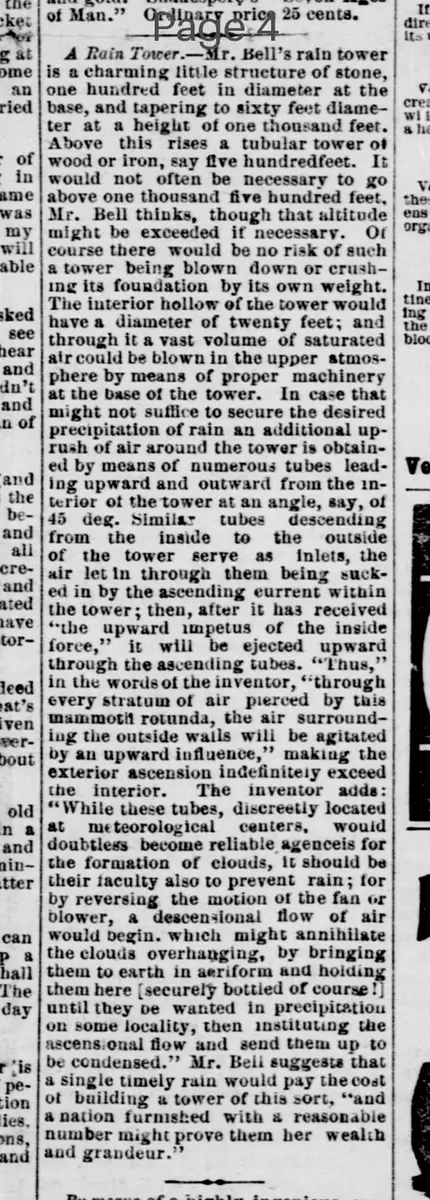
A Rain Tower.—Mr. Bell's rain tower is a charming little structure of stone, one hundred feet in diameter at the base, and tapering to sixty feet diameter at a height of one thousand feet. Above this rises a tubular tower of wood or iron, say five hundred feet. It would not often be necessary to go above one thousand five hundred feet. Mr. Bell thinks, though that altitude might be exceeded if necessary. Of course there would be no risk of such a tower being blown down or crushing its foundation by its own weight. The interior hollow of the tower would have a diameter of twenty feet: and through it a vast volume of saturated air could be blown in the upper atmosphere by means of proper machinery at the base of the tower. In case that might not suffice to secure the desired precipitation of rain an additional up-rush of air around the tower is obtained by means of numerous tubes leading upward and outward from the interior of the tower at an angle, say, of 45 deg. Similar tubes descending from the inside to the outside of the tower serve as inlets, the air let in through them being sucked in by the ascending current within the tower; then, after it has received the upward impetus of the inside force, it will be ejected upward through the ascending tubes. Thus, in the words of the inventor, "through every stratum of air pierced by this mammoth rotunda, the air surrounding the outside walls will be agitated by an upward influence," making the exterior ascension infinitely exceed the interior. The inventor adds: "While these tubes, discreetly located at meteorological centers, would doubtless become reliable agencies for the formation of clouds, it should be their faculty also to prevent rain; for by reversing the motion of the fan or blower, a descensional flow of air would begin, which might annihilate the clouds overhanging, by bringing them to earth in aeriform and holding them here [securely bottled of course!] until they be wanted in precipitation on some locality, then instituting the ascensional flow and send them up to be condensed." Mr. Bell suggests that a single timely rain would pay the cost of building a tower of this sort, "and a nation furnished with a reasonable number might prove them her wealth and grandeur."
What sub-type of article is it?
Curiosity
Extraordinary Event
What themes does it cover?
Triumph
What keywords are associated?
Rain Tower
Weather Control
Air Circulation
Invention
Cloud Formation
Mr Bell
What entities or persons were involved?
Mr. Bell
Where did it happen?
Meteorological Centers
Story Details
Key Persons
Mr. Bell
Location
Meteorological Centers
Story Details
Mr. Bell invents a tall tower to force saturated air upward for rain precipitation via machinery and angled tubes agitating surrounding air; reversible to prevent rain by dispersing clouds.