Thank you for visiting SNEWPapers!
Sign up free
Editorial
December 3, 1802
The National Intelligencer And Washington Advertiser
Washington, District Of Columbia
What is this article about?
An editorial defending democracy as superior to monarchies and aristocracies, citing historical examples from Athens, Rome, and modern Europe to argue that self-government minimizes crimes and promotes liberty compared to tyrannical rule.
Clipping
OCR Quality
95%
Excellent
Full Text
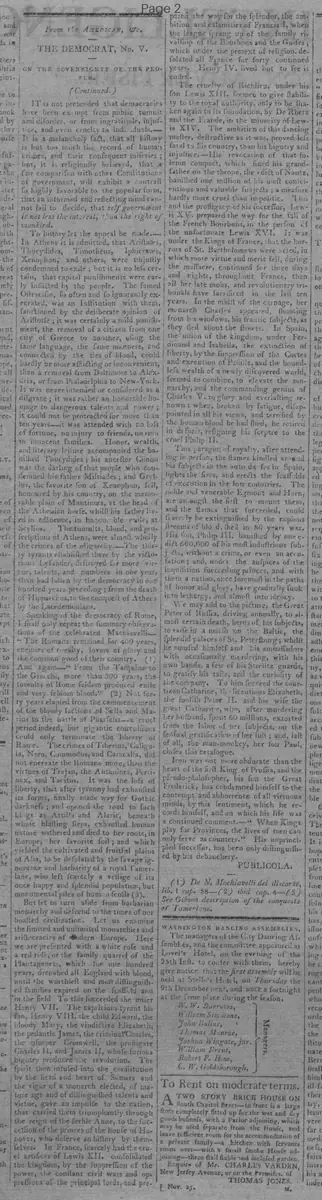
It is not pretended that democracies have been exempt from public tumult and disorder, or from ingratitude, injustice, and even cruelty to individuals.—It is a melancholy fact, that all history is but too much the record of human crimes, and their consequent miseries; but, it is religiously believed, that a fair comparison with other Constitutions of government, will exhibit a contrast so highly favorable to the popular form, that an informed and reflecting mind cannot fail to decide, that self government is not less the interest, than the right of mankind.
To history let the appeal be made.—In Athens it is admitted, that Aristides, Thucydides, Timotheus, Iphicrates, Xenophon, and others, were unjustly condemned to exile; but it is no less certain, that capital punishments were early inflicted by the people. The famed Ostracism, so often and so ignorantly execrated, was an Institution with them, sanctioned by the deliberate opinion of Aristotle; it was certainly a mild punishment, the removal of a citizen from one city of Greece to another, using the same language, the same manners, and connected by the ties of blood, could hardly be more affecting or inconvenient, than a removal from Baltimore to Alexandria, or from Philadelphia to New-York. It was never intended or considered as a disgrace; it was rather an honorable homage to dangerous talents and power; it could not be protracted for more than ten years—it was attended with no loss of fortune, no injury to friends, no ruin to innocent families. Honor, wealth, and literary leisure accompanied the banished Thucydides; his ancestor Cimon was the darling of that people who condemned his father Miltiades; and Gryllus, the favorite son of Xenophon, fell, honored by his country, on the memorable plain of Mantinea, at the head of the Athenian horse, whilst his father lived in affluence, in honorable exile, at Scyllus. The tumults, blood, and proscriptions of Athens, were almost wholly the crimes of the oligarchy.—The thirty tyrants established there by the vicious, Lysander, destroyed more virtue, talents, and numbers in one year, than had fallen by the democracy in one hundred years preceding; from the death of Hipparchus, to the conquest of Athens by the Lacedemonians.
Speaking of the democracy of Rome, I shall only repeat the summary observations of the celebrated Machiavelli
"The Romans remained for 400 years enemies of royalty, lovers of glory and the Common good of their country. (1)
And again—"From the Tarquins to the Gracchi, more than 300 years, the tumults of Rome seldom produced exile and very seldom blood." (2) Not forty years elapsed from the commencement of the bloody factions of Sylla and Marius to the battle of Pharsalia—a cruel period indeed, but gigantic convulsions could only terminate the liberty of Rome. The crimes of Tiberius, Caligula, Nero, Commodus, and Caracalla, did not enervate the Romans more, than the virtues of Trajan, the Antonines, Pertinax, and Tacitus. It was the loss of liberty, that after tyranny had exhausted its arms, finally made way for Gothic darkness; and opened the road to such kings as Attila and Alaric, beneath whose blighting curses, exhausted human nature withered and died to her roots, in Europe, her favorite soil; and which yielded the cultivated and fruitful plains of Asia, to be desolated by the savage ignorance and barbarity of a royal Tamerlane, who left scarcely a vestige of its once happy and splendid population, but monumental piles of human skulls (3).
But let us turn aside from barbarian monarchy and descend to the times of our boasted civilization. Let us examine the limited and unlimited monarchies and aristocracies of modern Europe. Here we are presented with a white rose and a red rose, or the family quarrel of the Plantagenets, which for one hundred years, drenched all England with blood, until the worthiest and most distinguished families expired on the scaffold and in the field. To this succeeded the miser Henry VII. The capricious tyrant his son, Henry VIII. the child Edward, the bloody Mary, the vindictive Elizabeth, the pedantic James, the criminal Charles, the usurper Cromwell, the profligate Charles II, and James II, whose furious bigotry produced the revolution. The spirit then infused into the constitution by the head and heart of Somers and the vigor of a monarch elected, of mature age and of distinguished talents and virtue, gave an impulse to the nation, that carried them triumphantly through the reign of the feeble Anne, to the succession of the princes of the house of Hanover, who deserve a history by themselves. In France, scarcely had the cruel artifices of Lewis XII. consolidated the kingdom, by the suppression of the power, the constant civil wars and oppressions of the principal lords, and pre-
pared the way for the splendor, the ambition and calamities of Francis I, when the league sprang up of the family rivalry of the Bourbons and the Guises; which under the pretext of religion, desolated all France for forty continued years. Henry IV. lived out to see it ended.
The cruelty of Richlieu, under his son Lewis XIII. came to give stability to the royal authority, only to be shaken again to its foundation, by De Retz and the Fronde, in the minority of Lewis XIV. The ambition of this dancing master, destructive as it was, proved less fatal to his country, than his bigotry and injustice.—His revocation of that solemn compact, which fixed his grandfather on the throne, the edict of Nantz, banished one million of his most conscientious and valuable subjects; a measure hardly more cruel than impolitic. This and the profligacy of his successor, Lewis XV. prepared the way for the fall of the French Bourbons, in the person of the unfortunate Lewis XVI. It was under the Kings of France, that the horrors of St. Bartholomews were acted, in which more virtue and merit fell, during the massacre, continued for three days and nights, throughout France, than all her late mobs, and revolutionary tribunals have sacrificed in the last ten years. In the midst of the carnage, her monarch Charles appeared, shooting from his windows, his frantic subjects, as they fled about the streets. In Spain, the union of the kingdoms, under Ferdinand and Isabella, the extinction of liberty, by the suppression of the Cortes and execution of Padilla, and the boundless wealth of a newly discovered world, seemed to combine, to elevate the monarchy, and the commanding genius of Charles V. to glory and everlasting renown: when, broken by fatigue, disappointed in all his views, and terrified by the human blood he had shed, he retired in despair, resigning his sceptre to the cruel Philip II.
This paragon of royalty, after attending in person, the flames kindled around his subjects in the auto da fes in Spain, lights the fires, and erects the scaffolds for execution in the low countries. The noble and venerable Egmont and Horn, are amongst the first to mount them, and the flames that succeeded, could scarcely be extinguished by the copious streams of blood, shed in 80 years war. His son, Philip III. banished by one edict 600,000 of his most industrious subjects, without a crime, or even an accusation; and, under the auspices of the inquisition succeeding princes, and with them a nation, once foremost in the paths of honor and glory, have gradually sunk into lethargy, and almost into idiocy.
We may add to the picture, the Great Peter of Russia, driving annually, to almost certain death, herds of his subjects, to raise in a marsh on the Baltic, the splendid palaces of St. Petersburgh; whilst he amused himself and his ambassadors with occasionally murdering, with his own hands, a few of his Streletz guards, to gratify his taste, and the curiosity of the company. To him succeed the courtezan Catharine, the licentious Elizabeth, the foolish Peter III. and his wife the great Catharine, who, after murdering her husband, spent 60 millions, extorted from the labor of her subjects, on the sensual gratification of her lust; and, last of all, the mad-monkey, her son Paul, closes this catalogue.
Iron was not more obdurate than the heart of the first King of Prussia, and the pseudo-philosopher, his son the Great Frederick, has condemned himself to the contempt and abhorrence of all virtuous minds, by this sentiment, which he records himself, and on which his life was a continued comment.—"When Kings play for Provinces, the lives of men can only serve as counters." His unprincipled successor, has been only distinguished by his debauchery.
PUBLICOLA.
(1) De N. Machiavelli dei discorsi, lib. 1 cap. 58—(2) ibid cap. 4—(3) See Gibson description of the conquests of Tamerlane.
To history let the appeal be made.—In Athens it is admitted, that Aristides, Thucydides, Timotheus, Iphicrates, Xenophon, and others, were unjustly condemned to exile; but it is no less certain, that capital punishments were early inflicted by the people. The famed Ostracism, so often and so ignorantly execrated, was an Institution with them, sanctioned by the deliberate opinion of Aristotle; it was certainly a mild punishment, the removal of a citizen from one city of Greece to another, using the same language, the same manners, and connected by the ties of blood, could hardly be more affecting or inconvenient, than a removal from Baltimore to Alexandria, or from Philadelphia to New-York. It was never intended or considered as a disgrace; it was rather an honorable homage to dangerous talents and power; it could not be protracted for more than ten years—it was attended with no loss of fortune, no injury to friends, no ruin to innocent families. Honor, wealth, and literary leisure accompanied the banished Thucydides; his ancestor Cimon was the darling of that people who condemned his father Miltiades; and Gryllus, the favorite son of Xenophon, fell, honored by his country, on the memorable plain of Mantinea, at the head of the Athenian horse, whilst his father lived in affluence, in honorable exile, at Scyllus. The tumults, blood, and proscriptions of Athens, were almost wholly the crimes of the oligarchy.—The thirty tyrants established there by the vicious, Lysander, destroyed more virtue, talents, and numbers in one year, than had fallen by the democracy in one hundred years preceding; from the death of Hipparchus, to the conquest of Athens by the Lacedemonians.
Speaking of the democracy of Rome, I shall only repeat the summary observations of the celebrated Machiavelli
"The Romans remained for 400 years enemies of royalty, lovers of glory and the Common good of their country. (1)
And again—"From the Tarquins to the Gracchi, more than 300 years, the tumults of Rome seldom produced exile and very seldom blood." (2) Not forty years elapsed from the commencement of the bloody factions of Sylla and Marius to the battle of Pharsalia—a cruel period indeed, but gigantic convulsions could only terminate the liberty of Rome. The crimes of Tiberius, Caligula, Nero, Commodus, and Caracalla, did not enervate the Romans more, than the virtues of Trajan, the Antonines, Pertinax, and Tacitus. It was the loss of liberty, that after tyranny had exhausted its arms, finally made way for Gothic darkness; and opened the road to such kings as Attila and Alaric, beneath whose blighting curses, exhausted human nature withered and died to her roots, in Europe, her favorite soil; and which yielded the cultivated and fruitful plains of Asia, to be desolated by the savage ignorance and barbarity of a royal Tamerlane, who left scarcely a vestige of its once happy and splendid population, but monumental piles of human skulls (3).
But let us turn aside from barbarian monarchy and descend to the times of our boasted civilization. Let us examine the limited and unlimited monarchies and aristocracies of modern Europe. Here we are presented with a white rose and a red rose, or the family quarrel of the Plantagenets, which for one hundred years, drenched all England with blood, until the worthiest and most distinguished families expired on the scaffold and in the field. To this succeeded the miser Henry VII. The capricious tyrant his son, Henry VIII. the child Edward, the bloody Mary, the vindictive Elizabeth, the pedantic James, the criminal Charles, the usurper Cromwell, the profligate Charles II, and James II, whose furious bigotry produced the revolution. The spirit then infused into the constitution by the head and heart of Somers and the vigor of a monarch elected, of mature age and of distinguished talents and virtue, gave an impulse to the nation, that carried them triumphantly through the reign of the feeble Anne, to the succession of the princes of the house of Hanover, who deserve a history by themselves. In France, scarcely had the cruel artifices of Lewis XII. consolidated the kingdom, by the suppression of the power, the constant civil wars and oppressions of the principal lords, and pre-
pared the way for the splendor, the ambition and calamities of Francis I, when the league sprang up of the family rivalry of the Bourbons and the Guises; which under the pretext of religion, desolated all France for forty continued years. Henry IV. lived out to see it ended.
The cruelty of Richlieu, under his son Lewis XIII. came to give stability to the royal authority, only to be shaken again to its foundation, by De Retz and the Fronde, in the minority of Lewis XIV. The ambition of this dancing master, destructive as it was, proved less fatal to his country, than his bigotry and injustice.—His revocation of that solemn compact, which fixed his grandfather on the throne, the edict of Nantz, banished one million of his most conscientious and valuable subjects; a measure hardly more cruel than impolitic. This and the profligacy of his successor, Lewis XV. prepared the way for the fall of the French Bourbons, in the person of the unfortunate Lewis XVI. It was under the Kings of France, that the horrors of St. Bartholomews were acted, in which more virtue and merit fell, during the massacre, continued for three days and nights, throughout France, than all her late mobs, and revolutionary tribunals have sacrificed in the last ten years. In the midst of the carnage, her monarch Charles appeared, shooting from his windows, his frantic subjects, as they fled about the streets. In Spain, the union of the kingdoms, under Ferdinand and Isabella, the extinction of liberty, by the suppression of the Cortes and execution of Padilla, and the boundless wealth of a newly discovered world, seemed to combine, to elevate the monarchy, and the commanding genius of Charles V. to glory and everlasting renown: when, broken by fatigue, disappointed in all his views, and terrified by the human blood he had shed, he retired in despair, resigning his sceptre to the cruel Philip II.
This paragon of royalty, after attending in person, the flames kindled around his subjects in the auto da fes in Spain, lights the fires, and erects the scaffolds for execution in the low countries. The noble and venerable Egmont and Horn, are amongst the first to mount them, and the flames that succeeded, could scarcely be extinguished by the copious streams of blood, shed in 80 years war. His son, Philip III. banished by one edict 600,000 of his most industrious subjects, without a crime, or even an accusation; and, under the auspices of the inquisition succeeding princes, and with them a nation, once foremost in the paths of honor and glory, have gradually sunk into lethargy, and almost into idiocy.
We may add to the picture, the Great Peter of Russia, driving annually, to almost certain death, herds of his subjects, to raise in a marsh on the Baltic, the splendid palaces of St. Petersburgh; whilst he amused himself and his ambassadors with occasionally murdering, with his own hands, a few of his Streletz guards, to gratify his taste, and the curiosity of the company. To him succeed the courtezan Catharine, the licentious Elizabeth, the foolish Peter III. and his wife the great Catharine, who, after murdering her husband, spent 60 millions, extorted from the labor of her subjects, on the sensual gratification of her lust; and, last of all, the mad-monkey, her son Paul, closes this catalogue.
Iron was not more obdurate than the heart of the first King of Prussia, and the pseudo-philosopher, his son the Great Frederick, has condemned himself to the contempt and abhorrence of all virtuous minds, by this sentiment, which he records himself, and on which his life was a continued comment.—"When Kings play for Provinces, the lives of men can only serve as counters." His unprincipled successor, has been only distinguished by his debauchery.
PUBLICOLA.
(1) De N. Machiavelli dei discorsi, lib. 1 cap. 58—(2) ibid cap. 4—(3) See Gibson description of the conquests of Tamerlane.
What sub-type of article is it?
Constitutional
What keywords are associated?
Democracy
Self Government
Monarchy
Tyranny
Historical Comparison
Ostracism
Roman Republic
European Kings
What entities or persons were involved?
Aristides
Thucydides
Xenophon
Machiavelli
Henry Viii
Lewis Xiv
Philip Ii
Peter The Great
Frederick The Great
Publicola
Editorial Details
Primary Topic
Defense Of Democracy Through Historical Comparison
Stance / Tone
Strongly Pro Democracy And Anti Monarchical
Key Figures
Aristides
Thucydides
Xenophon
Machiavelli
Henry Viii
Lewis Xiv
Philip Ii
Peter The Great
Frederick The Great
Publicola
Key Arguments
Democracies Experience Less Crime And Misery Than Monarchies Or Aristocracies
Athenian Ostracism Was A Mild And Honorable Punishment
Roman Democracy Lasted Centuries With Minimal Violence
Monarchies In Europe Caused Extensive Bloodshed And Tyranny
Loss Of Liberty Under Kings Led To Greater Barbarity