Thank you for visiting SNEWPapers!
Sign up free
Alexandria Daily Advertiser
Alexandria, Virginia
What is this article about?
In a House of Representatives debate on March 7, Mr. Early argues against a resolution on British affairs, emphasizing that public alarm stems from mercantile influence and that adopting it would harm southern agricultural exports like cotton and tobacco more than benefit commerce, urging consideration of regional interests.
Clipping
OCR Quality
Full Text
OF THE
UNITED STATES.
HOUSE OF REPRESENTATIVES
Friday, March 7.
BRITISH AFFAIRS.
DEBATE
In committee of the whole on the state of the union—Mr. F. C. Smith in the chair—on the resolution offered by Mr. Gregg.
(CONTINUED.)
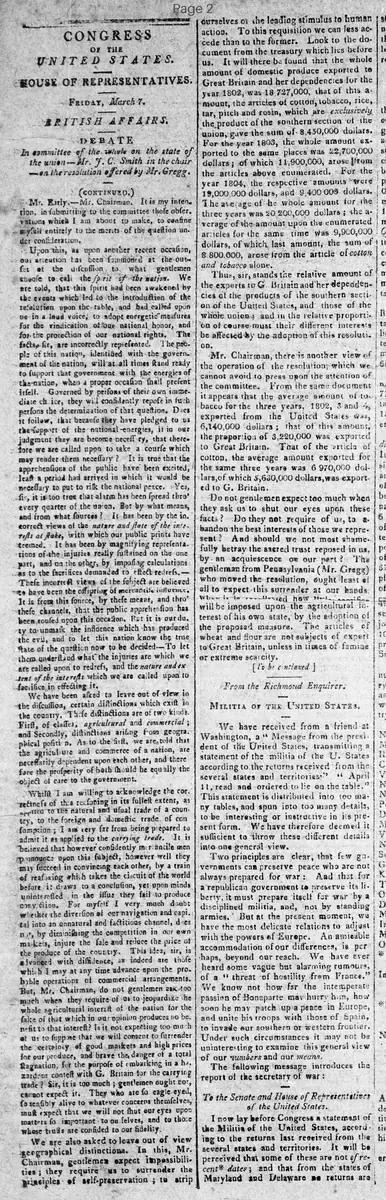
Mr. Early.—Mr. Chairman. It is my intention, in submitting to the committee those observations which I am about to make, to confine myself entirely to the merits of the question under consideration.
Upon this, as upon another recent occasion, our attention has been summoned at the outset of the discussion, to what gentlemen choose to call the spirit of the nation. We are told, that this spirit has been awakened by the events which led to the introduction of the resolution upon the table, and has called upon us in a loud voice, to adopt energetic measures for the vindication of our national honor, and for the protection of our national rights. The facts, sir, are incorrectly represented. The people of this nation, identified with the government of the nation, will at all times stand ready to support that government with the energies of the nation, when a proper occasion shall present itself. Governed by persons of their own immediate choice, they will confidently repose in such persons the determination of that question. Does it follow, that because they have pledged to us the support of the national energies, if in our judgment they are become necessary, that therefore we are called upon to take a course which may render them necessary? It is true that the apprehensions of the public have been excited, lest a period had arrived in which it would be necessary to put to risk the national peace. Yes, sir, it is too true that alarm has been spread thro' every quarter of the union. But by what means, and from what sources? It has been by the incorrect views of the nature and state of the interests at stake, with which our public prints have teemed. It has been by magnifying representations of the injuries really sustained on the one part, and on the other, by imposing calculations as to the sacrifices demanded to effect redress. These incorrect views of the object are believed to have been the offspring of mercantile influence. It is from this source, by these means, and thro' these channels, that the public apprehension has been roused upon this occasion. But it is our duty to unmask the influence which has produced the evil, and to let this nation know the true state of the question now to be decided—To let them understand what the injuries are which we are called upon to redress, and the nature and extent of the interests which we are called upon to sacrifice in effecting it.
We have been asked to leave out of view in the discussion, certain distinctions which exist in the country. These distinctions are of two kinds. First, of classes, agricultural and commercial; and secondly, distinctions arising from geographical position. As to the first, we are told that the agriculture and commerce of a nation, are necessarily dependent upon each other, and therefore the prosperity of both should be equally the object of care to the government.
Whilst I am willing to acknowledge the correctness of this reasoning in its fullest extent, as applied to the natural and usual trade of a country, to the foreign and domestic trade of consumption; I am very far from being prepared to admit it as applied to the carrying trade. It is believed that however confidently mercantile men pronounce upon this subject, however well they may succeed in convincing each other, by a train of reasoning which takes the circuit of the world before it draws to a conclusion, yet upon minds uninterested in the issue they fail to produce conviction. For myself I very much doubt whether the diversion of our navigation and capital into an unnatural and factitious channel, does not, by diminishing the competition in our own markets, injure the sale and reduce the price of the produce of the country. This idea, sir, is advanced with diffidence, as indeed are those which I may at any time advance upon the probable operations of commercial arrangements.
But, Mr. Chairman, do not gentlemen ask too much when they require of us to jeopardize the whole agricultural interest of the nation for the sake of that which in our opinion produces no benefit to that interest? Is it not expecting too much of us to suppose that we will consent to surrender the certainty of good markets and high prices for our produce, and brave the danger of a total stagnation, for the purpose of embarking in a hazardous contest with G. Britain for the carrying trade? Sir, it is too much; gentlemen ought not, cannot expect it. They who are so eagle eyed, so sensibly alive to whatever concerns themselves, must expect that we will not shut our eyes upon matters so important to ourselves, and to those whose trusts are confided to our fidelity.
We are also asked to leave out of view geographical distinctions. In this, Mr. Chairman, gentlemen expect impossibilities; they require us to surrender the principles of self-preservation; to strip ourselves of the leading stimulus to human action. To this requisition we can less accede than to the former. Look to the document from the treasury which lies before us. It will there be found that the whole amount of domestic produce exported to Great Britain and her dependencies for the year 1802, was 18,727,000, that of this amount, the articles of cotton, tobacco, rice, tar, pitch and rosin, which are exclusively the product of the southern section of the union, give the sum of 8,450,000 dollars. For the year 1803, the whole amount exported to the same places was 22,700,000 dollars; of which 11,900,000, arose from the articles above enumerated. For the year 1804, the respective amounts were 19,000,000 dollars, and 9,400,000 dollars. The average of the whole amount for the three years was 20,200,000 dollars; the average of the amount upon the enumerated articles for the same time was 9,900,000 dollars, of which last amount, the sum of 8,800,000, arose from the article of cotton and tobacco alone.
Thus, sir, stands the relative amount of the exports to G. Britain and her dependencies of the products of the southern section of the United States, and those of the whole union; and in the relative proportion of course must their different interests be affected by the adoption of this resolution.
Mr. Chairman, there is another view of the operation of the resolution; which we cannot avoid to press upon the attention of the committee. From the same document it appears that the average amount of tobacco for the three years, 1802, 3 and 4, exported from the United States was, 6,140,000 dollars; that of this amount, the proportion of 3,220,000 was exported to Great Britain. That of the article of cotton, the average amount exported for the same three years was 6,970,000 dollars, of which 5,630,000 dollars, was exported to G. Britain.
Do not gentlemen expect too much when they ask us to shut our eyes upon these facts? Do they not require of us, to abandon the best interests of those we represent? And should we not most shamefully betray the sacred trust reposed in us, by an acquiescence on our part? The gentleman from Pennsylvania (Mr. Gregg) who moved the resolution, ought least of all to expect this surrender at our hands. He who has shown how hot Georgia will be imposed upon the agricultural interest of his own state, by the adoption of the proposed measure. The articles of wheat and flour are not subjects of export to Great Britain, unless in times of famine or extreme scarcity.
[To be continued]
What sub-type of article is it?
What themes does it cover?
What keywords are associated?
What entities or persons were involved?
Where did it happen?
Story Details
Key Persons
Location
House Of Representatives, United States
Event Date
Friday, March 7
Story Details
Mr. Early delivers a speech in committee opposing Mr. Gregg's resolution on British affairs, arguing that public alarm is due to mercantile exaggeration, that commerce and agriculture are not equally dependent especially in carrying trade, and that southern exports like cotton and tobacco would suffer disproportionately from conflict, citing treasury export figures for 1802-1804.