Thank you for visiting SNEWPapers!
Sign up free
Edgefield Advertiser
Edgefield, Edgefield County, South Carolina
What is this article about?
In March 1837, at Omsk in Siberia, seven leaders of a Polish political rising against Russian authorities were each sentenced to 7,000 blows with the stick. Six died during the brutal execution overseen by General Galafieyef on orders from Emperor Nicholas I; survivor Szokalski was sent to Nerchinsk mines. Lesser offenders received 500-2,000 blows and penal servitude.
Clipping
OCR Quality
Full Text
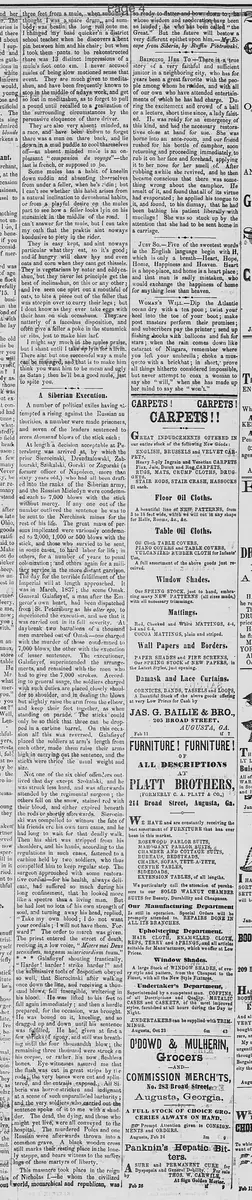
A number of political exiles having attempted a rising against the Russian authorities, a number were made prisoners, and seven of the leaders sentenced to seven thousand blows of the stick each. At length a decision acceptable at Petersburg was arrived at, by which the prior Sierocinski, Druzdzalowski, Zablourski, Szokalski, Gorski or Zagorski (a former officer of Napoleon, more than sixty years old,) who had all been drafted into the ranks of the Siberian army, and the Russian Mielezyn were condemned each to 7,000 blows with the stick without mercy. If any one out of the number outlived the sentence he was to be sent to the Nerchinsk mines for the rest of his life. The great mass of persons implicated were variously condemned to 2,000, 1,000 or 500 blows with the stick, and those who survived to be sent in some cases, to hard labor for life; in others, for a number of years to penal colonization; and others again for a military service in the more distant garrisons.
The day for the terrible fulfillment of the Imperial will at length approached. It was in March, 1837; the scene Omsk. General Galafieyef, a man after the Emperor's own heart, had been dispatched from St. Petersburg as his alter ego, to superintend the execution, and see that it was carried out in its full severity. At daybreak two battalions of a thousand men marched out of Omsk—one charged with the murder of those condemned to 7,000 blows, the other with the execution of lesser sentences. The executioner, Galafieyef, superintended the arrangements, and remained with the men who had to give the 7,000 strokes. According to general usage, the soldiers charged with such duties are placed closely shoulder to shoulder, and in dealing the blows but slightly raise the arm from the elbow, and keep their feet together, as when standing on parade. The sticks could only be so thick that three can be dropped in a carbine barrel. On this occasion all this was reversed. Galafieyef placed the soldiers at arm's length from each other, made them raise their arms high in carrying out the sentence, and the sticks were thrice the usual weight and size.
Not one of the six chief offenders outlived that day except Szokalski, and he was struck less hard, and was afterwards attended by the regimental surgeon; the others fell on the snow, stained red with their blood, and either expired beneath the rods or shortly afterwards. Sierocinski was compelled to witness the fate of his friends ere his own turn came, and he had long to wait for that deadly walk. Then his shirt was stripped from his shoulders, and his hands, according to the regulations in such cases, fastened to a carbine held by two soldiers, who thus compelled him to keep regular step. The surgeon approached with some restorative cordial—for his health, always delicate, had suffered so much during his long confinement, that he looked more like a spectre than a living man. But he had lost no iota of his own strength of soul, and turning away his head, replied, "Take my own blood; I do not want your cordials; I will not have them. Forward!" The order to march was given. The priest entered the street of death, reciting in a low voice, "Miserere mei Deus secundum magnam misericordiam tuam."
* * * Galafieyef shouting frantically, "Harder! harder! strike harder!" and the submissive tools of despotism obeyed so well, that Sierocinski after walking once down the line, and receiving a thousand blows, fell insensible, weltering in his blood. He was lifted to his feet to fall again immediately; and then a hurdle prepared, for the occasion, was brought. He was bound on it, kneeling, and so dragged up and down until his sentence was fulfilled. He had given at first a few shrieks of agony, and still was breathing until the four thousandth blow; the remaining three thousand were struck on his corpse, or rather, his now fleshless bones. Eye-witnesses assured me that the flesh was cut in great strips by the rods; the very bones were cut and splintered, and the entrails exposed. All Siberia was horror-stricken and indignant at a scene of such unparalleled barbarity; and the very soldiers who carried out the sentence spoke of it to me with a shudder. The dead, the dying, and those who might yet live, were all conveyed to the hospital. The murdered Poles and one Russian were afterwards thrown into a common grave. A black wooden cross still marks their resting place in the lonely steppe, and bears witness to the sufferings of these martyrs of liberty.
This massacre took place in the reign of Nicholas I.—he whom the civilized world, monarchical and republican, was so ready to flatter and bow down to—whose wisdom and moderation have been so lauded: he who has been called "the Great." But the future will bestow a very different epithet upon him.—My Escape from Siberia, by Ruffin Piotrowski.
What sub-type of article is it?
What keywords are associated?
What entities or persons were involved?
Where did it happen?
Foreign News Details
Primary Location
Omsk
Event Date
March 1837
Key Persons
Outcome
six of the seven leaders died during the execution from 7,000 blows each; szokalski survived but was sent to nerchinsk mines for life; other implicated persons received 500-2,000 blows and were sentenced to hard labor, penal colonization, or distant military service.
Event Details
Political exiles attempted a rising against Russian authorities in Siberia; seven leaders, including prior Sierocinski and others drafted into the Siberian army, were sentenced to 7,000 blows each without mercy, with survivors to Nerchinsk mines. In March 1837 at Omsk, General Galafieyef supervised the execution using heavier sticks and full-force blows by spaced soldiers. Sierocinski and others died under the punishment; Szokalski survived with medical aid. The scene involved extreme brutality, with victims dragged on hurdles after collapsing.