Thank you for visiting SNEWPapers!
Sign up free
Norfolk Gazette And Publick Ledger
Norfolk, Virginia
What is this article about?
In a Paris trial on April 24, Englishmen Sir Robert Wilson, Mr. Bruce, and Capt. Hutchinson defended against charges of aiding Lavalette's escape, with speeches by advocate M. Dupin and Wilson emphasizing their honorable service, lack of conspiracy, and humanitarian motives. Sovereign letters were presented; sentencing followed with pleas for leniency.
Merged-components note: Continuation of the foreign news story detailing the trial and defense of Sir Robert Wilson, spanning across pages 2 and 3; sequential reading order and text flow indicate they form a single coherent article.
Clippings
1 of 2
OCR Quality
Full Text
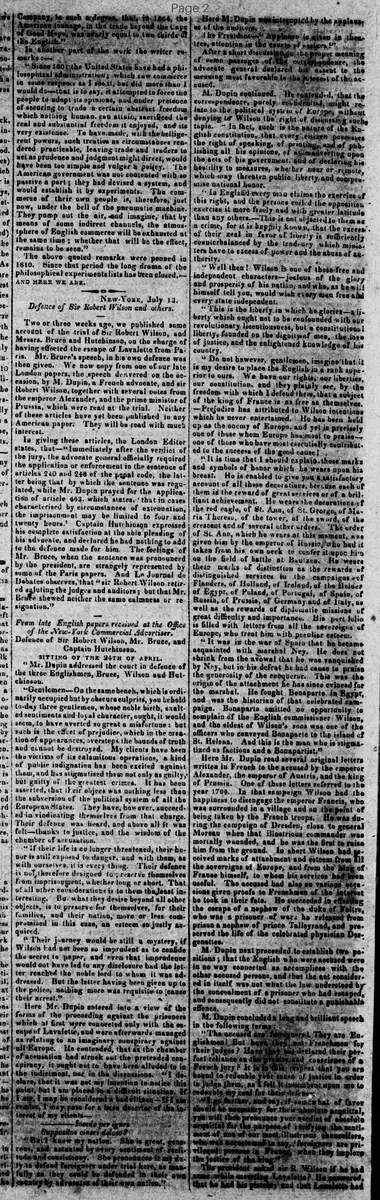
Defence of Sir Robert Wilson and others.
Two or three weeks ago, we published some account of the trial of Sir Robert Wilson, and Messrs. Bruce and Hutchinson, on the charge of having effected the escape of Lavalette from Paris. Mr. Bruce's speech, in his own defence was then given. We now copy from one of our late London papers, the speech delivered on the occasion, by M. Dupin, a French advocate, and Sir Robert Wilson, together with several notes from the emperor Alexander, and the prime minister of Prussia, which were read at the trial. Neither of these articles have yet been published in any American paper: They will be read with much interest.
In giving these articles, the London Editor states, that—Immediately after the verdict of the jury, the advocate general officially required the application or enforcement in the sentence of articles 240 and 248 of the penal code, the latter being that by which the sentence was regulated, while Mr. Dupin prayed for the application of article 463. which states, 'that in cases characterised by circumstances of extenuation, the imprisonment may be limited to four and twenty hours.' Captain Hutchinson expressed his complete satisfaction at the able pleading of his advocate, and declared he had nothing to add to the defence made for him. The feelings of Mr. Bruce, when the sentence was pronounced by the president, are strangely represented by some of the Paris papers. And Le Journal de Debats observes, that "sir Robert Wilson retired saluting the judges and auditors; but that Mr. Bruce shewed neither the same calmness or resignation."
From late English papers received at the Office of the New-York Commercial Advertiser
Defence of Sir Robert Wilson, Mr. Bruce, and Captain Hutchinson.
SITTING OF THE 24TH OF APRIL.
"Mr. Dupin addressed the court in defence of the three Englishmen, Bruce, Wilson and Hutchinson.
"Gentlemen—On the same bench, which is ordinarily occupied but by obscure culprits, you behold to-day three gentlemen, whose noble birth, exalted sentiments and loyal character, ought, it would seem, to have averted so great a misfortune: but such is the effect of prejudice, which in the creation of appearances, oversteps the bounds of truth and cannot be destroyed. My clients have been the victims of its calamitous operations, a kind of public indignation has been excited against them, and has stigmatised them not only as guilty, but guilty of the greatest crimes. It has been asserted, that their object was nothing less than the subversion of the political system of all the European States. They have, however, succeeded in vindicating themselves from that charge. Their defence was heard, and above all it was felt—thanks to justice; and the wisdom of the chamber of accusation..
"If their life is no longer threatened, their honor is still exposed to danger, and with them; as with ourselves, it is every thing. Their defence is not therefore designed to preserve themselves from imprisonment, whether long or short. That of all other considerations is to them the least interesting. But what they desire beyond all other objects, is to preserve for themselves, for their families, and their nation, more or less compromised in this case, an esteem so justly acquired.
"Their journey would be still a mystery, if Wilson had not been so imprudent as to confide the secret to paper, and even that imprudence would not have led to any disclosure had the letter reached the noble lord to whom it was addressed. But the letter having been given up to the police, nothing more was requisite to cause their arrest."
Here Mr. Dupin entered into a view of the forms of the proceeding against the prisoners which at first were connected only with the escape of Lavalette, and were afterwards managed as relating to an imaginary conspiracy against all Europe. He contended, that as the chamber of accusation had struck out the pretended conspiracy, it ought not to have been alluded to in the indictment, nor in the discussions. "I declare, that it was not my intention to notice this point, but I am placed in a difficult situation. If I err I may be considered a bad citizen If I am remiss I may pass for a bad defender tho interest of my clients rea Ineedo per ignest lrGuppositos cineri doloso? a But I know my nation. She is great, generous and penetrated by every sentiment of gratitude and consistency, She pronounces it my duty to defend foreigners under trial here as fully as they could be defended in their own country."
Here M. Dupin was interrupted by the Applause of the audience. The President: Applause is given in the theatre, attention in the court is announced. After a short discussion on the proper meaning of some passages of the correspondence, the advocate general declared his assent to the meaning most favorable to the subject of the accused. M. Dupin continued. He conjured, that the correspondence, purely confidential, might relate to the political system of Europe, without denying to Wilson the right of discussing such topic. "In fact, such is the nature of the English constitution, that every citizen possesses the right of speaking, of printing and of publishing all his opinions, of inveighing upon the acts of his government, and of declaring his hostility to measures, whether near or remote which may threaten public liberty and compromise national honor. In England every man claims the exercise of this right, and the persons called the opposition exercise it more freely and with greater latitude than any others.—This is not objected to them as a crime, for it is happily known, that the excess of their zeal in favor of liberty is sufficiently counterbalanced by the tendency which ministers have to excess of power and the abuse of authority.
"Well then! Wilson is one of those free and independent characters—jealous of the glory and prosperity of his nation, and who, as he will himself tell you, would wish every man free and every state independent.
"This is the liberty in which he glories—a liberty which ought not to be confounded with our revolutionary licentiousness, but a constitutional liberty, founded on the dignity of men, the love of justice, and the enlightened knowledge of his country,
"Do not however, gentlemen, imagine that it is my desire to place the English in a rank superior to ours. We have our rights our liberties. our constitution. and they plainly see, by the freedom with which I defend them, that a subject of the king of France is as free as themselves.
-Prejudice has attributed to Wilson intentions which he never entertained. He has been held up as the enemy of Europe, and yet is precisely one of those whom Europe has most to praise., one of those who have most essentially contributed to the success of the good cause!
"It is time that I should explain those marks and symbols of honor which he wears upon his breast. He is enabled to give you a satisfactory account of all these decorations, because each of them is the reward of great services or of a brilliant achievement. He wears the decorations of the red eagle, of St. Ann, of St. George, of Maria Theresa, of the tower, of the sword, of the crescent and of several other orders. The order of St. Ann, which he wears at this moment, was given him by the emperor of Russia who had it taken from his own neck to confer it upon him on the field of battle at Brienne. He wears these marks of distinction as the rewards of distinguished services in the campaigns of Flanders, of Holland, of Ireland, of the Helder of Egypt, of Poland, of Portugal, of Spain, of Russia, of Prussia, of Germany and of Italy, as well as the rewards of diplomatic missions of great difficulty and importance. His port folio is filled with letters from all the sovereigns of Europe, who treat him with peculiar esteem.
"It was in the war of Spain that he became acquainted with marshal Ney.. He does not shrink from the avowal that he was vanquished by Ney, but in his defeat he had cause to praise the generosity of the conqueror. This was the origin of the attachment he has since evinced for the marshal. He fought Bonaparte in Egypt, and was the historian of that celebrated campaign. Bonaparte omitted no opportunity to complain of the English commissioner Wilson, and the eldest of Wilson's sons was one of the officers who conveyed Bonaparte to the island of St. Helena. And this is the man who is stigmatized as factious and a Bonapartist."
Here Mr. Dupin read several original letters written in French to the accused by the emperor Alexander, the emperor of Austria, and the king of Prussia. One of these letters referred to the year 1814. In that campaign Wilson had the happiness to disengage the emperor Francis, who was surrounded in a village and on the point of being taken by the French troops. He was during the campaign of Dresden, close to general Moreau when that illustrious commander was mortally wounded, and he was the first to raise him from the ground. In short Wilson had received marks of attachment and esteem from all the sovereigns of Europe, and from the king of France himself, to whom his services had been useful. The accused had also on various occasions given proofs to Frenchmen of the interest he took in their fate. He succeeded in effecting the escape of a nephew of the duke of Feltre who was a prisoner of war: he released from prison a nephew of prince Talleyrand and preserved the life of the celebrated physician Desgenettes..
M. Dupin next proceeded to establish two positions; that the English who were accused were in no way connected as accomplices with the other accused persons, and that the act considered in itself was not what the law understood by the concealment of a prisoner who had escaped. and consequently did not constitute a punishable offence.
M. Dupin concluded a long and brilliant speech in the following terms
"The accused are foreigners! They are Englishmen! But have they not declared their perfect reliance on the honor and conscience of a French jury? It is in this that you are bound to redouble your sense of justice in order to judge them, as I felt it incumbent upon me to redouble my zeal for their defence .. I go farther and say, if some act of favor should be necessary. for their absolute acquittal) then pronounce your verdict of absolute acquittal for the purpose of verifying the sentiment of one of our most illustrious chancellors, Ec0akomedans Joreirdord-Aro Dri. Aleordnamemi : the justice of the king."
The president asked sir R. Wilson if he had anything to say. Mt
Only one, having left the other with Washington.
He translated a passage from his letter, in which he had said, that he struggled more to his presence of mind than to his means of resistance.
Sir Robert Wilson addressed the court as follows:
"Gentlemen, the president did me too much honor in saying, that I had a perfect knowledge of the French language. I speak it very badly, and therefore cannot entreat your indulgence.
Having no knowledge of your code of laws, the principles and forms of which are essentially different from those of England, we have given up the whole of our defense to our advocate, who is in every respect entitled to our gratitude, not only for the exercise of his talents, and that eloquence by which he was distinguished on every occasion, but for the generous zeal which he has continually manifested in our cause. It remains, however, for me to make some explanations; and I will do so with all the respect which is due to the authority and the majesty of justice.
Gentlemen, you are not ignorant that a most weighty accusation impended over us. Threatened as we were by an attack against our lives and our honor, we did not seek for safety either in the policy of cabinets, or in applications for mercy. Trusting to our innocence, we required nothing from any government but the protection of an impartial trial; and we found our protection in the wisdom and justice of the Chamber of Accusation. Yet in opposition to the decree of that chamber, the act of accusation contains a multitude of facts that are foreign from the offence with which we are now accused; and at the same time that I am pointed out as an enemy to all governments, for observations made in the most sacred confidence, I am overwhelmed before Europe with the most outrageous and calumnious expressions.
Born in a free country, accustomed by my education to think freely on every subject, and to express my thoughts either verbally or in writing, I exercised the right of doing so.
Animated by the love of justice, of humanity, and liberty (not revolutionary liberty, but the liberty on which the social order of my country is founded, and which we cherish as the animating principle of our happiness and our power) I always orated with ardor, in my correspondence, whatever these sentiments inspired me with.
Undoubtedly that correspondence might contain news, anecdotes and predictions which were not verified - Knowing that they were never to be disclosed by those to whom my letters were addressed. I communicated them without any idea of the results. But there was not a single opinion of mine upon the morality of politics which I am not proud to avow and ready to defend.
It is true, that I thought there appeared in the political horizon of Europe hurricanes ready to burst out once more, and lightnings ready to flash again? I also thought I saw in France marks of discontent which I believed to be general; but I did no more than describe the symptoms on which that belief was founded.
My political religion restrained me from interfering in the internal concerns of other nations. I bemoaned their misfortunes, I wished for their prosperity: I was desirous to see every man free, and every state independent; but I never formed those wishes as a conspirator.
Devoted to honor and the Constitution of my country I did, and always will, resist every act that wounds or even threatens them with injury; but I follow the standard of that same Constitution, and my arms are neither the poniard nor poison, but the laws and the rights of my country.
O Gentlemen, do not imagine that it is a crime for an Englishman to watch over the projects, or form a judgment on the acts of his government. The means employed not being sufficient to prove a crime, they are made use of to add more weight to the offence with which we are charged. I do not wish to dwell upon this subject; our advocate has done us noble justice; and particularly in vindicating the outraged honor of my brother, who is dear to me not only as a relation, but on account of my country. -The liberty and reputation of his country is his patrimony, of which he cannot cease to be the guardian, without betraying what he owes to his fellow citizens and to posterity.
O Nature, honor and religion, enforce this obligation, and the exercise of that duty constitutes the proud prerogative of a freeman:-and it is a truth which you must admit, after you shall have lived some time longer under a Constitutional government, such as that under which you now live.
My principles have been held forth as frightful; but it will not be easy to make people think that the principles which evince an attachment to good faith, decency, patriotism and philanthropy, are those which spring from a criminal source.
But who has given publicity to my thoughts? By whom and by what means has my correspondence, addressed only to my friends and countrymen, been taken possession of: Correspondence addressed only to a brother, and to a Personage, whose name carries along with it the assurance of every thing that is most illustrious and loyal in the nation, of which he has ever been one of the most enlightened and zealous supporters.
With respect to the accusation of having conducted Lavalette out of France, I shall not detain you long. The fact is acknowledged. I shall only unveil the motives by which I was actuated.
It is true, that M. de Lavalette, with whom I never in any other instance, had the least connection, had inspired me with an interest, which appeared to me to be felt by all classes of society in France. The painful sacrifices, the interesting devotion, the bold attempts so judiciously planned by Madame Lavalette, had increased that interest. And where is the man who could with dry eyes behold the happiness of a man, terminate in irreparable misfortune? It is also true, that I consider Lavalette condemned in a time of revolutionary fury for an offence
Politicalness
himself upon and by reason
41
itod hiscinddcedcer
presumed faith of it
But I declare that those conditions
What sub-type of article is it?
What keywords are associated?
What entities or persons were involved?
Where did it happen?
Foreign News Details
Primary Location
Paris
Event Date
24th Of April
Key Persons
Outcome
the accused were sentenced following the trial; pleas were made for leniency under article 463, limiting imprisonment to 24 hours in cases of extenuation. captain hutchinson expressed satisfaction with the defense. mr. bruce showed less calmness upon sentencing.
Event Details
Report on the trial in Paris of Sir Robert Wilson, Mr. Bruce, and Captain Hutchinson for aiding the escape of Lavalette. M. Dupin delivered a defense speech highlighting their honorable backgrounds, military services, and lack of conspiracy intent, reading letters from European sovereigns. Sir Robert Wilson also spoke, emphasizing his innocence, commitment to liberty, and motives of humanity in assisting Lavalette. The proceedings addressed initial charges of conspiracy reduced by the chamber of accusation.