Thank you for visiting SNEWPapers!
Sign up free
Story
March 24, 1898
The Monmouth Inquirer
Freehold, Monmouth County, New Jersey
What is this article about?
Commentary criticizing the secretive French trials of Dreyfus and Esterhazy, particularly the handwriting evidence, by comparing it to the absurd reasoning in the trial scene from 'Alice in Wonderland.'
Clipping
OCR Quality
98%
Excellent
Full Text
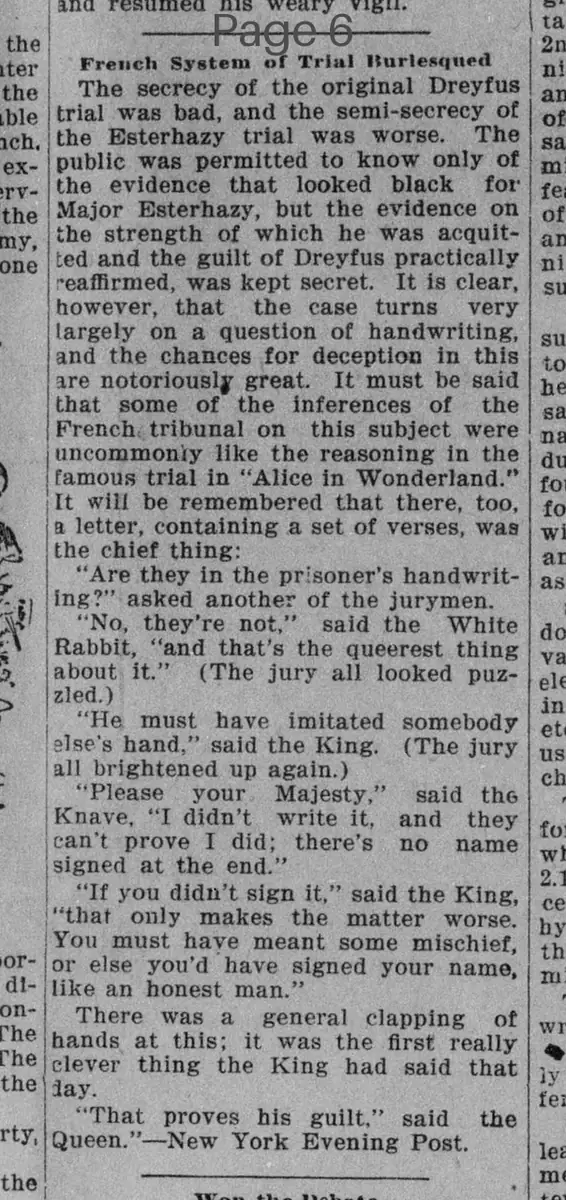
French System of Trial Burlesqued.
The secrecy of the original Dreyfus trial was bad, and the semi-secrecy of the Esterhazy trial was worse. The public was permitted to know only of the evidence that looked black for Major Esterhazy, but the evidence on the strength of which he was acquitted and the guilt of Dreyfus practically reaffirmed, was kept secret. It is clear, however, that the case turns very largely on a question of handwriting and the chances for deception in this are notoriously great. It must be said that some of the inferences of the French tribunal on this subject were uncommonly like the reasoning in the famous trial in "Alice in Wonderland."
It will be remembered that there, too, a letter, containing a set of verses, was the chief thing:
"Are they in the prisoner's handwriting?" asked another of the jurymen.
"No, they're not," said the White Rabbit, "and that's the queerest thing about it." (The jury all looked puzzled.)
"He must have imitated somebody else's hand," said the King. (The jury all brightened up again.)
"Please your Majesty," said the Knave, "I didn't write it, and they can't prove I did; there's no name signed at the end."
"If you didn't sign it," said the King, "that only makes the matter worse. You must have meant some mischief, or else you'd have signed your name, like an honest man."
There was a general clapping of hands at this; it was the first really clever thing the King had said that day.
"That proves his guilt," said the Queen."--New York Evening Post.
The secrecy of the original Dreyfus trial was bad, and the semi-secrecy of the Esterhazy trial was worse. The public was permitted to know only of the evidence that looked black for Major Esterhazy, but the evidence on the strength of which he was acquitted and the guilt of Dreyfus practically reaffirmed, was kept secret. It is clear, however, that the case turns very largely on a question of handwriting and the chances for deception in this are notoriously great. It must be said that some of the inferences of the French tribunal on this subject were uncommonly like the reasoning in the famous trial in "Alice in Wonderland."
It will be remembered that there, too, a letter, containing a set of verses, was the chief thing:
"Are they in the prisoner's handwriting?" asked another of the jurymen.
"No, they're not," said the White Rabbit, "and that's the queerest thing about it." (The jury all looked puzzled.)
"He must have imitated somebody else's hand," said the King. (The jury all brightened up again.)
"Please your Majesty," said the Knave, "I didn't write it, and they can't prove I did; there's no name signed at the end."
"If you didn't sign it," said the King, "that only makes the matter worse. You must have meant some mischief, or else you'd have signed your name, like an honest man."
There was a general clapping of hands at this; it was the first really clever thing the King had said that day.
"That proves his guilt," said the Queen."--New York Evening Post.
What sub-type of article is it?
Historical Event
Deception Fraud
Mystery
What themes does it cover?
Deception
Justice
Crime Punishment
What keywords are associated?
Dreyfus Trial
Esterhazy Trial
Handwriting Evidence
Alice In Wonderland
French Justice
Trial Secrecy
What entities or persons were involved?
Dreyfus
Major Esterhazy
Where did it happen?
France
Story Details
Key Persons
Dreyfus
Major Esterhazy
Location
France
Story Details
The article critiques the secretive handling of evidence in the Dreyfus and Esterhazy trials, focusing on handwriting analysis, and parallels the French tribunal's inferences to the illogical trial logic in 'Alice in Wonderland,' where unsigned verses are taken as proof of guilt.