Thank you for visiting SNEWPapers!
Sign up free
The Augusta Courier
Augusta, Richmond County, Georgia
What is this article about?
Georgia's kaolin mining industry has grown from post-Civil War beginnings to a $16 million annual output today, with production in 1940 at $10 million and 1947 at $13 million. Deposits known since colonial times, principal counties include Twiggs, Wilkinson, and others. Used in pottery, paper coating, and more.
Clipping
OCR Quality
Full Text
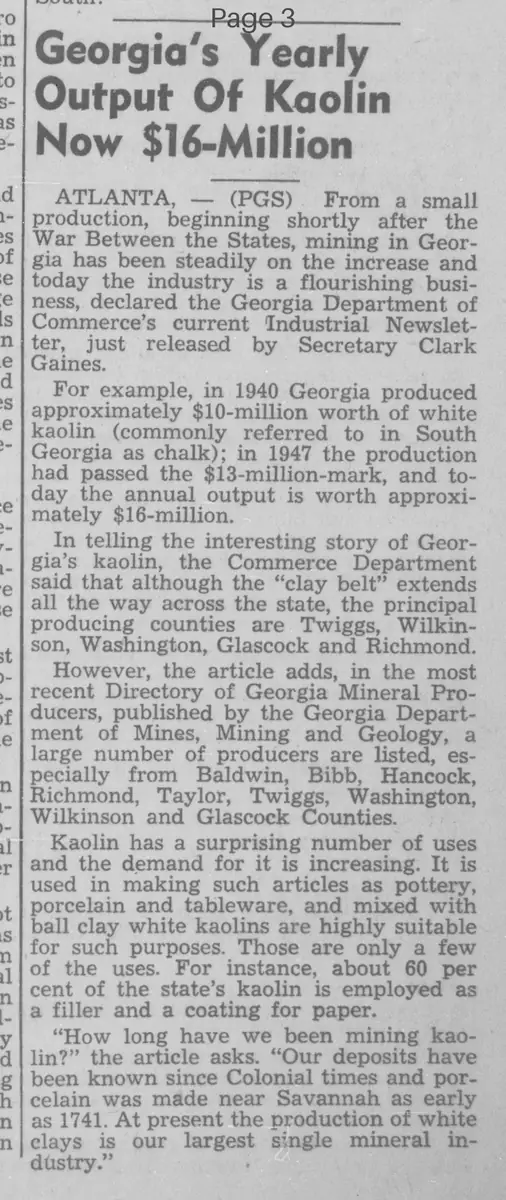
ATLANTA. - (PGS) From a small production, beginning shortly after the War Between the States, mining in Georgia has been steadily on the increase and today the industry is a flourishing business, declared the Georgia Department of Commerce's current Industrial Newsletter, just released by Secretary Clark Gaines.
For example, in 1940 Georgia produced approximately $10-million worth of white kaolin (commonly referred to in South Georgia as chalk); in 1947 the production had passed the $13-million-mark, and today the annual output is worth approximately $16-million.
In telling the interesting story of Georgia's kaolin, the Commerce Department said that although the "clay belt" extends all the way across the state, the principal producing counties are Twiggs, Wilkinson, Washington, Glascock and Richmond.
However, the article adds, in the most recent Directory of Georgia Mineral Producers, published by the Georgia Department of Mines, Mining and Geology, a large number of producers are listed, especially from Baldwin, Bibb, Hancock, Richmond, Taylor, Twiggs, Washington, Wilkinson and Glascock Counties.
Kaolin has a surprising number of uses and the demand for it is increasing. It is used in making such articles as pottery, porcelain and tableware, and mixed with ball clay white kaolins are highly suitable for such purposes. Those are only a few of the uses. For instance, about 60 per cent of the state's kaolin is employed as a filler and a coating for paper.
"How long have we been mining kaolin?" the article asks. "Our deposits have been known since Colonial times and porcelain was made near Savannah as early as 1741. At present the production of white clays is our largest single mineral industry."
What sub-type of article is it?
What themes does it cover?
What keywords are associated?
What entities or persons were involved?
Where did it happen?
Story Details
Key Persons
Location
Georgia, Including Twiggs, Wilkinson, Washington, Glascock, Richmond, Baldwin, Bibb, Hancock, Taylor Counties; Near Savannah
Event Date
Shortly After The War Between The States; 1940; 1947; Today; Colonial Times; 1741
Story Details
Kaolin mining in Georgia began post-Civil War and has increased steadily to a $16 million annual industry. Production values: $10 million in 1940, $13 million in 1947. Deposits known since colonial era, porcelain made near Savannah in 1741. Principal producing counties listed. Kaolin used in pottery, porcelain, paper filler and coating.