Thank you for visiting SNEWPapers!
Sign up free
Mcallen Daily Monitor
Mcallen, Brownsville, Harlingen, Hidalgo County, Cameron County, Texas
What is this article about?
Secretary Henry Morgenthau successfully managed a major Treasury financing of $1.25 billion in March, receiving $8.46 billion in subscriptions, demonstrating his financial expertise amid the New Deal. His rise from farm roles to Treasury Secretary under Roosevelt is highlighted, with challenges in filling the undersecretary position.
Clipping
OCR Quality
Full Text
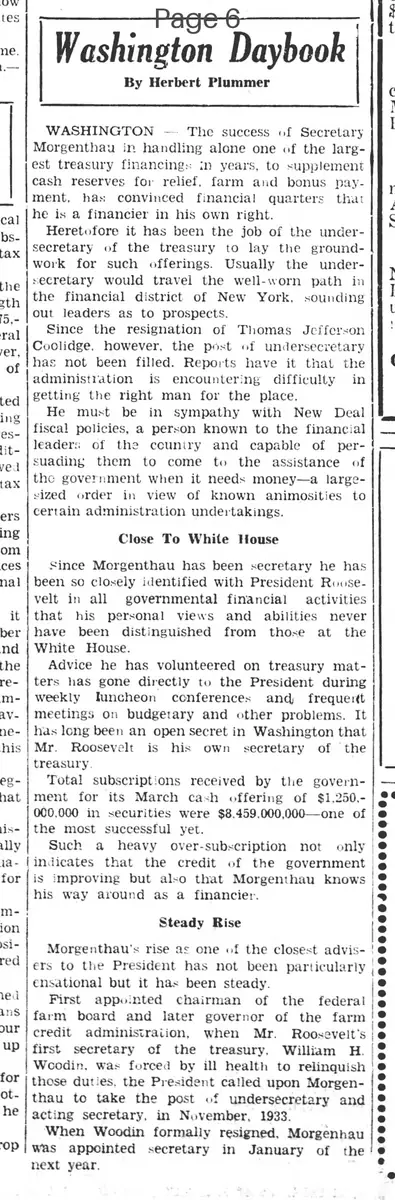
By Herbert Plummer
WASHINGTON—The success of Secretary
Morgenthau in handling alone one of the largest
treasury financings in years, to supplement
cash reserves for relief, farm and bonus payment,
has convinced financial quarters that
he is a financier in his own right.
Heretofore it has been the job of the under-
secretary of the treasury to lay the ground-
work for such offerings. Usually the under-
secretary would travel the well-worn path in
the financial district of New York, sounding
out leaders as to prospects.
Since the resignation of Thomas Jefferson
Coolidge, however, the post of undersecretary
has not been filled. Reports have it that the
administration is encountering difficulty in
getting the right man for the place.
He must be in sympathy with New Deal
fiscal policies, a person known to the financial
leaders of the country and capable of persuading
them to come to the assistance of
the government when it needs money—a large-
sized order in view of known animosities to
certain administration undertakings.
Close To White House
Since Morgenthau has been secretary he has
been so closely identified with President Roosevelt
in all governmental financial activities
that his personal views and abilities never
have been distinguished from those at the
White House.
Advice he has volunteered on treasury matters
has gone directly to the President during
weekly luncheon conferences and frequent
meetings on budgetary and other problems. It
has long been an open secret in Washington that
Mr. Roosevelt is his own secretary of the
treasury.
Total subscriptions received by the government
for its March cash offering of $1,250,
000,000 in securities were $8,459,000,000—one of
the most successful yet.
Such a heavy over-subscription not only
indicates that the credit of the government
is improving but also that Morgenthau knows
his way around as a financier.
Steady Rise
Morgenthau's rise as one of the closest advisers
to the President has not been particularly
sensational but it has been steady.
First appointed chairman of the federal
farm board and later governor of the farm
credit administration, when Mr. Roosevelt's
first secretary of the treasury, William H.
Woodin, was forced by ill health to relinquish
those duties, the President called upon Morgen-
thau to take the post of undersecretary and
acting secretary, in November, 1933.
When Woodin formally resigned, Morgenthau
was appointed secretary in January of the
next year.
What sub-type of article is it?
What keywords are associated?
What entities or persons were involved?
Where did it happen?
Domestic News Details
Primary Location
Washington
Event Date
March
Key Persons
Outcome
total subscriptions of $8,459,000,000 for $1,250,000,000 offering; morgenthau appointed undersecretary and acting secretary in november 1933, secretary in january 1934; undersecretary position unfilled since coolidge's resignation.
Event Details
Secretary Morgenthau handled a major treasury financing alone to supplement cash reserves for relief, farm, and bonus payments, convincing financial leaders of his expertise. The undersecretary role, vacant since Thomas Jefferson Coolidge's resignation, is hard to fill due to need for New Deal sympathy and financial influence. Morgenthau advises Roosevelt closely on financial matters. The March offering was heavily oversubscribed. His steady rise: appointed farm board chairman, farm credit governor, then undersecretary and acting secretary in November 1933, full secretary in January 1934 after Woodin's resignation due to health.