Thank you for visiting SNEWPapers!
Sign up free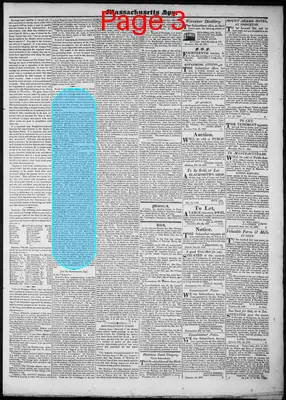
The Massachusetts Spy, And Worcester County Advertiser
Worcester, Worcester County, Massachusetts
What is this article about?
Congressional debate on presidential message about Georgia-Indian controversy. Forsyth (GA) defends state sovereignty and moves for committee referral; Webster counters, emphasizing Indian rights and contracts, rejecting intimidation by assertions.
Clipping
OCR Quality
Full Text
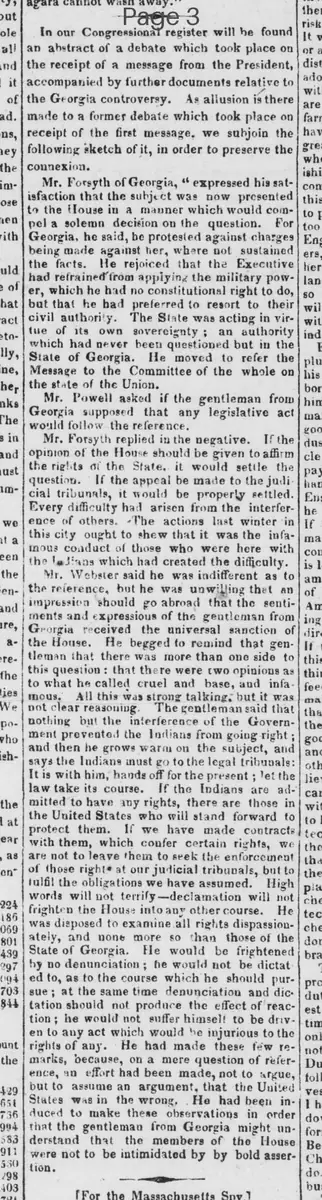
Mr. Forsyth of Georgia, expressed his satisfaction that the subject was now presented to the House in a manner which would compel a solemn decision on the question. For Georgia, he said, he protested against charges being made against her, where not sustained by the facts. He rejoiced that the Executive had refrained from applying the military power, which he had no constitutional right to do, but that he had preferred to resort to their civil authority. The State was acting in virtue of its own sovereignty: an authority which had never been questioned but in the State of Georgia. He moved to refer the Message to the Committee of the whole on the state of the Union.
Mr. Powell asked if the gentleman from Georgia supposed that any legislative act would follow the reference.
Mr. Forsyth replied in the negative. If the opinion of the House should be given to affirm the rights of the State, it would settle the question. If the appeal be made to the judicial tribunals, it would be properly settled. Every difficulty had arisen from the interference of others. —The actions last winter in this city ought to shew that it was the infamous conduct of those who were here with the Indians which had created the difficulty.
Mr. Webster said he was indifferent as to the reference, but he was unwilling that an impression should go abroad that the sentiments and expressions of the gentleman from Georgia received the universal sanction of the House. He begged to remind that gentleman that there was more than one side to this question: that there were two opinions as to what he called cruel and base, and infamous. All this was strong talking, but it was not clear reasoning. The gentleman said that nothing but the interference of the Government prevented the Indians from going right; and then he grows warm on the subject, and says the Indians must go to the legal tribunals: It is with him, hands off for the present; let the law take its course. If the Indians are admitted to have any rights, there are those in the United States who will stand forward to protect them. If we have made contracts with them, which confer certain rights, we are not to leave them to seek the enforcement of those rights at our judicial tribunals, but to fulfill the obligations we have assumed. High words will not terrify—declamation will not frighten the House into any other course. He was disposed to examine all rights dispassionately, and none more so than those of the State of Georgia. He would be frightened by no denunciation; he would not be dictated to, as to the course which he should pursue; at the same time denunciation and dictation should not produce the effect of reaction: he would not suffer himself to be driven to any act which would be injurious to the rights of any. He had made these few remarks, because, on a mere question of reference, an effort had been made, not to argue, but to assume an argument, that the United States was in the wrong. He had been induced to make these observations in order that the gentleman from Georgia might understand that the members of the House were not to be intimidated by bold assertion.
What sub-type of article is it?
What keywords are associated?
What entities or persons were involved?
Where did it happen?
Domestic News Details
Primary Location
Washington
Key Persons
Event Details
Debate in the House on a message from the President regarding the Georgia controversy with Indians. Mr. Forsyth moved to refer the message to the Committee of the whole, defending Georgia's sovereignty and protesting charges against the state. Mr. Powell questioned the reference's effect. Mr. Forsyth replied it would affirm state rights or lead to judicial settlement. Mr. Webster opposed the impression of universal House sanction for Forsyth's views, defending Indian rights and contracts, and urged dispassionate examination.