Thank you for visiting SNEWPapers!
Sign up free
Editorial
January 19, 1819
The Portland Gazette
Portland, Cumberland County, Maine
What is this article about?
Editorial denounces military despotism, recounting Gen. Wilkinson's 1810s false imprisonment and seizure of Gen. Adair's property in New Orleans, his release via habeas corpus in Baltimore, and contrasts with Gen. Jackson's execution of Arbuthnot without repercussions, criticizing trampling of civil authority.
Clipping
OCR Quality
98%
Excellent
Full Text
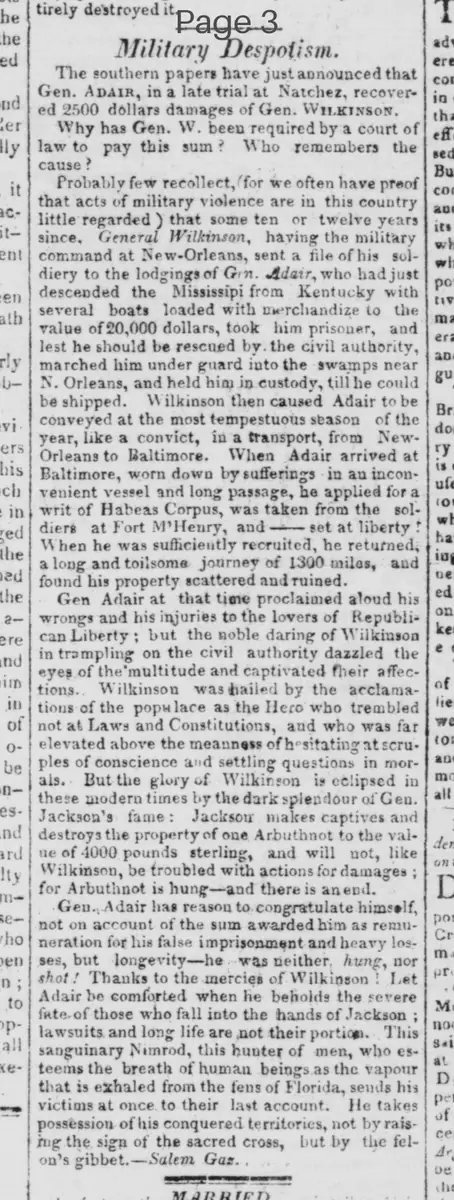
Military Despotism.
The southern papers have just announced that Gen. Adair, in a late trial at Natchez, recovered 2500 dollars damages of Gen. Wilkinson.
Why has Gen. W. been required by a court of law to pay this sum? Who remembers the cause?
Probably few recollect, (for we often have proof that acts of military violence are in this country little regarded) that some ten or twelve years since, General Wilkinson, having the military command at New-Orleans, sent a file of his soldiery to the lodgings of Gen. Adair, who had just descended the Mississippi from Kentucky with several boats loaded with merchandize to the value of 20,000 dollars, took him prisoner, and lest he should be rescued by the civil authority, marched him under guard into the swamps near N. Orleans, and held him in custody, till he could be shipped. Wilkinson then caused Adair to be conveyed at the most tempestuous season of the year, like a convict, in a transport, from New-Orleans to Baltimore. When Adair arrived at Baltimore, worn down by sufferings in an inconvenient vessel and long passage, he applied for a writ of Habeas Corpus, was taken from the soldiers at Fort McHenry, and set at liberty!
When he was sufficiently recruited, he returned, a long and toilsome journey of 1300 miles, and found his property scattered and ruined.
Gen. Adair at that time proclaimed aloud his wrongs and his injuries to the lovers of Republican Liberty; but the noble daring of Wilkinson in trampling on the civil authority dazzled the eyes of the multitude and captivated their affections. Wilkinson was hailed by the acclamations of the populace as the Hero who trembled not at Laws and Constitutions, and who was far elevated above the meanness of hesitating at scruples of conscience and settling questions in morals. But the glory of Wilkinson is eclipsed in these modern times by the dark splendour of Gen. Jackson's fame: Jackson makes captives and destroys the property of one Arbuthnot to the value of 4000 pounds sterling, and will not, like Wilkinson, be troubled with actions for damages; for Arbuthnot is hung—and there is an end.
Gen. Adair has reason to congratulate himself, not on account of the sum awarded him as remuneration for his false imprisonment and heavy losses, but longevity—he was neither hung, nor shot! Thanks to the mercies of Wilkinson! Let Adair be comforted when he beholds the severe fate of those who fall into the hands of Jackson; lawsuits and long life are not their portion. This sanguinary Nimrod, this hunter of men, who esteems the breath of human beings as the vapour that is exhaled from the fens of Florida, sends his victims at once to their last account. He takes possession of his conquered territories, not by raising the sign of the sacred cross, but by the felon's gibbet.—Salem Gaz.
The southern papers have just announced that Gen. Adair, in a late trial at Natchez, recovered 2500 dollars damages of Gen. Wilkinson.
Why has Gen. W. been required by a court of law to pay this sum? Who remembers the cause?
Probably few recollect, (for we often have proof that acts of military violence are in this country little regarded) that some ten or twelve years since, General Wilkinson, having the military command at New-Orleans, sent a file of his soldiery to the lodgings of Gen. Adair, who had just descended the Mississippi from Kentucky with several boats loaded with merchandize to the value of 20,000 dollars, took him prisoner, and lest he should be rescued by the civil authority, marched him under guard into the swamps near N. Orleans, and held him in custody, till he could be shipped. Wilkinson then caused Adair to be conveyed at the most tempestuous season of the year, like a convict, in a transport, from New-Orleans to Baltimore. When Adair arrived at Baltimore, worn down by sufferings in an inconvenient vessel and long passage, he applied for a writ of Habeas Corpus, was taken from the soldiers at Fort McHenry, and set at liberty!
When he was sufficiently recruited, he returned, a long and toilsome journey of 1300 miles, and found his property scattered and ruined.
Gen. Adair at that time proclaimed aloud his wrongs and his injuries to the lovers of Republican Liberty; but the noble daring of Wilkinson in trampling on the civil authority dazzled the eyes of the multitude and captivated their affections. Wilkinson was hailed by the acclamations of the populace as the Hero who trembled not at Laws and Constitutions, and who was far elevated above the meanness of hesitating at scruples of conscience and settling questions in morals. But the glory of Wilkinson is eclipsed in these modern times by the dark splendour of Gen. Jackson's fame: Jackson makes captives and destroys the property of one Arbuthnot to the value of 4000 pounds sterling, and will not, like Wilkinson, be troubled with actions for damages; for Arbuthnot is hung—and there is an end.
Gen. Adair has reason to congratulate himself, not on account of the sum awarded him as remuneration for his false imprisonment and heavy losses, but longevity—he was neither hung, nor shot! Thanks to the mercies of Wilkinson! Let Adair be comforted when he beholds the severe fate of those who fall into the hands of Jackson; lawsuits and long life are not their portion. This sanguinary Nimrod, this hunter of men, who esteems the breath of human beings as the vapour that is exhaled from the fens of Florida, sends his victims at once to their last account. He takes possession of his conquered territories, not by raising the sign of the sacred cross, but by the felon's gibbet.—Salem Gaz.
What sub-type of article is it?
Military Affairs
Constitutional
What keywords are associated?
Military Despotism
Wilkinson Adair Trial
Jackson Arbuthnot Execution
Civil Authority Violation
Habeas Corpus
Republican Liberty
What entities or persons were involved?
Gen. Adair
Gen. Wilkinson
Gen. Jackson
Arbuthnot
Editorial Details
Primary Topic
Criticism Of Military Despotism By Generals Wilkinson And Jackson
Stance / Tone
Strongly Critical Of Military Overreach And Violation Of Civil Rights
Key Figures
Gen. Adair
Gen. Wilkinson
Gen. Jackson
Arbuthnot
Key Arguments
Wilkinson's Soldiers Arrested Adair Without Civil Authority And Transported Him Like A Convict
Adair Released Via Habeas Corpus But Returned To Find Property Ruined
Public Admired Wilkinson's Defiance Of Laws Over Adair's Republican Complaints
Jackson's Execution Of Arbuthnot Avoids Lawsuits By Killing Victims Outright
Military Figures Eclipse Civil Liberties With Violence And Executions