Thank you for visiting SNEWPapers!
Sign up free
The Virginia Gazette
Richmond, Williamsburg, Richmond County, Virginia
What is this article about?
A freeholder critiques two Pennsylvania assembly acts from 1779 for unequal taxation during the Revolutionary War, arguing they unfairly burden slaves more than freemen and exempt other property, violating equality principles, and urges voters to elect representatives who prioritize fair distribution.
Clipping
OCR Quality
Full Text
To the PUBLIC.
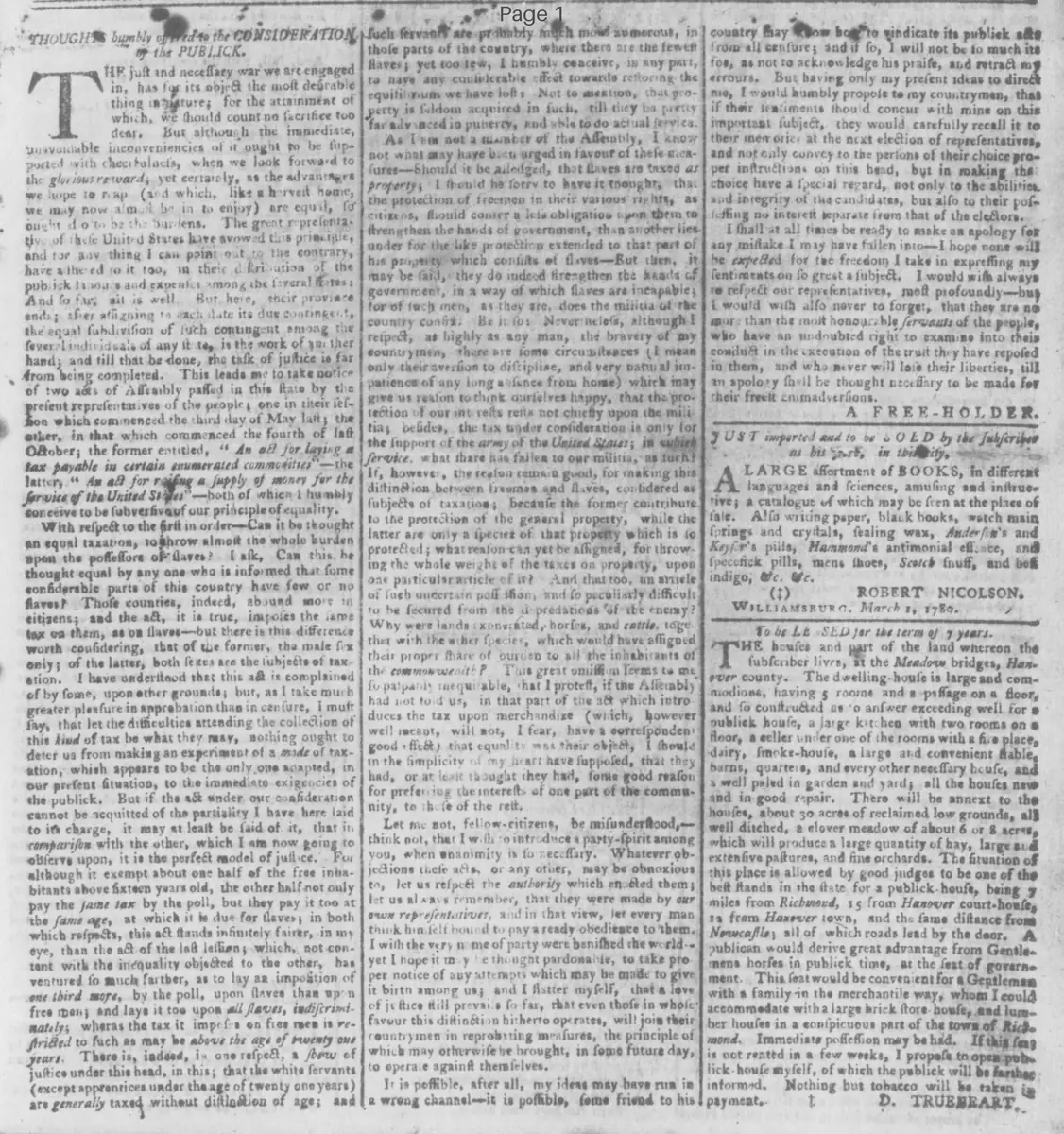
If just and necessary war we are engaged in, has for its object the most desirable thing in nature; for the attainment of which, we should count no sacrifice too dear. But although the immediate, unavoidable inconveniences of it ought to be supported with cheerfulness, when we look forward to the glorious reward; yet certainly, as the advantages we hope to reap (and which, like a harvest home, we may now almost be in to enjoy) are equal, so ought to be the Burdens. The great representatives of these United States have avowed this principle, and for anything I can point out to the contrary, have adhered to it too, in their distribution of the public law and expense among the several states: And so far, all is well. But here, their province ends; after assigning to each state its due contingent, the equal subdivision of such contingent among the several individuals of any state is the work of another hand; and till that be done, the task of justice is far from being completed. This leads me to take notice of two acts of Assembly passed in this state by the present representatives of the people one in their session which commenced the third day of May last: the other, in that which commenced the fourth of last October; the former entitled, "An act for laying tax payable in certain enumerated commodities"—the latter, "An act for raising a supply of money for the service of the United States"—both of which I humbly conceive to be subversive of our principle of equality.
With respect to the first in order—Can it be thought an equal taxation, to throw almost the whole burden upon the poorer slaves? I ask, Can this be thought equal by any one who is informed that some considerable parts of this country have few or no slaves? Those counties, indeed, abound more in citizens; and the act, it is true, imposes the same tax on them, as on slaves—but there is this difference worth considering, that on the former, the male sex only; of the latter, both sexes are the subjects of taxation. I have understood that this act is complained of by some, upon other grounds; but, as I take much greater pleasure in approbation than in censure, I must say, that let the difficulties attending the collection of this kind of tax be what they may, nothing ought to deter us from making an experiment of a mode of taxation, which appears to be the only one adapted, in our present Situation, to the immediate exigencies of the publick. But if the act under our consideration cannot be acquitted of the partiality I have here laid to its charge, it may at least be said of it, that in comparison with the other, which I am now going to observe upon, it is the perfect model of justice. For although it exempt about one half of the free inhabitants above sixteen years old, the other half not only pay the same tax by the poll, but they pay it too at the same age, at which it is due for slaves; in both which respects, this act stands infinitely fairer, in my eye, than the act of the last session; which, not content with the inequality objected to the other, has ventured so much farther, as to lay an imposition of one third more, by the poll, upon slaves than upon free men; and lays it too upon all slaves, indiscriminately; whereas the tax it imposes on free men is restricted to such as may be above the age of twenty one years.
There is, indeed, in one respect, a show of justice under this head, in this; that the white servants (except apprentices under the age of twenty one years) are generally taxed without distinction of age; and such servants are probably much more numerous, in those parts of the country, where there were the fewest slaves; yet too few, I humbly conceive, in any part, to have any considerable effect towards restoring the equilibrium we have lost. Not to mention, that property in freedom acquired in such circumstances, they have but lately far advanced in puberty, and while to do actual services.
As I am not a member of the Assembly, I know not what may have been urged in favour of these measures—Should it be alleged, that slaves are taxed as property; I should be sorry to have it thought, that the protection of freemen in their various rights, as citizens, should confer a less obligation upon them to strengthen the hands of government, than another lies under for the like protection extended to that part of his property which consists of slaves—But then, it may be said, they do indeed strengthen the hands of government, in a way of which slaves are incapable; for of such men, as they are, does the militia of the country consist. Be it so: Nevertheless, although I respect, as highly as any man, the bravery of my countrymen, there are some circumstances (I mean only their aversion to discipline, and very partial impatience of any long absence from home) which may give us reason to think ourselves happy, that the protection of our interests rests not chiefly upon the militia, beside, the tax under consideration is only for the support of the army of the United States; in which service, what share has fallen to our militia, as such?
If, however, the reason remain good, for making this distinction between freemen and slaves, considered as subjects of taxation; because the former contribute to the protection of the general property, while the latter are only a species of that property which is to be protected; what reason can yet be assigned, for throwing the whole weight of the taxes on property, upon one particular article of it? And that too, an article of such uncertain position, and so peculiarly difficult to be secured from the depredations of the enemy? Why were lands exonerated, horses, and cattle, together with the other species, which would have allotted their proper share of burden to all the inhabitants of the commonwealth? This great omission seems to me palpably inequitable, that I protest, if the Assembly had not told us, in that part of the act which introduces the tax upon merchandize (which, however well meant, will not, I fear, have a correspondent good effect) that equality was their object, I should in the simplicity of my heart have supposed, that they had, or at least thought they had, some good reason for preferring the interests of one part of the community, to those of the rest.
Let me not, fellow-citizens, be misunderstood,—think not, that I wish to introduce a party-spirit among you, when unanimity is so necessary. Whatever objections these acts or any other, may be obnoxious to, let us respect the authority which enacted them; let us always remember, that they were made by our own representatives, and in that view, let every man think himself bound to pay a ready obedience to them. I wish the very name of party were banished the world—yet I hope it may be thought pardonable, to take proper notice of any attempts which may be made to give it birth among us; and I flatter myself, that a love of justice still prevails so far, that even those in whose favour this distinction hitherto operates, will join their countrymen in reprobating measures, the principle of which may otherwise be brought, in some future day, to operate against themselves.
It is possible, after all, my ideas may have run in a wrong channel—it is possible, Some friend to his Country may now boast vindicated its publick from all censure; and if so, I will not be too much its foe, as not to acknowledge his praise, and retract my errours. But having only my present ideas to direct me, I would humbly propose to my countrymen, that if their sentiments should concur with mine on this important subject, they would carefully recall it to their memory at the next election of representatives, and not only convey to the persons of their choice proper instructions on this head, but in making the choice have a special regard, not only to the abilities and integrity of the candidates, but also to their pursuing no interest separate from that of the elector.
I shall at all times be ready to make an apology for any mistake I may have fallen into—I hope none will be expected for the freedom I take in expressing my sentiments on so great a subject. I would with always respect our representatives, most profoundly—but I would with also never to forget, that they are no more than the most honourable servants of the people, who have an undoubted right to examine into their conduct in the execution of the trust they have reposed in them, and who never will lose their liberties, till an apology shall be thought necessary to be made for their freest animadversions.
A FREE-HOLDER.
What sub-type of article is it?
What themes does it cover?
What keywords are associated?
What entities or persons were involved?
Letter to Editor Details
Author
A Free Holder.
Recipient
To The Public.
Main Argument
two recent state assembly tax acts are unjust as they disproportionately tax slaves over freemen and exempt other property like land and livestock, violating the principle of equal burden-sharing in the war effort; voters should elect representatives committed to equitable taxation.
Notable Details