Thank you for visiting SNEWPapers!
Sign up free
Letter to Editor
January 20, 1849
Arkansas Intelligencer
Van Buren, Crawford County, Arkansas
What is this article about?
Letter corrects distance estimates for California expedition from Fort Smith, discusses routes via Albuquerque, Gen. Kearney's 1846 army path, and Spanish trail, warns of challenges, and estimates 2000+ miles and 5 months travel time to San Francisco gold regions.
Clipping
OCR Quality
95%
Excellent
Full Text
For the Intelligencer.
The California Expedition.
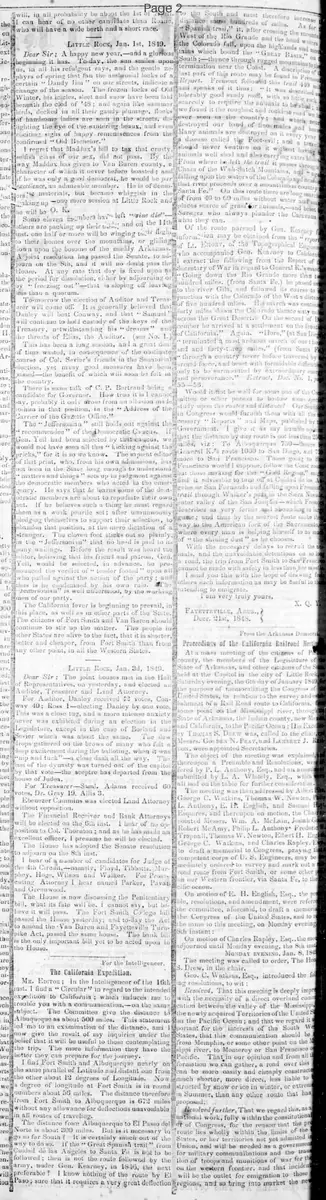
Mr. Editor: In the Intelligencer of the 16th inst. I find a "Circular" in regard to the intended expedition to California; which induces me to trouble you with a communication,--on the same subject. The Committee give the distance to Albuquerque as about 500 miles. This statement led me to an examination of the distance, and I now give the result of my inquiries under the belief that it will be useful to those contemplating the trip. The more information they have the better they can prepare for the journey.
I find Fort Smith and Albuquerque nearly on the same parallel of Latitude and distant one from the other about 12 degrees of Longitude. Now a degree of longitude at Fort Smith is in round numbers about 56 miles. The distance therefore from Fort Smith to Albuquerque is 672 miles without any allowance for deflections unavoidable in all routes of traveling.
The distance from Albuquerque to El Passo del Norte is about 300 miles. But is it necessary to go so far South? It is certainly much out of the way to do so. If the "Great Spanish trail" from Cuidad de las Angeles to Santa Fe is not to be followed; then is not the route followed by the army, under Gen. Kearney, in 1846, the next preferable? I know nothing of the route by El Paso; sure that it requires a very great deflection to the South and must therefore increase distance some hundreds of miles. The "Spanish trail," it, after crossing the mountains West of the Rio Grande and the head waters of the Colorado fall, upon the highlands and mountains which bound the "Great Basin." On the North ;--thence through rugged mountains to its termination near the Coast. A description of the last part of this route may be found in Fremont's Report. Fremont followed this trail 410 miles and speaks of it thus: "It was described to us as a tolerably good sandy road, with so little rock scarcely to require the animals to be shod;" but we found it the roughest and rockiest road we had ever seen in the country; and which nearly destroyed our band of fine mules and horses. Many animals are destroyed on it every year by a disease called the Foot-evil; and a traveler should never venture on it without having his animals well shod and also carrying extra Shoes. From where he left the trail it passes through the main Chain of the Wah-Satch Mountains, and "falling upon the waters of the Colorado and Gila" that river proceeds over a mountainous country to Santa Fe." On this route there are long marches of from 40 to 60 miles without water and at places scarce of grass for animals,--and beset with Savages who always plunder the Caravan of what they can.
Of the route pursued by Gen. Kearney information may be obtained from the "report of Lt. Emory, of the Topographical Engineers who accompanied Gen. Kearney to California. I extract the following from the Report of the Secretary of War in regard to General K.'s march. Going down the Rio Grande more than four hundred miles, (from Santa Fe.) he passed over to the river Gila, and followed its course to its junction with the Colorado of the West a distance of five hundred miles. His march was continued forty miles down the Colorado thence sixty miles across the Great Desert. On the second of December he arrived at a settlement on the frontier of California." Again. "I here," (at San Diego) "terminated a most arduous march of one thousand and forty-three miles." (from Santa Fe.) through a country never before traversed by an armed force, and beset with formidably difficult passes, only to be surmounted by extraordinary endurance and perseverance.
Would it not be well for some one of the Committee or other person to bestow some study upon these routes and distances? Our Senators and Congress would furnish them with all the necessary "Reports" and Maps, published by the Government. I give it as my humble opinion that the distance by either route is not less than 2000 miles, viz: To Albuquerque 750--thence by General K.'s route 1000 to San Diego, and 200 more to San Francisco. Those going to San Francisco would I suppose, follow the Coast route but those seeking for the "Gold Region," would find it advisable to turn off at Cuidad de los Angeles or San Fernando and falling upon Fremont's trail through Walker's pass in the Sierra Nevada to the San Joaquin valley-which Fremont describes as very fertile and abounding in game; and thus by the nearest route more directly to the American fork of the Sacramento where every man is helping himself to as much of the shining dust" as he chooses.
With the necessary delays to recruit the animals, and the unavoidable detentions on so long a road, the trip from Fort Smith to San Francisco cannot be made with safety in less than five months I send you this with the hope of drawing out others such information as may be useful to those intending to emigrate.
I am very truly yours,
J. Q.
The California Expedition.
Mr. Editor: In the Intelligencer of the 16th inst. I find a "Circular" in regard to the intended expedition to California; which induces me to trouble you with a communication,--on the same subject. The Committee give the distance to Albuquerque as about 500 miles. This statement led me to an examination of the distance, and I now give the result of my inquiries under the belief that it will be useful to those contemplating the trip. The more information they have the better they can prepare for the journey.
I find Fort Smith and Albuquerque nearly on the same parallel of Latitude and distant one from the other about 12 degrees of Longitude. Now a degree of longitude at Fort Smith is in round numbers about 56 miles. The distance therefore from Fort Smith to Albuquerque is 672 miles without any allowance for deflections unavoidable in all routes of traveling.
The distance from Albuquerque to El Passo del Norte is about 300 miles. But is it necessary to go so far South? It is certainly much out of the way to do so. If the "Great Spanish trail" from Cuidad de las Angeles to Santa Fe is not to be followed; then is not the route followed by the army, under Gen. Kearney, in 1846, the next preferable? I know nothing of the route by El Paso; sure that it requires a very great deflection to the South and must therefore increase distance some hundreds of miles. The "Spanish trail," it, after crossing the mountains West of the Rio Grande and the head waters of the Colorado fall, upon the highlands and mountains which bound the "Great Basin." On the North ;--thence through rugged mountains to its termination near the Coast. A description of the last part of this route may be found in Fremont's Report. Fremont followed this trail 410 miles and speaks of it thus: "It was described to us as a tolerably good sandy road, with so little rock scarcely to require the animals to be shod;" but we found it the roughest and rockiest road we had ever seen in the country; and which nearly destroyed our band of fine mules and horses. Many animals are destroyed on it every year by a disease called the Foot-evil; and a traveler should never venture on it without having his animals well shod and also carrying extra Shoes. From where he left the trail it passes through the main Chain of the Wah-Satch Mountains, and "falling upon the waters of the Colorado and Gila" that river proceeds over a mountainous country to Santa Fe." On this route there are long marches of from 40 to 60 miles without water and at places scarce of grass for animals,--and beset with Savages who always plunder the Caravan of what they can.
Of the route pursued by Gen. Kearney information may be obtained from the "report of Lt. Emory, of the Topographical Engineers who accompanied Gen. Kearney to California. I extract the following from the Report of the Secretary of War in regard to General K.'s march. Going down the Rio Grande more than four hundred miles, (from Santa Fe.) he passed over to the river Gila, and followed its course to its junction with the Colorado of the West a distance of five hundred miles. His march was continued forty miles down the Colorado thence sixty miles across the Great Desert. On the second of December he arrived at a settlement on the frontier of California." Again. "I here," (at San Diego) "terminated a most arduous march of one thousand and forty-three miles." (from Santa Fe.) through a country never before traversed by an armed force, and beset with formidably difficult passes, only to be surmounted by extraordinary endurance and perseverance.
Would it not be well for some one of the Committee or other person to bestow some study upon these routes and distances? Our Senators and Congress would furnish them with all the necessary "Reports" and Maps, published by the Government. I give it as my humble opinion that the distance by either route is not less than 2000 miles, viz: To Albuquerque 750--thence by General K.'s route 1000 to San Diego, and 200 more to San Francisco. Those going to San Francisco would I suppose, follow the Coast route but those seeking for the "Gold Region," would find it advisable to turn off at Cuidad de los Angeles or San Fernando and falling upon Fremont's trail through Walker's pass in the Sierra Nevada to the San Joaquin valley-which Fremont describes as very fertile and abounding in game; and thus by the nearest route more directly to the American fork of the Sacramento where every man is helping himself to as much of the shining dust" as he chooses.
With the necessary delays to recruit the animals, and the unavoidable detentions on so long a road, the trip from Fort Smith to San Francisco cannot be made with safety in less than five months I send you this with the hope of drawing out others such information as may be useful to those intending to emigrate.
I am very truly yours,
J. Q.
What sub-type of article is it?
Informative
Historical
Persuasive
What themes does it cover?
Infrastructure
Military War
Commerce Trade
What keywords are associated?
California Expedition
Route Distances
Kearney March
Spanish Trail
Fremont Report
Gold Regions
Emigration Preparation
What entities or persons were involved?
J. Q.
Mr. Editor
Letter to Editor Details
Author
J. Q.
Recipient
Mr. Editor
Main Argument
the writer corrects the committee's distance estimate to albuquerque as 672 miles from fort smith and discusses preferable routes to california, such as gen. kearney's 1846 army path over the el paso route, estimating total distance to san francisco at over 2000 miles and recommending study of government reports for better preparation.
Notable Details
References Fremont's Report On Spanish Trail
Quotes Lt. Emory's Report On Kearney's March
Mentions Distances: 672 Miles To Albuquerque, 1043 Miles From Santa Fe To San Diego
Warnings About Rough Terrain, Lack Of Water, Savages, And Animal Diseases