Thank you for visiting SNEWPapers!
Sign up free
The New York Journal, And Weekly Register
New York, New York County, New York
What is this article about?
An 1786 letter from Davidson County, North Carolina, argues for American rights to navigate the Mississippi River per treaty, denounces Spanish restrictions as hostile, and warns of potential western settler uprisings or invasions of Spanish territories like New Orleans or Mexico if unresolved.
Merged-components note: These are continuations of the same extract of a letter from Davidson County on the navigation of the Mississippi and relations with Spain; relabeled to foreign_news as it concerns international matters.
Clippings
1 of 2
OCR Quality
Full Text
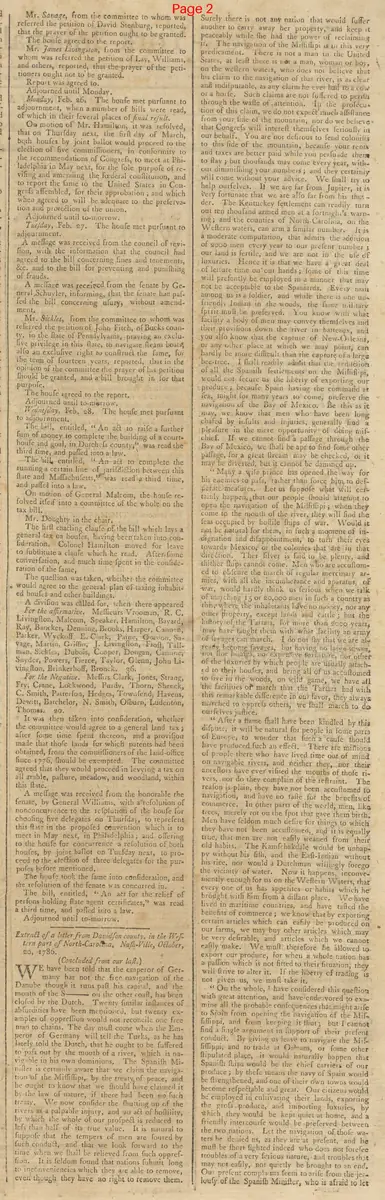
(Concluded from our last.)
We have been told that the emperor of Germany has not the free navigation of the Danube though it runs past his capital, and the mouth of the Scheldt on the other coast, has been closed by the Dutch. Twenty similar instances of absurdities have been mentioned, but twenty examples of oppression would not reconcile one free man to chains. The day must come when the Emperor of Germany will tell the Turks, as he has lately told the Dutch, that he ought to be suffered to pass out by the mouth of a river, which is navigable in his own dominions. The Spanish Minister is certainly aware that we claim the navigation of the Mississippi, by the treaty of peace, and he ought to know that we should have claimed it by the law of nature, if there had been no such treaty. We now consider the shutting up of the rivers as a palpable injury, and an act of hostility, by which the whole of our prospect is reduced to less than half of its true value. It is natural to suppose that the tempers of men are soured by such conduct, and that we look forward to the time when we shall be relieved from such oppression. It is seldom found that nations submit long to inconveniencies which they are able to remove, even though they have no right to remove them.
Surely there is not any nation that would suffer another to carry away her property, and keep it peaceably while she had the power of reclaiming it. The navigation of the Mississippi is in this very predicament. There is not a man in the United States, at least there is not a man, woman or boy, on the western waters, who does not believe that his claim to the navigation of that river, is as clear and indisputable, as any claim he ever had to a cow or a horse. Such claims are not suffered to perish through the waste of attention. In the prosecution of this claim, we do not expect much assistance from your side of the mountain, nor do we believe that Congress will interest themselves seriously in our behalf. You are not desirous to send colonists to this side of the mountain, because your rents and taxes are better paid while you persuade them to stay; but thousands may come every year, without diminishing your numbers; and they certainly will come without your advice. We shall try to help ourselves. If we are far from Jupiter, it is very fortunate that we are also far from his thunder. The Kentucky settlement can readily turn out ten thousand armed men at a fortnight's warning; and the counties of North-Carolina, on the Western waters, can arm a similar number. It is a moderate computation, that admits the addition of 5000 men every year to our present number; our land is fertile, and we are not in the use of luxuries. Hence it is that we have a great deal of leisure time on our hands; some of this time will presently be employed in a manner that may not be acceptable to the Spaniards. Every man among us is a soldier, and while there is one unfriendly Indian in the woods, the same military spirit must be preserved. You know with what facility a body of men may convey themselves and their provisions down the river in batteaux, and you also know that the capture of New-Orleans, or any other place at which we may point, can hardly be more difficult than the capture of a large bee-hive. I shall readily admit that the reduction of all the Spanish settlements on the Mississippi, would not secure us the liberty of exporting our produce; because Spain having the command at sea, might for many years to come, preserve the navigation of the Bay of Mexico. Be this as it may, we know that men who have been long chafed by insults and injuries, generally find a pleasure in the mere opportunity of doing mischief. If we cannot find a passage through the Bay of Mexico, we shall be apt to find some other passage, or a great stream may be checked, or it may be diverted, but it cannot be dammed up.
"Many a wise prince has opened the way for his enemies to pass, rather than force him, to desperate measures. Let us suppose what will certainly happen, that our people should attempt to open the navigation of the Mississippi; when they come to the mouth of the river, they will find the seas occupied by hostile ships of war. Would it not be natural for them, in such a moment of indignation and disappointment, to turn their eyes towards Mexico, or the colonies that are in that direction. Their silver is said to be plenty, and thither ships cannot come. Men who are accustomed to obscure the march of regular mercenary armies, with all the incumbrance and apparatus, of war, would hardly think us serious when we talk of marching 15 or 20,000 men in such a country as this, where the inhabitants have no money, nor any other property, except lands and cattle; but the history of the Tartars, for more than 2000 years, may have taught them with what facility an army of savages can march. I do not say that we are already become savages, but having no large towns, nor stone houses, nor expensive furniture, nor other of the luxuries by which people are usually attached to their houses, and being all of us accustomed to live in the woods, on wild game, we have all the facilities of march that the Tartars had with this remarkable difference in our favor, they always marched to oppress others, we shall march to do ourselves justice.
"After a flame shall have been kindled by this dispute, it will be natural for people in some parts of Europe, to wonder that such a cause should have produced such an effect. There are millions of people there who have lived time out of mind on navigable rivers, and neither they, nor their ancestors have ever visited the mouths of those rivers, nor do they complain of the restraint. The reason is plain, they have not been accustomed to navigation, and have no taste for the benefits of commerce. In other parts of the world, men, like trees, merely rot on the spot that gave them birth. Men have seldom much desire for things to which they have not been accustomed, and it is equally true, that men are not easily weaned from their old habits. The Kamchadale would be unhappy without his fish, and the East-Indian without his rice, nor would a Dutchman willingly forego the vicinity of water. Now it happens, inconveniently enough for us on the Western Waters, that every one of us has appetites or habits which he brought with him from a distant place. We have lived in maritime countries, and have tasted the benefits of commerce; we know that by exporting certain articles which can easily be produced on our farms, we may buy other articles which may be very desirable, and articles which we cannot easily make. We must therefore be allowed to export our produce, for when a whole nation has a passion which is not fitted to their situation, they will strive to alter it. If the liberty of trading is not given us, we must take it.
"On the whole, I have considered this question with great attention, and have endeavored to examine all the probable consequences that might arise to Spain from opening the navigation of the Mississippi, and from keeping it shut; but I cannot find a single argument in support of their present conduct. By giving us leave to navigate the Mississippi, and to trade at Orleans, or some other stipulated place, it would naturally happen that Spanish ships would be the chief carriers of our produce; by these means the navy of Spain would be strengthened, and one of their own towns would become respectable and great. Our citizens would be employed in cultivating their lands, exporting the gross produce, and importing luxuries, by which they would be kept quiet at home, and a friendly intercourse would be preserved between the two nations. Let the navigation of those waters be denied us, as they are at present, and he must be short sighted indeed who does not foresee troubles of a very serious nature, and troubles that may not easily, nor quietly be brought to an end. Our present complaints seem to arise from the jealousy of the Spanish Minister, who is afraid to let
pass through a corner of a very inconsiderable province, lest we should in process of time find our way to the silver mines. By preventing us from doing in the road that we have a right to travel, we shall certainly be provoked to explore other paths, which to a wise nation are not so desirable. A path which does not lead to such desirable riches as those which are gained by cultivating the soil, the result, though not more profitable nor desirable to us, must be extremely inconvenient to the Spanish nation.
What sub-type of article is it?
What keywords are associated?
What entities or persons were involved?
Where did it happen?
Foreign News Details
Primary Location
Mississippi River
Event Date
October 20, 1786
Key Persons
Event Details
The letter asserts American rights to Mississippi navigation under the peace treaty and natural law, views Spanish closure as injury and hostility reducing western prospects, anticipates settler frustration leading to self-help actions like arming thousands to capture New Orleans or march to Mexico, warns of serious troubles if unresolved, and argues opening navigation would benefit Spain through trade and strengthened navy.