Thank you for visiting SNEWPapers!
Sign up free
Editorial
May 15, 1937
Nogales International
Nogales, Santa Cruz County, Arizona
What is this article about?
The editorial opposes price-fixing laws like the Miller-Tydings bill, arguing they unjustly raise consumer prices for manufacturer profits without aiding employment or wages. It criticizes government protection of inefficient businesses and urges consumer organization to combat rising costs.
Clipping
OCR Quality
100%
Excellent
Full Text
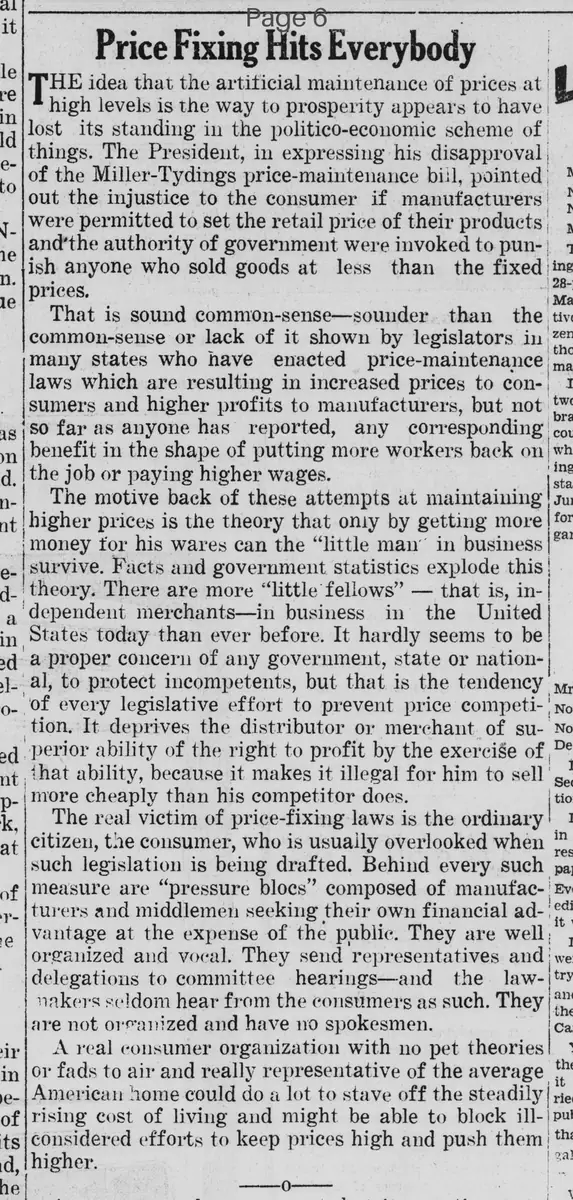
Price Fixing Hits Everybody
The idea that the artificial maintenance of prices at high levels is the way to prosperity appears to have lost its standing in the politico-economic scheme of things. The President, in expressing his disapproval of the Miller-Tydings price-maintenance bill, pointed out the injustice to the consumer if manufacturers were permitted to set the retail price of their products and the authority of government were invoked to punish anyone who sold goods at less than the fixed prices.
That is sound common-sense--sounder than the common-sense or lack of it shown by legislators in many states who have enacted price-maintenance laws which are resulting in increased prices to consumers and higher profits to manufacturers, but not so far as anyone has reported, any corresponding benefit in the shape of putting more workers back on the job or paying higher wages.
The motive back of these attempts at maintaining higher prices is the theory that only by getting more money for his wares can the "little man" in business survive. Facts and government statistics explode this theory. There are more "little fellows" - that is, independent merchants - in business in the United States today than ever before. It hardly seems to be a proper concern of any government, state or national, to protect incompetents, but that is the tendency of every legislative effort to prevent price competition. It deprives the distributor or merchant of superior ability of the right to profit by the exercise of that ability, because it makes it illegal for him to sell more cheaply than his competitor does.
The real victim of price-fixing laws is the ordinary citizen, the consumer, who is usually overlooked when such legislation is being drafted. Behind every such measure are "pressure blocs" composed of manufacturers and middlemen seeking their own financial advantage at the expense of the public. They are well organized and vocal. They send representatives and delegations to committee hearings - and the lawmakers seldom hear from the consumers as such. They are not organized and have no spokesmen.
A real consumer organization with no pet theories or fads to air and really representative of the average American home could do a lot to stave off the steadily rising cost of living and might be able to block ill-considered efforts to keep prices high and push them higher.
The idea that the artificial maintenance of prices at high levels is the way to prosperity appears to have lost its standing in the politico-economic scheme of things. The President, in expressing his disapproval of the Miller-Tydings price-maintenance bill, pointed out the injustice to the consumer if manufacturers were permitted to set the retail price of their products and the authority of government were invoked to punish anyone who sold goods at less than the fixed prices.
That is sound common-sense--sounder than the common-sense or lack of it shown by legislators in many states who have enacted price-maintenance laws which are resulting in increased prices to consumers and higher profits to manufacturers, but not so far as anyone has reported, any corresponding benefit in the shape of putting more workers back on the job or paying higher wages.
The motive back of these attempts at maintaining higher prices is the theory that only by getting more money for his wares can the "little man" in business survive. Facts and government statistics explode this theory. There are more "little fellows" - that is, independent merchants - in business in the United States today than ever before. It hardly seems to be a proper concern of any government, state or national, to protect incompetents, but that is the tendency of every legislative effort to prevent price competition. It deprives the distributor or merchant of superior ability of the right to profit by the exercise of that ability, because it makes it illegal for him to sell more cheaply than his competitor does.
The real victim of price-fixing laws is the ordinary citizen, the consumer, who is usually overlooked when such legislation is being drafted. Behind every such measure are "pressure blocs" composed of manufacturers and middlemen seeking their own financial advantage at the expense of the public. They are well organized and vocal. They send representatives and delegations to committee hearings - and the lawmakers seldom hear from the consumers as such. They are not organized and have no spokesmen.
A real consumer organization with no pet theories or fads to air and really representative of the average American home could do a lot to stave off the steadily rising cost of living and might be able to block ill-considered efforts to keep prices high and push them higher.
What sub-type of article is it?
Economic Policy
Trade Or Commerce
What keywords are associated?
Price Fixing
Consumer Rights
Economic Policy
Price Maintenance
Fair Competition
Rising Costs
What entities or persons were involved?
President
Miller Tydings Bill
Legislators In Many States
Manufacturers
Consumers
Independent Merchants
Editorial Details
Primary Topic
Opposition To Price Fixing Laws
Stance / Tone
Critical Of Price Maintenance And Supportive Of Consumer Protection
Key Figures
President
Miller Tydings Bill
Legislators In Many States
Manufacturers
Consumers
Independent Merchants
Key Arguments
Price Maintenance Harms Consumers By Raising Prices Without Benefits To Employment Or Wages
Government Should Not Protect Incompetent Businesses From Competition
Price Fixing Deprives Efficient Merchants Of The Ability To Profit Through Lower Prices
Consumers Are Overlooked In Legislation Influenced By Manufacturer Pressure Groups
A Representative Consumer Organization Could Prevent Rising Costs