Thank you for visiting SNEWPapers!
Sign up free
The Daily Advertiser
New York, New York County, New York
What is this article about?
Essay by Americanus critiques Montesquieu's 'Spirit of Laws' for flawed government classifications and principles, proposing democracy, aristocracy, and monarchy instead. It defends the US Constitution's biennial elections, state executive Senate appointments, and small representation against Cato's objections, using British analogies.
Merged-components note: These components form a single continuous 'Americanus' letter to the editor spanning multiple columns and pages, discussing republican government and responding to Cato.
Clippings
1 of 2
OCR Quality
Full Text
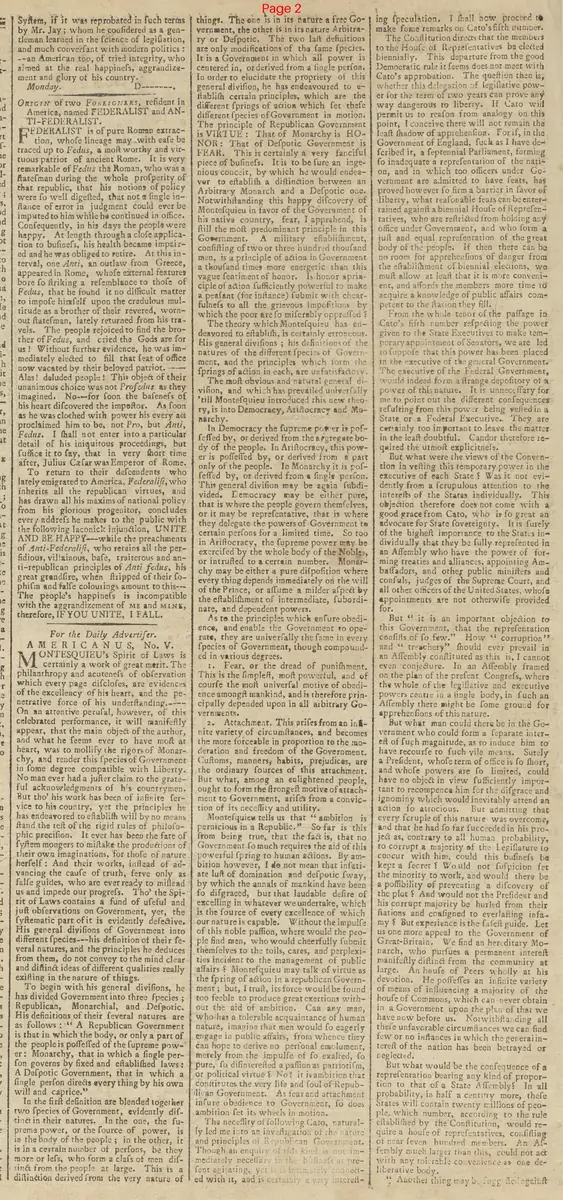
AMERICANUS, NO. V.
MONTESQUIEU'S Spirit of Laws philanthropy and acuteness of observation which every page discloses, are evidences of the excellency of his heart, and the penetrative force of his understanding.----
On an attentive perusal, however, of this celebrated performance, it will manifestly appear, that the main object of the author, and what he seems ever to have most at heart, was to mollify the rigors of Monarchy, and render this species of Government in some degree compatible with Liberty.
No man ever had a juster claim to the grateful acknowledgments of his countrymen. But tho' his work has been of infinite service to his country, yet the principles he has endeavored to establish will by no means stand the test of the rigid rules of philosophic precision. It ever has been the fate of system mongers to mistake the productions of their own imaginations, for those of nature herself: And their works, instead of advancing the cause of truth, serve only as false guides, who are ever ready to mislead us and impede our progress. Tho the Spirit of Laws contains a fund of useful and just observations on Government, yet, the systematic part of it is evidently defective.
His general divisions of Government into different species---his definition of their several natures, and the principles he deduces from them, do not convey to the mind clear and distinct ideas of different qualities really existing in the nature of things.
To begin with his general divisions, he has divided Government into three species; Republican, Monarchical, and Despotic.
His definitions of their several natures are as follows: A Republican Government is that in which the body, or only a part of the people is possessed of the supreme power: Monarchy, that in which a single person governs by fixed and established laws: A Despotic Government, that in which a single person directs every thing by his own will and caprice."
In the first definition are blended together two species of Government, evidently distinct in their natures. In the one, the supreme power, or the source of power, is in the body of the people; in the other, it is in a certain number of persons, be they more or less, who form a class of men distinct from the people at large. This is a distinction derived from the very nature of things. The one is in its nature a free Government, the other is in its nature Arbitrary or Despotic. The two last definitions are only modifications of the same species.
It is a Government in which all power is centered in, or derived from a single person. In order to elucidate the propriety of this general division, he has endeavoured to establish certain principles, which are the different springs of action which set these different species of Government in motion.
The principle of Republican Government is VIRTUE: That of Monarchy is HONOR: That of Despotic Government is FEAR. This is certainly a very fanciful piece of business. It is to be sure an ingenious conceit, by which he would endeavor to establish a distinction between an Arbitrary Monarch and a Despotic one.
Notwithstanding this happy discovery of Montesquieu in favor of the Government of his native country, fear, I apprehend, is still the most predominant principle in this Government. A military establishment, consisting of two or three hundred thousand men, is a principle of action in Government a thousand times more energetic than this vague sentiment of honor. Is honor a principle of action sufficiently powerful to make a peasant (for instance) submit with cheerfulness to all the grievous impositions by which the poor are so miserably oppressed?
The theory which Montesquieu has endeavored to establish, is certainly erroneous. His general divisions; his definitions of the natures of the different species of Government, and the principles which form the springs of action in each, are unsatisfactory.
The most obvious and natural general division, and which has prevailed universally till Montesquieu introduced this new theory, is into Democracy, Aristocracy and Monarchy.
In Democracy the supreme power is possessed by, or derived from the aggregate body of the people. In Aristocracy, this power is possessed by, or derived from a part only of the people. In Monarchy it is possessed by, or derived from a single person.
This general division may be again subdivided. Democracy may be either pure, that is where the people govern themselves, or it may be representative, that is where they delegate the powers of Government to certain persons for a limited time. So too in Aristocracy, the supreme power may be exercised by the whole body of the Nobles, or intrusted to a certain number. Monarchy may be either a pure despotism where every thing depends immediately on the will of the Prince, or assume a milder aspect by the establishment of intermediate, subordinate, and dependent powers.
As to the principles which ensure obedience, and enable the Government to operate, they are universally the same in every species of Government, though compounded in various degrees.
1. Fear, or the dread of punishment. This is the simplest, most powerful, and of course the most universal motive of obedience amongst mankind, and is therefore principally depended upon in all arbitrary Governments.
2. Attachment. This arises from an infinite variety of circumstances, and becomes the more forcible in proportion to the moderation and freedom of the Government. Customs, manners, habits, prejudices, are the ordinary sources of this attachment. But what, among an enlightened people, ought to form the strongest motive of attachment to Government, arises from a conviction of its necessity and utility.
Montesquieu tells us that "ambition is pernicious in a Republic." So far is this from being true, that the fact is, that no Government so much requires the aid of this powerful spring to human actions. By ambition however, I do not mean that insatiate lust of domination and despot sway, by which the annals of mankind have been so disgraced, but that laudable desire of excelling in whatever we undertake, which is the source of every excellence of which our nature is capable. Without the impulse of this noble passion, where would the people find men, who would cheerfully submit themselves to the toils, cares, and perplexities incident to the management of public affairs? And Montesquieu may talk of virtue as the spring of action in a republican Government; but, I trust, its force would be found too feeble to produce great exertions without the aid of ambition. Can any man, who has a tolerable acquaintance of human nature, imagine that men would so eagerly engage in public affairs, from whence they can hope to derive no personal emolument, merely from the impulse of so exalted, so pure, so disinterested a passion as patriotism, or political virtue? No! it is ambition that constitutes the very life and soul of Republican Government. As fear and attachment insure obedience to Government, so does ambition set its wheels in motion.
The necessity of following Cato, naturally led me into an investigation of the nature and principles of Republican Government. Though an enquiry of this kind is not immediately necessary in the business at present agitating, yet it is intimately connected with it, and is certainly a very interesting speculation.
I shall now proceed to make some remarks on Cato's fifth number.
The Constitution directs that the members to the House of Representatives be elected biennially. This departure from the good Democratic rule it seems does not meet with Cato's approbation. The question then is; whether this delegation of legislative power or the term of two years can prove any way dangerous to liberty. If Cato will permit us to reason from analogy on this point, I conceive there will not remain the least shadow of apprehension. For if, in the Government of England, such as I have described it, a septennial Parliament, forming so inadequate a representation of the nation, and in which too officers under Government are admitted to have seats, has proved however so firm a barrier in favor of liberty, what reasonable fears can be entertained against a biennial House of Representatives, who are restricted from holding any office under Government, and who form a just and equal representation of the great body of the people. If then there can be no room for apprehensions of danger from the establishment of biennial elections, we must allow at least that it is more convenient, and affords the members more time to acquire a knowledge of public affairs competent to the station they fill.
From the whole tenor of the passage in Cato's fifth number respecting the power given to the State Executives to make temporary appointment of Senators, we are led to suppose that this power has been placed in the executive of the general Government. The executive of the Federal Government, would indeed form a strange depository of a power of this nature. It is unnecessary for me to point out the different consequences resulting from this power being vested in a State or a Federal Executive. They are certainly too important to leave the matter in the least doubtful. Candor therefore required the utmost explicitness.
But what were the views of the Convention in vesting this temporary power in the executive of each State? Was it not evidently from a scrupulous attention to the interests of the States individually. This objection therefore does not come with a good grace from Cato, who is so great an advocate for State sovereignty. It is surely of the highest importance to the States individually that they be fully represented in an Assembly who have the power of forming treaties and alliances, appointing Ambassadors, and other public ministers and consuls, judges of the Supreme Court, and all other officers of the United States, whose appointments are not otherwise provided for.
But "it is an important objection to this Government, that the representation consists of so few." How "corruption" and "treachery" should ever prevail in an Assembly constituted as this is, I cannot even conjecture. In an Assembly framed on the plan of the present Congress, where the whole of the legislative and executive powers centre in a single body, in such an Assembly there might be some ground for apprehensions of this nature.
But what man could there be in the Government who could form a separate interest of such magnitude, as to induce him to have recourse to such vile means. Surely a President, whose term of office is so short, and whose powers are so limited, could have no object in view sufficiently important to recompence him for the disgrace and ignominy which would inevitably attend an action so atrocious. But admitting that every scruple of this nature was overcome, and that he had so far succeeded in his project as, contrary to all human probability, to corrupt a majority of the Legislature to concur with him, could this business be kept a secret? Would not suspicion set the minority to work, and would there be a possibility of preventing a discovery of the plot? And would not the President and his corrupt majority be hurled from their stations and consigned to everlasting infamy? But experience is the safest guide. Let us once more appeal to the Government of Great-Britain. We find an hereditary Monarch, who pursues a permanent interest manifestly distinct from the community at large. An house of Peers wholly at his devotion. He possesses an infinite variety of means of influencing a majority of the house of Commons, which can never obtain in a Government upon the plan of that we have now before us. Notwithstanding all these unfavorable circumstances we can find few or no instances in which the general interest of the nation has been betrayed or neglected.
But what would be the consequence of a representation bearing any kind of proportion to that of a State Assembly? In all probability, in half a century more, these States will contain twenty millions of people, which number, according to the rule established by the Constitution, would require a house of representatives, consisting of near seven hundred members. An Assembly much larger than this, could not act with any tolerable convenience as one deliberative body.
"Another thing may be suggested against
the small number of representatives is, that the choice will be confined to a very few. And so it would be was this number quadrupled. For what proportion would twenty four bear to the whole number of citizens in this State. But the fact is, that no Government, that has ever yet existed in the world, affords so ample a field, to individuals of all ranks, for the display of political talents and abilities. Here are no Patricians, who engross the offices of State. No man who has real merit, let his situation be what it will, need despair. He but distinguishes himself amongst his neighbours at township and county meeting; he is next sent to the State Legislature. In this theatre his abilities, whatever they are, are exhibited in their true colors, and displayed to the views of every man in the State: from hence his ascent to a seat in Congress becomes easy and sure. Such a regular uninterrupted gradation from the chief men in a village, to the chair of the President of the United States, which this Government affords to all her citizens without distinction, is a perfection in Republican Government, heretofore unknown and unprecedented.
AMERICANUS.
What sub-type of article is it?
What themes does it cover?
What keywords are associated?
What entities or persons were involved?
Letter to Editor Details
Author
Americanus
Recipient
For The Daily Advertiser
Main Argument
montesquieu's government classifications and principles are flawed; better divisions are democracy, aristocracy, and monarchy with universal principles like fear, attachment, and ambition. the us constitution's biennial elections, state executive senate appointments, and small representation are safe and beneficial, unlike cato's fears, as shown by british precedents.
Notable Details