Thank you for visiting SNEWPapers!
Sign up free
The Nome Daily Nugget
Nome, Nome County, Alaska
What is this article about?
Development of high-grade quartz mining districts in Alaska, particularly the Chichagof district on Chichagof Island, following placer mining discoveries. Operations by Chichagof Mining Company and Golden Gate Company include mills processing ore averaging $17 per ton, powered by hydroelectric plant.
Clipping
OCR Quality
Full Text
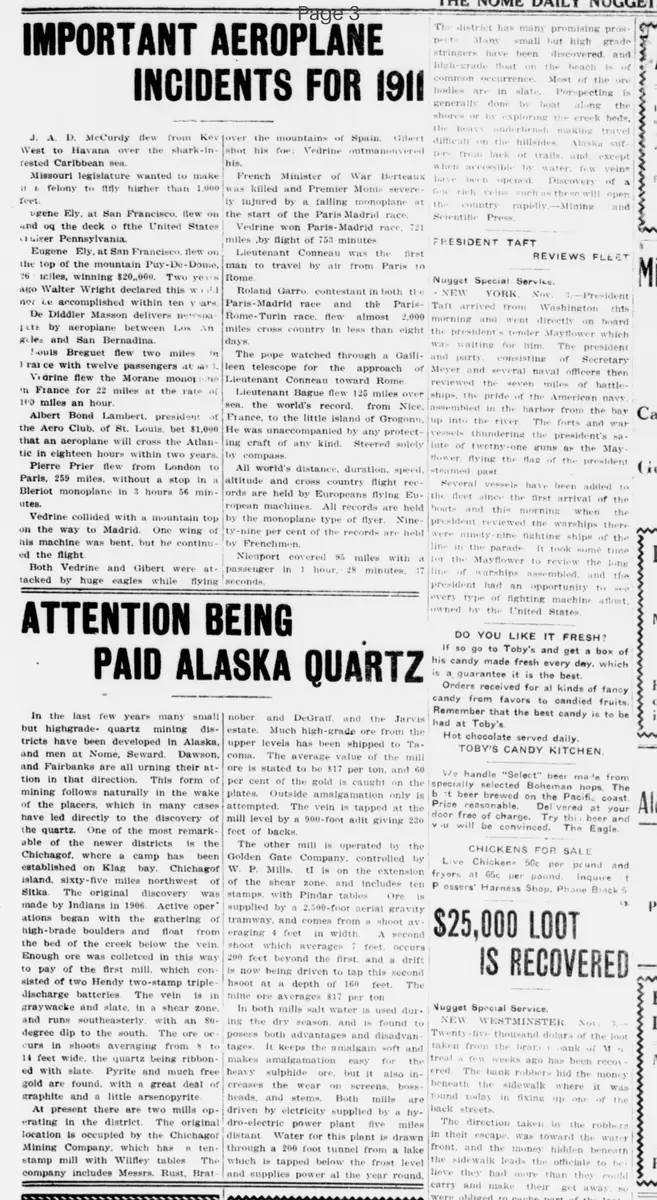
In the last few years many small but high-grade quartz mining districts have been developed in Alaska, and men at Nome, Seward, Dawson, and Fairbanks are all turning their attention in that direction. This form of mining follows naturally in the wake of the placers, which in many cases have led directly to the discovery of the quartz.
One of the most remarkable of the newer districts is the Chichagof, where a camp has been established on Klag bay, Chichagof island, sixty-five miles northwest of Sitka. The original discovery was made by Indians in 1906. Active operations began with the gathering of high-grade boulders and float from the bed of the creek below the vein. Enough ore was collected in this way to pay off the first mill, which consisted of two Hendy two-stamp triple-discharge batteries.
The vein is in graywacke and slate, in a shear zone, and runs southeasterly with an 80-degree dip to the south. The ore occurs in shoots averaging from 8 to 14 feet wide, the quartz being ribboned with slate. Pyrite and much free gold are found, with a great deal of graphite and a little arsenopyrite.
At present there are two mills operating in the district. The original location is occupied by the Chichagof Mining Company, which has a ten-stamp mill with Wilfley tables. The company includes Messrs. Rust, Brattain and DeGraff and the Jarvis estate.
Much high-grade ore from the upper levels has been shipped to Tacoma. The average value of the mill ore is stated to be $17 per ton, and 60 per cent of the gold is caught on the plates. Outside amalgamation only is attempted. The vein is tapped at the mill level by a 900-foot adit giving 230 feet of backs.
The other mill is operated by the Golden Gate Company, controlled by W. P. Mills. It is on the extension of the shear zone, and includes ten stamps, with Pindar tables. Ore is supplied by a 2,500-foot aerial gravity tramway, and comes from a shoot averaging 4 feet in width. A second shoot which averages 5 feet occurs 200 feet beyond the first, and a drift is now being driven to tap this second shoot at a depth of 160 feet. The mine ore averages $17 per ton.
In both mills salt water is used during the dry season, and is found to possess both advantages and disadvantages. It keeps the amalgam soft and makes amalgamation easy for the heavy sulphide ore, but it also increases the wear on screens, bosses, heads, and stems.
Both mills are driven by electricity supplied by a hydro-electric power plant five miles distant. Water for this plant is drawn through a 200-foot tunnel from a lake which is tapped below the frost level and supplies power all the year round.
The district has many promising prospects. Many small but high-grade stringers have been discovered, and high-grade float on the beach is of common occurrence. Most of the ore bodies are in slate. Prospecting is generally done by boat along the shores or by exploring the creek beds, the heavy underbrush making travel difficult on the hillsides. Alaska suffers from a lack of trails and except when accessible in water but veins such as these will open the country rapidly.
Mining and Scientific Press.
What sub-type of article is it?
What keywords are associated?
What entities or persons were involved?
Where did it happen?
Domestic News Details
Primary Location
Chichagof District, Alaska
Event Date
1906
Key Persons
Outcome
ore averaging $17 per ton processed; high-grade ore shipped to tacoma; two mills operating with 60% gold recovery on plates.
Event Details
Development of quartz mining districts in Alaska following placer mining, with focus on Chichagof district where camp established on Klag bay, Chichagof island. Discovery by Indians in 1906; operations by Chichagof Mining Company (ten-stamp mill) and Golden Gate Company (ten-stamp mill with tramway); vein in graywacke and slate with free gold; powered by hydroelectric plant.