Thank you for visiting SNEWPapers!
Sign up free
Literary
May 26, 1790
Gazette Of The United States
New York, New York County, New York
What is this article about?
Essay by Aristides on human passions, focusing on laughter's peculiar nature: excited by contrary causes like decency or absurdity, its social value in companionship and conversation, and risks of immoderation leading to levity. References Franklin's humor.
Clipping
OCR Quality
95%
Excellent
Full Text
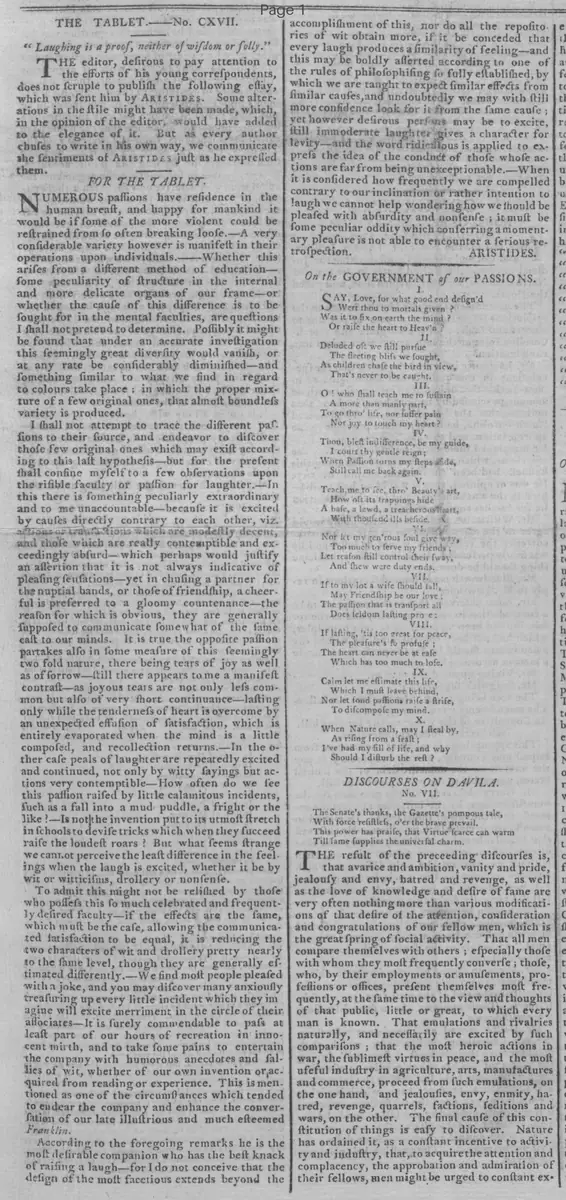
THE TABLET.- No. CXVII.
"Laughing is a proof, neither of wisdom or folly."
THE editor, desirous to pay attention to the efforts of his young correspondents, does not scruple to publish the following essay, which was sent him by Aristides. Some alterations in the style might have been made, which, in the opinion of the editor, would have added to the elegance of it. But as every author chooses to write in his own way, we communicate the sentiments of Aristides just as he expressed them.
FOR THE TABLET
NUMEROUS passions have residence in the human breast, and happy for mankind it would be if some of the more violent could be restrained from so often breaking loose.—A very considerable variety however is manifest in their operations upon individuals. Whether this arises from a different method of education—some peculiarity of structure in the internal and more delicate organs of our frame—or whether the cause of this difference is to be sought for in the mental faculties, are questions I shall not pretend to determine. Possibly it might be found that under an accurate investigation this seemingly great diversity would vanish, or at any rate be considerably diminished—and something similar to what we find in regard to colours take place; in which the proper mixture of a few original ones, that almost boundless variety is produced.
I shall not attempt to trace the different passions to their source, and endeavor to discover those few original ones which may exist according to this last hypothesis—but for the present shall confine myself to a few observations upon the risible faculty or passion for laughter.—In this there is something peculiarly extraordinary and to me unaccountable—because it is excited by causes directly contrary to each other, viz. actions or situations which are modestly decent, and those which are really contemptible and exceedingly absurd—which perhaps would justify an assertion that it is not always indicative of pleasing sensations—yet in choosing a partner for the nuptial bands, or those of friendship, a cheerful is preferred to a gloomy countenance—the reason for which is obvious, they are generally supposed to communicate somewhat of the same cast to our minds. It is true the opposite passion partakes also in some measure of this seemingly two fold nature, there being tears of joy as well as of sorrow—still there appears to me a manifest contrast—as joyous tears are not only less common but also of very short continuance—lasting only while the tenderness of heart is overcome by an unexpected effusion of satisfaction, which is entirely evaporated when the mind is a little composed, and recollection returns.—In the other case peals of laughter are repeatedly excited and continued, not only by witty sayings but actions very contemptible—How often do we see this passion raised by little calamitous incidents, such as a fall into a mud puddle, a fright or the like?—Is not the invention put to its utmost stretch in schools to devise tricks which when they succeed raise the loudest roars? But what seems strange we cannot perceive the least difference in the feelings when the laugh is excited, whether it be by wit or witticisms, drollery or nonsense.
To admit this might not be relished by those who possess this so much celebrated and frequently desired faculty—if the effects are the same, which must be the case, allowing the communicated satisfaction to be equal, it is reducing the two characters of wit and drollery pretty nearly to the same level, though they are generally estimated differently.—We find most people pleased with a joke, and you may discover many anxiously treasuring up every little incident which they imagine will excite merriment in the circle of their associates—It is surely commendable to pass at least part of our hours of recreation in innocent mirth, and to take some pains to entertain the company with humorous anecdotes and sallies of wit, whether of our own invention or acquired from reading or experience. This is mentioned as one of the circumstances which tended to endear the company and enhance the conversation of our late illustrious and much esteemed Franklin.
According to the foregoing remarks he is the most desirable companion who has the best knack of raising a laugh—for I do not conceive that the design of the most facetious extends beyond the accomplishment of this, nor do all the repositories of wit obtain more. If it be conceded that every laugh produces a similarity of feeling—and this may be boldly asserted according to one of the rules of philosophising so fully established, by which we are taught to expect similar effects from similar causes, and undoubtedly we may with still more confidence look for it from the same cause; yet however desirous persons may be to excite, still immoderate laughter gives a character for levity—and the word ridiculous is applied to express the idea of the conduct of those whose actions are far from being unexceptionable.—When it is considered how frequently we are compelled contrary to our inclination or rather intention to laugh we cannot help wondering how we should be pleased with absurdity and nonsense; it must be some peculiar oddity which conferring a momentary pleasure is not able to encounter a serious retrospection.
ARISTIDES.
"Laughing is a proof, neither of wisdom or folly."
THE editor, desirous to pay attention to the efforts of his young correspondents, does not scruple to publish the following essay, which was sent him by Aristides. Some alterations in the style might have been made, which, in the opinion of the editor, would have added to the elegance of it. But as every author chooses to write in his own way, we communicate the sentiments of Aristides just as he expressed them.
FOR THE TABLET
NUMEROUS passions have residence in the human breast, and happy for mankind it would be if some of the more violent could be restrained from so often breaking loose.—A very considerable variety however is manifest in their operations upon individuals. Whether this arises from a different method of education—some peculiarity of structure in the internal and more delicate organs of our frame—or whether the cause of this difference is to be sought for in the mental faculties, are questions I shall not pretend to determine. Possibly it might be found that under an accurate investigation this seemingly great diversity would vanish, or at any rate be considerably diminished—and something similar to what we find in regard to colours take place; in which the proper mixture of a few original ones, that almost boundless variety is produced.
I shall not attempt to trace the different passions to their source, and endeavor to discover those few original ones which may exist according to this last hypothesis—but for the present shall confine myself to a few observations upon the risible faculty or passion for laughter.—In this there is something peculiarly extraordinary and to me unaccountable—because it is excited by causes directly contrary to each other, viz. actions or situations which are modestly decent, and those which are really contemptible and exceedingly absurd—which perhaps would justify an assertion that it is not always indicative of pleasing sensations—yet in choosing a partner for the nuptial bands, or those of friendship, a cheerful is preferred to a gloomy countenance—the reason for which is obvious, they are generally supposed to communicate somewhat of the same cast to our minds. It is true the opposite passion partakes also in some measure of this seemingly two fold nature, there being tears of joy as well as of sorrow—still there appears to me a manifest contrast—as joyous tears are not only less common but also of very short continuance—lasting only while the tenderness of heart is overcome by an unexpected effusion of satisfaction, which is entirely evaporated when the mind is a little composed, and recollection returns.—In the other case peals of laughter are repeatedly excited and continued, not only by witty sayings but actions very contemptible—How often do we see this passion raised by little calamitous incidents, such as a fall into a mud puddle, a fright or the like?—Is not the invention put to its utmost stretch in schools to devise tricks which when they succeed raise the loudest roars? But what seems strange we cannot perceive the least difference in the feelings when the laugh is excited, whether it be by wit or witticisms, drollery or nonsense.
To admit this might not be relished by those who possess this so much celebrated and frequently desired faculty—if the effects are the same, which must be the case, allowing the communicated satisfaction to be equal, it is reducing the two characters of wit and drollery pretty nearly to the same level, though they are generally estimated differently.—We find most people pleased with a joke, and you may discover many anxiously treasuring up every little incident which they imagine will excite merriment in the circle of their associates—It is surely commendable to pass at least part of our hours of recreation in innocent mirth, and to take some pains to entertain the company with humorous anecdotes and sallies of wit, whether of our own invention or acquired from reading or experience. This is mentioned as one of the circumstances which tended to endear the company and enhance the conversation of our late illustrious and much esteemed Franklin.
According to the foregoing remarks he is the most desirable companion who has the best knack of raising a laugh—for I do not conceive that the design of the most facetious extends beyond the accomplishment of this, nor do all the repositories of wit obtain more. If it be conceded that every laugh produces a similarity of feeling—and this may be boldly asserted according to one of the rules of philosophising so fully established, by which we are taught to expect similar effects from similar causes, and undoubtedly we may with still more confidence look for it from the same cause; yet however desirous persons may be to excite, still immoderate laughter gives a character for levity—and the word ridiculous is applied to express the idea of the conduct of those whose actions are far from being unexceptionable.—When it is considered how frequently we are compelled contrary to our inclination or rather intention to laugh we cannot help wondering how we should be pleased with absurdity and nonsense; it must be some peculiar oddity which conferring a momentary pleasure is not able to encounter a serious retrospection.
ARISTIDES.
What sub-type of article is it?
Essay
What themes does it cover?
Moral Virtue
Social Manners
What keywords are associated?
Laughter
Passions
Wit
Drollery
Franklin
Levity
Mirth
Companionship
What entities or persons were involved?
Aristides
Literary Details
Author
Aristides
Subject
On The Risible Faculty Or Passion For Laughter
Key Lines
Laughing Is A Proof, Neither Of Wisdom Or Folly.
In This There Is Something Peculiarly Extraordinary And To Me Unaccountable—Because It Is Excited By Causes Directly Contrary To Each Other, Viz. Actions Or Situations Which Are Modestly Decent, And Those Which Are Really Contemptible And Exceedingly Absurd
Yet In Choosing A Partner For The Nuptial Bands, Or Those Of Friendship, A Cheerful Is Preferred To A Gloomy Countenance
This Is Mentioned As One Of The Circumstances Which Tended To Endear The Company And Enhance The Conversation Of Our Late Illustrious And Much Esteemed Franklin.
Immoderate Laughter Gives A Character For Levity