Thank you for visiting SNEWPapers!
Sign up free
Gazette Of The United States & Evening Advertiser
Philadelphia, Philadelphia County, Pennsylvania
What is this article about?
In the U.S. House of Representatives, Mr. Smith of South Carolina concluded his defense of a bill authorizing naval frigates to counter Algerine pirate threats, rebutting objections on force adequacy, war risks, friendly ports, costs, seamen shortages, seasonal timing, and long-term naval establishment dangers.
Clipping
OCR Quality
Full Text
House of Representatives
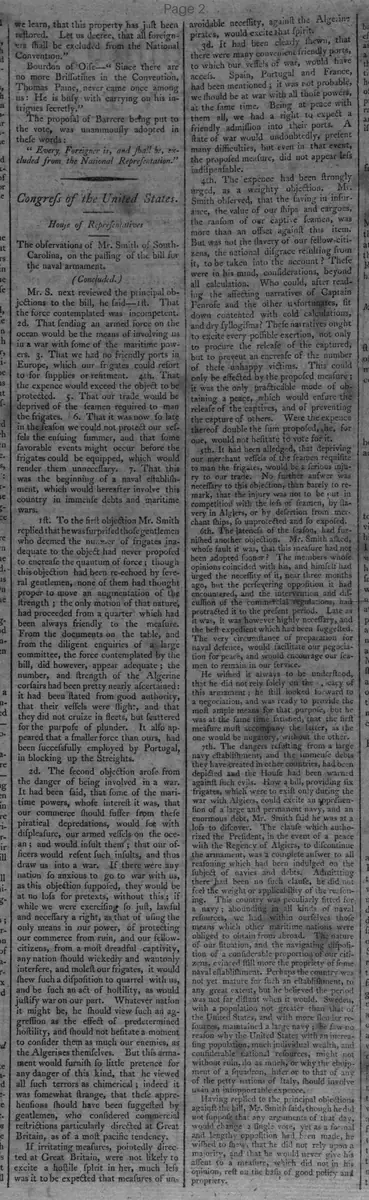
The observations of Mr. Smith, of South-Carolina, on the passing of the bill for the naval armament.
(Concluded.)
Mr. S. next reviewed the principal objections to the bill, he said--1st. That the force contemplated was incompetent. 2d. That sending an armed force on the ocean would be the means of involving us in a war with some of the maritime powers. 3. That we had no friendly ports in Europe, which our frigates could resort to for supplies or refitment. 4th. That the expense would exceed the object to be protected. 5. That our trade would be deprived of the seamen required to man the frigates. 6. That it was now so late in the season we could not protect our vessels the ensuing summer, and that some favorable events might occur before the frigates could be equipped, which would render them unnecessary. 7. That this was the beginning of a naval establishment, which would hereafter involve this country in immense debts and maritime wars.
1st. To the first objection Mr. Smith replied that he was surprised those gentlemen who deemed the number of frigates inadequate to the object had never proposed to increase the quantum of force; though this objection had been re-echoed by several gentlemen, none of them had thought proper to move an augmentation of the strength; the only motion of that nature, had proceeded from a quarter: which had been always friendly to the measure.
From the documents on the table, and from the diligent enquiries of a large committee, the force contemplated by the bill, did however, appear adequate; the number, and strength of the Algerine corsairs had been pretty nearly ascertained: it had been stated from good authority, that their vessels were slight, and that they did not cruise in fleets, but scattered for the purpose of plunder. It also appeared that a smaller force than ours, had been successfully employed by Portugal, in blocking up the Straits.
2d. The second objection arose from the danger of being involved in a war. It had been said, that some of the maritime powers, whose interest it was, that our commerce should suffer from these piratical depredations, would see with displeasure, our armed vessels on the ocean; and would insult them; that our officers would resent such insults, and thus draw us into a war. If there were any nation so anxious to go to war with us, as this objection supposed, they would be at no loss for pretexts, without this; if while we were exercising so just, lawful and necessary a right, as that of using the only means in our power, of protecting our commerce from ruin, and our fellow-citizens, from a most dreadful captivity, any nation should wickedly and wantonly interfere, and molest our frigates, it would shew such a disposition to quarrel with us, and be such an act of hostility, as would justify war on our part. Whatever nation it might be, he should view such an aggression as the effect of predetermined hostility, and should not hesitate a moment to consider them as much our enemies, as the Algerines themselves. But this armament would furnish so little pretence for any danger of this kind, that he viewed all such terrors as chimerical; indeed it was somewhat strange, that these apprehensions should have been suggested by gentlemen, who considered commercial restrictions particularly directed at Great Britain, as of a most pacific tendency.
If irritating measures, pointedly directed at Great Britain, were not likely to excite a hostile spirit in her, much less was it to be expected that measures of unavoidable necessity, against the Algerine pirates, would excite that spirit.
3d. It had been clearly shewn, that there were many convenient friendly ports in Spain, Portugal and France, to which our vessels of war would have access; it was not probable, we should be at war with all those powers, at the same time. Being at peace with them all, we had a right to expect a friendly admission into their ports. A state of war would undoubtedly, present many difficulties, but even in that event, the proposed measure, did not appear less indispensable.
4th. The expense had been strongly urged, as a weighty objection. Mr. Smith observed, that the saving in insurance, the value of our ships and cargoes, the ransom of our captive seamen, was more than an offset against this item.
But was not the slavery of our fellow-citizens, the national disgrace resulting from it, to be taken into the account? These were in his mind, considerations, beyond all calculation. Who could, after reading the affecting narratives of Captain Penrose and the other unfortunates, sit down contented with cold calculations, and dry syllogisms? These narratives ought to excite every possible exertion, not only to procure the release of the captured, but to prevent an increase of the number of these unhappy victims. This could only be effected by the proposed measure; it was the only practicable mode of obtaining a peace, which would ensure the release of the captives, and of preventing the capture of others. Were the expense thereof double the sum proposed, he, for one, would not hesitate to vote for it.
5th. It had been alledged, that depriving our merchant vessels of the seamen requisite to man the frigates, would be a serious injury to our trade. No further answer was necessary to this objection, than barely to remark, that the injury was not to be put in competition with the loss of seamen, by slavery in Algiers, or by desertion from merchant ships, so unprotected and so exposed.
6th. The lateness of the season, had furnished another objection. Mr. Smith asked, whose fault it was, that this measure had not been adopted sooner? The members whose opinions coincided with his, and himself had urged the necessity of it, near three months ago, but the persevering opposition it had encountered, and the intervention and discussion of the commercial regulations, had protracted it to the present period. Late as it was, it was however highly necessary, and the best expedient which had been suggested.
The very circumstance of preparation for naval defence, would facilitate our negotiation for peace, and would encourage our seamen to remain in our service.
He wished it always to be understood, that he did not rely solely on the efficacy of this armament; he still looked forward to a negotiation, and was ready to provide the most ample means for that purpose, but he was at the same time satisfied, that the first measure must accompany the latter, as the one would be nugatory, without the other.
7th. The dangers resulting from a large navy establishment, and the immense debts they have created in other countries, had been depicted and the House had been warned against such evils. How a bill, providing six frigates, which were to exist only during the war with Algiers, could excite an apprehension of a large and permanent navy, and an enormous debt, Mr. Smith said he was at a loss to discover. The clause which authorized the President, in the event of a peace with the Regency of Algiers, to discontinue the armament, was a complete answer to all reasoning which had been indulged on the subject of navies and debts. Admitting there had been no such clause, he did not feel the weight or applicability of the reasoning. This country was peculiarly fitted for a navy; abounding in all kinds of naval resources, we had within ourselves those means which other maritime nations were obliged to obtain from abroad. The nature of our situation, and the navigating disposition of a considerable proportion of our citizens, evinced still more the propriety of some naval establishment. Perhaps the country was not yet mature for such an establishment, to any great extent, but he believed the period was not far distant when it would. Sweden, with a population not greater than that of the United States, and with more slender resources, maintained a large navy; he saw no reason why the United States with an increasing population, much individual wealth, and considerable national resources, might not without ruin, do as much, or why the shipment of a squadron, inferior to that of any of the petty nations of Italy, should involve us in an insupportable expense.
Having replied to the principal objections against the bill, Mr. Smith said, though he did not suppose that any arguments of that day, would change a single vote, yet as a formal and lengthy opposition had been made, he wished to shew, that he did not rely upon a majority, and that he would never give his assent to a measure, which did not in his opinion, rest on the basis of good policy and propriety.
He viewed this measure as resting on that basis; he trusted it would produce the good effects which its friends anticipated, and that as he was confident it would be supported by a majority of that House, he had little doubt, that it would be sanctioned by the approbation of their constituents; but that even were he persuaded it would be attended with some of the mischiefs which its opponents had predicted, he should still deem himself warranted, in supporting it as a thing irresistibly and loudly called for by the urgency of existing circumstances.
What sub-type of article is it?
What keywords are associated?
What entities or persons were involved?
Where did it happen?
Domestic News Details
Primary Location
United States House Of Representatives
Key Persons
Outcome
mr. smith expressed confidence in majority support for the bill in the house and anticipated constituent approval, viewing it as essential despite predicted risks.
Event Details
Mr. Smith of South Carolina reviewed and rebutted seven principal objections to the naval armament bill: inadequacy of force, risk of war with maritime powers, lack of friendly European ports, excessive expense, depletion of merchant seamen, lateness of season, and dangers of a permanent naval establishment leading to debts and wars. He argued the force was adequate based on documents and committee inquiries, war risks were chimerical, friendly ports existed in Spain, Portugal, and France, expenses were offset by savings and moral imperatives to end citizen slavery, seamen losses to Algiers were greater, delay was due to opposition, and the bill was temporary with provisions for discontinuation upon peace.