Thank you for visiting SNEWPapers!
Sign up free
Story
August 16, 1891
The Wichita Daily Eagle
Wichita, Sedgwick County, Kansas
What is this article about?
Edgar W. Nye's satirical visit to Plymouth, MA, contemplates Pilgrim history, site descriptions, Puritan zeal, and contrasts with modern life, including a suspicious Boston bank encounter. (187 chars)
Clipping
OCR Quality
95%
Excellent
Full Text
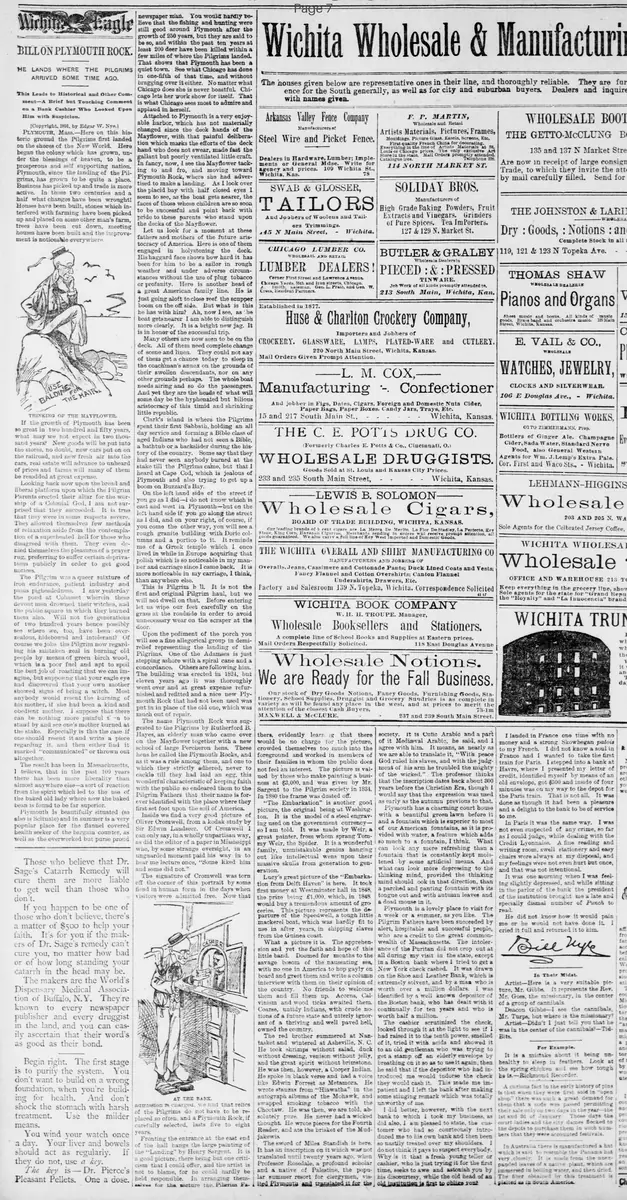
BILL ON PLYMOUTH ROCK.
HE LANDS WHERE THE PILGRIMS ARRIVED SOME TIME AGO.
This Leads to Historical and Other Comment—A Brief but Touching Comment on a Bank Cashier Who Looked upon Him with Suspicion.
[Copyright, 1891, by Edgar W. Nye.]
PLYMOUTH, Mass.—Here on this historic ground the Pilgrims first landed on the shores of the New World. Here began the colony which has grown, under the blessings of heaven, to be a prosperous and self supporting nation.
Plymouth, since the landing of the Pilgrims, has grown to be quite a place. Business has picked up and trade is more active.
In those two centuries and a half what changes have been wrought! Houses have been built, stones which interfered with farming have been picked up and placed on some other man's farm, trees have been cut down, meeting houses have been built and the improvement is noticeable everywhere.
THINKING OF THE MAYFLOWER.
If the growth of Plymouth has been so great in two hundred and fifty years, what may we not expect in two thousand years? New goods will be put into the stores, no doubt, new cars put on the railroad, and new fresh air into the cars, real estate will advance to unheard of prices and farms will many of them be resodded at great expense.
Looking back now upon the broad and liberal platform upon which the Pilgrim Parents erected their altar for the worship of a Colonial God, I am not surprised that they succeeded. It is true that they were in some respects severe. They allowed themselves few methods of relaxation aside from the contemplation of a superheated hell for those who disagreed with them. They even denied themselves the pleasures of a prayer rug, preferring to suffer certain deprivations publicly in order to get good notices.
The Pilgrim was a queer mixture of iron endurance, patient industry and pious pigheadedness. I saw yesterday the pond at Cohasset wherein these devout men drowned their witches, and the public square in which they burned them also. Will not the generations of two hundred years hence possibly see where we, too, have been overzealous, hidebound and intolerant? Of course we joke the Pilgrim now regarding his mistaken zeal in burning old people by means of green birch wood, which is a poor fuel and apt to spoil the best job of roasting that we can imagine, but supposing that your eagle eye had discovered that your own mother showed signs of being a witch. Most anybody would resent the burning of his mother, if she had been a kind and obedient mother. I suppose that there can be nothing more painful than to stand by and see one's mother burned at the stake. Especially is this the case if one should resent it and write a piece regarding it, and then either find it marked "communicated" or thrown out altogether.
The result has been in Massachusetts, I believe, that in the past 100 years there has been more liberality than almost anywhere else—a sort of reaction from the spirit which led to the use of the baked old lady where now the baked bean is found to be far superior.
Plymouth is beautifully situated (so also is Scituate) and in summer is a very popular place for the flannel covered health seeker of the bargain counter, as well as the overworked but purse proud newspaper man. You would hardly believe that the fishing and hunting were still good around Plymouth after the growth of 250 years, but they are said to be so, and within the past ten years at least 200 deer have been killed within a few miles of where the Pilgrims landed. That shows that Plymouth has been a quiet town. See what Chicago has done in one-fifth of that time, and without bragging over it either. No matter what Chicago does she is never boastful. Chicago lets her work show for itself. That is what Chicago sees most to admire and applaud in herself.
Attached to Plymouth is a very enjoyable harbor, which has not materially changed since the deck hands of the Mayflower, with that painful deliberation which marks the efforts of the deck hand who does not swear, made fast the gallant but poorly ventilated little craft.
In fancy, now, I see the Mayflower tacking to and fro, and moving toward Plymouth Rock, where she had advertised to make a landing. As I look over the placid bay with half closed eyes I seem to see, as the boat gets nearer, the faces of those whose children are so soon to be successful and point back with pride to these parents who stand upon the decks of the Mayflower.
Let us look for a moment at these fathers and mothers of the future aristocracy of America. Here is one of them engaged in holystoning the deck. His haggard face shows how hard it has been for him to be a sailor in rough weather and under adverse circumstances without the use of plug tobacco or profanity. Here is another head of a great American family line. He is just going aloft to close reef the scupper boom on the off side. But what is this he has with him? Ah, now I see, as the boat gets nearer I am able to distinguish more clearly. It is a bright new jug. It is in honor of the successful trip.
Many others are now seen to be on the deck. All of them need complete change of scene and linen. They could not any of them get a chance today to sleep in the coachman's annex on the grounds of their swollen descendants, nor on any other grounds perhaps. The whole boat needs airing and so do the passengers. And yet they are the heads of what will some day be the hyphenated but bilious aristocracy of this timid and shrinking little republic.
Clark's island is where the Pilgrims spent their first Sabbath, holding an all day service and forming a Bible class of aged Indians who had not seen a Bible, a bathtub or a backslider during the history of the country. Some say that they had never seen anybody burned at the stake till the Pilgrims came, but that I heard at Cape Cod, which is jealous of Plymouth and also trying to get up a boom on Buzzard's Bay.
On the left hand side of the street if you go as I did—I do not know which is east and west in Plymouth—but on the left hand side if you go along the street as I did, and on your right, of course, if you come the other way, you will see a rough granite building with Doric columns and a portico to it. It reminds me of a Greek temple which I once lived in while in Europe acquiring that polish which is so noticeable in my manner and carriage since I came back. It is more noticeable in my carriage, I think, than anywhere else.
This is Pilgrim hall. It is not the first and original Pilgrim hall, but we will not dwell on that. Before entering let us wipe our feet carefully on the grass at the roadside in order to avoid unnecessary wear on the scraper at the door.
Upon the pediment of the porch you will see a fine allegorical group in demi-relief representing the landing of the Pilgrims. One of the Adamses is just stepping ashore with a spiral cane and a concordance. Others are following him.
The building was erected in 1824, but eleven years ago it was thoroughly gone over and at great expense refurnished and refitted and a nice new Plymouth Rock that had not been used was put in in place of the old one, which was much out of repair.
The name Plymouth Rock was suggested to the Pilgrims by Rutherford B. Hayes, an elderly man who came over on the Mayflower together with a new school of large Percheron hens. These hens he called the Plymouth Rocks, and as it was a rule among them, and one to which they strictly adhered, never to cackle till they had laid an egg, this wonderful characteristic of keeping faith with the public so endeared them to the Pilgrim Fathers that their name is forever identified with the place where they first set foot upon the soil of America.
Inside we find a very good picture of Oliver Cromwell, from a kodak study by Sir Edwin Landseer. Of Cromwell I can only say, in a wholly unpartisan way, as did the editor of a paper in Mississippi who, by some strange oversight, in an unguarded moment paid his way in to hear me lecture once, "Some liked him and some did not."
The signature of Cromwell was torn off the corner of this portrait by some fiend in human form in the days when visitors were admitted free. Now that admission is charged, we find that relics of the Pilgrims do not have to be replaced so often, and a Plymouth Rock, if carefully selected, lasts five to eight years.
Fronting the entrance at the east end of the hall hangs the large painting of the "Landing" by Henry Sargent. It is a good picture, there being but one criticism that I could offer, and the artist is not to blame, for he could hardly be held responsible. In arranging themselves for the picture the Pilgrim Fathers, evidently learning that there would be no charge for the picture, crowded themselves too much into the foreground and worked in members of their families in whom the public does not feel an interest. The picture is valued by those who make painting a business at $3,000, and was given by Mr. Sargent to the Pilgrim society in 1834. In 1880 the frame was dusted off.
"The Embarkation" is another good picture, the original being at Washington. It is the model of a steel engraving used on the government currency—so I am told. It was made by Weir, a great painter, from whom sprang Tommy Weir, the Spider. It is a wonderful family, unmistakable genius hanging out like intellectual wens upon their massive skulls from generation to generation.
Lucy's great picture of the "Embarkation from Delft Haven" is here. It took first money at Westminster hall in 1848, the prize being £1,000, which, in 1848 would buy a tremendous amount of groceries.
This picture represents the departure of the Speedwell, a tough little mackerel boat, which was hardly fit to use in after years, in shipping slaves from the Guinea coast.
What a picture it is. The apprehension and yet the faith and hope of this little band, doomed for months to the savage bosom of the nauseating sea, with no one in America to hop gayly on board and greet them and write a column interview with them on their opinion of the country. No friends to welcome them and fill them up. Acorns, Calvinism and wood ticks awaited them.
Coarse, untidy Indians, with crude notions of a future state and utterly ignorant of a thriving and well paved hell owned the country.
The red brother summered at Nantasket and wintered at Asheville, N. C. He took shrimps without salad, duck without dressing, venison without jelly, and the great spirit without brimstone. He was then, however, a Cooper Indian. He spoke in blank verse and had a voice like Edwin Forrest as Metamora. He wrote stanzas from "Hiawatha" in the autograph albums of the Mohawk, and swapped smoking tobacco with the Choctaw. He was then, we are told, absolutely pure. He never had a wicked thought. He wrote pieces for the Fourth Reader, and ate the brisket of the Mudjakewis.
The sword of Miles Standish is here. It has an inscription on it which was not translated until twenty years ago, when Professor Rosedale, a profound scholar and a native of Palestine, the popular summer resort for clergymen, visited Plymouth and translated it for the society. It is Cufic Arabic and a part of it Medieval Arabic, he said, and I agree with him. It means, as nearly as we are able to translate it, "With peace God ruled his slaves, and with the judgment of his arm he troubled the mighty of the wicked." The professor thinks that the inscription dates back about 300 years before the Christian Era, though I would say that the expression was used as early as the autumn previous to that.
Plymouth has a charming court house with a beautiful green lawn before it and a fountain which is superior to most of our American fountains, as it is provided with water, a feature which adds so much to a fountain, I think. What can look any more refreshing than a fountain that is constantly kept moistened by some artificial means. And what can look more depressing to the thinking mind, provided the thinking mind should look in that direction, than a parched and panting fountain with its tongue out and with autumn leaves and a dead mouse in it.
Plymouth is a lovely place to visit for a week or a summer, as you like. The Pilgrim Fathers have been succeeded by alert, hospitable and successful people, who are a credit to the great commonwealth of Massachusetts. The intolerance of the Puritan did not crop out at all during my visit in the state, except in a Boston bank where I tried to get a New York check cashed. It was drawn on the Shoe and Leather Bank, which is extremely solvent, and by a man who is worth over a million dollars. I was identified by a well known depositor of the Boston bank, who has dealt with it continually for ten years and who is worth half a million.
The cashier scrutinized the check, looked through it at the light to see if I had raised it to the tenth power, smelled of it, tried it with acids and showed it to an old gentleman who was trying to get a stamp off an elderly envelope by breathing on it so as to use it again, then he said that if the depositor who had introduced me would indorse the check they would cash it. This made me impatient and I left the bank after making some stinging remark which was totally unworthy of me.
I did better, however, with the next bank to which I took my business, as did also, I am pleased to state, the customer who had so courteously introduced me to his own bank and then been so nastily treated over my shoulders. I do not think it pays to suspect everybody. Why is it that a fresh young teller or cashier, who is just trying it for the first time, seeks to awe and astonish you by his discourtesy, while the old head of an old institution is first to oblige?
I landed in France one time with no money and a strong Skowhegan patois to my French. I did not know a soul in France and I wanted to take the first train for Paris. I stepped into a bank at Havre, where I presented my letter of credit, identified myself by means of an old envelope, got $500 and inside of four minutes was on my way to the depot for the Paris train. That is not all. It was done as though it had been a pleasure and a delight to the bank to be of service to me.
In Paris it was the same way. I was not even suspected of any crime, so far as I could judge, while dealing with the Credit Lyonnaise. A fine reading and writing room, swell stationery and easy chairs were always at my disposal, and my feelings were not even hurt but once, and that was not intentional.
It was one morning when I was feeling slightly depressed, and while sitting in the parlor of the bank the president of the institution brought me a late and specially dismal number of Punch to read.
He did not know how it would pain me or he would not have done it. I cried it full and returned it to him.
HE LANDS WHERE THE PILGRIMS ARRIVED SOME TIME AGO.
This Leads to Historical and Other Comment—A Brief but Touching Comment on a Bank Cashier Who Looked upon Him with Suspicion.
[Copyright, 1891, by Edgar W. Nye.]
PLYMOUTH, Mass.—Here on this historic ground the Pilgrims first landed on the shores of the New World. Here began the colony which has grown, under the blessings of heaven, to be a prosperous and self supporting nation.
Plymouth, since the landing of the Pilgrims, has grown to be quite a place. Business has picked up and trade is more active.
In those two centuries and a half what changes have been wrought! Houses have been built, stones which interfered with farming have been picked up and placed on some other man's farm, trees have been cut down, meeting houses have been built and the improvement is noticeable everywhere.
THINKING OF THE MAYFLOWER.
If the growth of Plymouth has been so great in two hundred and fifty years, what may we not expect in two thousand years? New goods will be put into the stores, no doubt, new cars put on the railroad, and new fresh air into the cars, real estate will advance to unheard of prices and farms will many of them be resodded at great expense.
Looking back now upon the broad and liberal platform upon which the Pilgrim Parents erected their altar for the worship of a Colonial God, I am not surprised that they succeeded. It is true that they were in some respects severe. They allowed themselves few methods of relaxation aside from the contemplation of a superheated hell for those who disagreed with them. They even denied themselves the pleasures of a prayer rug, preferring to suffer certain deprivations publicly in order to get good notices.
The Pilgrim was a queer mixture of iron endurance, patient industry and pious pigheadedness. I saw yesterday the pond at Cohasset wherein these devout men drowned their witches, and the public square in which they burned them also. Will not the generations of two hundred years hence possibly see where we, too, have been overzealous, hidebound and intolerant? Of course we joke the Pilgrim now regarding his mistaken zeal in burning old people by means of green birch wood, which is a poor fuel and apt to spoil the best job of roasting that we can imagine, but supposing that your eagle eye had discovered that your own mother showed signs of being a witch. Most anybody would resent the burning of his mother, if she had been a kind and obedient mother. I suppose that there can be nothing more painful than to stand by and see one's mother burned at the stake. Especially is this the case if one should resent it and write a piece regarding it, and then either find it marked "communicated" or thrown out altogether.
The result has been in Massachusetts, I believe, that in the past 100 years there has been more liberality than almost anywhere else—a sort of reaction from the spirit which led to the use of the baked old lady where now the baked bean is found to be far superior.
Plymouth is beautifully situated (so also is Scituate) and in summer is a very popular place for the flannel covered health seeker of the bargain counter, as well as the overworked but purse proud newspaper man. You would hardly believe that the fishing and hunting were still good around Plymouth after the growth of 250 years, but they are said to be so, and within the past ten years at least 200 deer have been killed within a few miles of where the Pilgrims landed. That shows that Plymouth has been a quiet town. See what Chicago has done in one-fifth of that time, and without bragging over it either. No matter what Chicago does she is never boastful. Chicago lets her work show for itself. That is what Chicago sees most to admire and applaud in herself.
Attached to Plymouth is a very enjoyable harbor, which has not materially changed since the deck hands of the Mayflower, with that painful deliberation which marks the efforts of the deck hand who does not swear, made fast the gallant but poorly ventilated little craft.
In fancy, now, I see the Mayflower tacking to and fro, and moving toward Plymouth Rock, where she had advertised to make a landing. As I look over the placid bay with half closed eyes I seem to see, as the boat gets nearer, the faces of those whose children are so soon to be successful and point back with pride to these parents who stand upon the decks of the Mayflower.
Let us look for a moment at these fathers and mothers of the future aristocracy of America. Here is one of them engaged in holystoning the deck. His haggard face shows how hard it has been for him to be a sailor in rough weather and under adverse circumstances without the use of plug tobacco or profanity. Here is another head of a great American family line. He is just going aloft to close reef the scupper boom on the off side. But what is this he has with him? Ah, now I see, as the boat gets nearer I am able to distinguish more clearly. It is a bright new jug. It is in honor of the successful trip.
Many others are now seen to be on the deck. All of them need complete change of scene and linen. They could not any of them get a chance today to sleep in the coachman's annex on the grounds of their swollen descendants, nor on any other grounds perhaps. The whole boat needs airing and so do the passengers. And yet they are the heads of what will some day be the hyphenated but bilious aristocracy of this timid and shrinking little republic.
Clark's island is where the Pilgrims spent their first Sabbath, holding an all day service and forming a Bible class of aged Indians who had not seen a Bible, a bathtub or a backslider during the history of the country. Some say that they had never seen anybody burned at the stake till the Pilgrims came, but that I heard at Cape Cod, which is jealous of Plymouth and also trying to get up a boom on Buzzard's Bay.
On the left hand side of the street if you go as I did—I do not know which is east and west in Plymouth—but on the left hand side if you go along the street as I did, and on your right, of course, if you come the other way, you will see a rough granite building with Doric columns and a portico to it. It reminds me of a Greek temple which I once lived in while in Europe acquiring that polish which is so noticeable in my manner and carriage since I came back. It is more noticeable in my carriage, I think, than anywhere else.
This is Pilgrim hall. It is not the first and original Pilgrim hall, but we will not dwell on that. Before entering let us wipe our feet carefully on the grass at the roadside in order to avoid unnecessary wear on the scraper at the door.
Upon the pediment of the porch you will see a fine allegorical group in demi-relief representing the landing of the Pilgrims. One of the Adamses is just stepping ashore with a spiral cane and a concordance. Others are following him.
The building was erected in 1824, but eleven years ago it was thoroughly gone over and at great expense refurnished and refitted and a nice new Plymouth Rock that had not been used was put in in place of the old one, which was much out of repair.
The name Plymouth Rock was suggested to the Pilgrims by Rutherford B. Hayes, an elderly man who came over on the Mayflower together with a new school of large Percheron hens. These hens he called the Plymouth Rocks, and as it was a rule among them, and one to which they strictly adhered, never to cackle till they had laid an egg, this wonderful characteristic of keeping faith with the public so endeared them to the Pilgrim Fathers that their name is forever identified with the place where they first set foot upon the soil of America.
Inside we find a very good picture of Oliver Cromwell, from a kodak study by Sir Edwin Landseer. Of Cromwell I can only say, in a wholly unpartisan way, as did the editor of a paper in Mississippi who, by some strange oversight, in an unguarded moment paid his way in to hear me lecture once, "Some liked him and some did not."
The signature of Cromwell was torn off the corner of this portrait by some fiend in human form in the days when visitors were admitted free. Now that admission is charged, we find that relics of the Pilgrims do not have to be replaced so often, and a Plymouth Rock, if carefully selected, lasts five to eight years.
Fronting the entrance at the east end of the hall hangs the large painting of the "Landing" by Henry Sargent. It is a good picture, there being but one criticism that I could offer, and the artist is not to blame, for he could hardly be held responsible. In arranging themselves for the picture the Pilgrim Fathers, evidently learning that there would be no charge for the picture, crowded themselves too much into the foreground and worked in members of their families in whom the public does not feel an interest. The picture is valued by those who make painting a business at $3,000, and was given by Mr. Sargent to the Pilgrim society in 1834. In 1880 the frame was dusted off.
"The Embarkation" is another good picture, the original being at Washington. It is the model of a steel engraving used on the government currency—so I am told. It was made by Weir, a great painter, from whom sprang Tommy Weir, the Spider. It is a wonderful family, unmistakable genius hanging out like intellectual wens upon their massive skulls from generation to generation.
Lucy's great picture of the "Embarkation from Delft Haven" is here. It took first money at Westminster hall in 1848, the prize being £1,000, which, in 1848 would buy a tremendous amount of groceries.
This picture represents the departure of the Speedwell, a tough little mackerel boat, which was hardly fit to use in after years, in shipping slaves from the Guinea coast.
What a picture it is. The apprehension and yet the faith and hope of this little band, doomed for months to the savage bosom of the nauseating sea, with no one in America to hop gayly on board and greet them and write a column interview with them on their opinion of the country. No friends to welcome them and fill them up. Acorns, Calvinism and wood ticks awaited them.
Coarse, untidy Indians, with crude notions of a future state and utterly ignorant of a thriving and well paved hell owned the country.
The red brother summered at Nantasket and wintered at Asheville, N. C. He took shrimps without salad, duck without dressing, venison without jelly, and the great spirit without brimstone. He was then, however, a Cooper Indian. He spoke in blank verse and had a voice like Edwin Forrest as Metamora. He wrote stanzas from "Hiawatha" in the autograph albums of the Mohawk, and swapped smoking tobacco with the Choctaw. He was then, we are told, absolutely pure. He never had a wicked thought. He wrote pieces for the Fourth Reader, and ate the brisket of the Mudjakewis.
The sword of Miles Standish is here. It has an inscription on it which was not translated until twenty years ago, when Professor Rosedale, a profound scholar and a native of Palestine, the popular summer resort for clergymen, visited Plymouth and translated it for the society. It is Cufic Arabic and a part of it Medieval Arabic, he said, and I agree with him. It means, as nearly as we are able to translate it, "With peace God ruled his slaves, and with the judgment of his arm he troubled the mighty of the wicked." The professor thinks that the inscription dates back about 300 years before the Christian Era, though I would say that the expression was used as early as the autumn previous to that.
Plymouth has a charming court house with a beautiful green lawn before it and a fountain which is superior to most of our American fountains, as it is provided with water, a feature which adds so much to a fountain, I think. What can look any more refreshing than a fountain that is constantly kept moistened by some artificial means. And what can look more depressing to the thinking mind, provided the thinking mind should look in that direction, than a parched and panting fountain with its tongue out and with autumn leaves and a dead mouse in it.
Plymouth is a lovely place to visit for a week or a summer, as you like. The Pilgrim Fathers have been succeeded by alert, hospitable and successful people, who are a credit to the great commonwealth of Massachusetts. The intolerance of the Puritan did not crop out at all during my visit in the state, except in a Boston bank where I tried to get a New York check cashed. It was drawn on the Shoe and Leather Bank, which is extremely solvent, and by a man who is worth over a million dollars. I was identified by a well known depositor of the Boston bank, who has dealt with it continually for ten years and who is worth half a million.
The cashier scrutinized the check, looked through it at the light to see if I had raised it to the tenth power, smelled of it, tried it with acids and showed it to an old gentleman who was trying to get a stamp off an elderly envelope by breathing on it so as to use it again, then he said that if the depositor who had introduced me would indorse the check they would cash it. This made me impatient and I left the bank after making some stinging remark which was totally unworthy of me.
I did better, however, with the next bank to which I took my business, as did also, I am pleased to state, the customer who had so courteously introduced me to his own bank and then been so nastily treated over my shoulders. I do not think it pays to suspect everybody. Why is it that a fresh young teller or cashier, who is just trying it for the first time, seeks to awe and astonish you by his discourtesy, while the old head of an old institution is first to oblige?
I landed in France one time with no money and a strong Skowhegan patois to my French. I did not know a soul in France and I wanted to take the first train for Paris. I stepped into a bank at Havre, where I presented my letter of credit, identified myself by means of an old envelope, got $500 and inside of four minutes was on my way to the depot for the Paris train. That is not all. It was done as though it had been a pleasure and a delight to the bank to be of service to me.
In Paris it was the same way. I was not even suspected of any crime, so far as I could judge, while dealing with the Credit Lyonnaise. A fine reading and writing room, swell stationery and easy chairs were always at my disposal, and my feelings were not even hurt but once, and that was not intentional.
It was one morning when I was feeling slightly depressed, and while sitting in the parlor of the bank the president of the institution brought me a late and specially dismal number of Punch to read.
He did not know how it would pain me or he would not have done it. I cried it full and returned it to him.
What sub-type of article is it?
Historical Event
Journey
Curiosity
What themes does it cover?
Social Manners
Fortune Reversal
Moral Virtue
What keywords are associated?
Plymouth Rock
Pilgrims
Mayflower
Historical Reflection
Puritan Intolerance
Banking Suspicion
What entities or persons were involved?
Pilgrims
Edgar W. Nye
Miles Standish
Oliver Cromwell
Where did it happen?
Plymouth, Mass.
Story Details
Key Persons
Pilgrims
Edgar W. Nye
Miles Standish
Oliver Cromwell
Location
Plymouth, Mass.
Event Date
1891
Story Details
Humorous visit to Plymouth reflecting on Pilgrim landing, growth of the colony, historical sites like Pilgrim Hall and Plymouth Rock, satirical descriptions of Mayflower passengers and Puritan intolerance, contrasted with modern liberality, ending with a frustrating experience cashing a check in Boston.