Thank you for visiting SNEWPapers!
Sign up free
Domestic News
February 18, 1874
Watertown Republican
Watertown, Jefferson County, Dodge County, Wisconsin
What is this article about?
J. G. Huntington shares practices for maintaining dairy cow milk production into autumn and winter using sweet corn and cabbages as feed, potentially increasing yield by 10% for profit in Massachusetts dairy farming.
Clipping
OCR Quality
98%
Excellent
Full Text
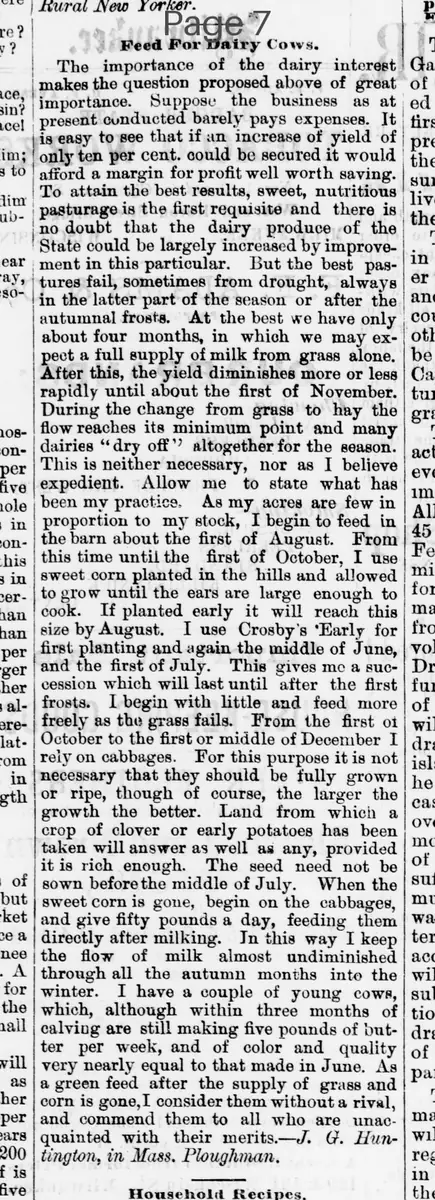
Feed For Dairy Cows.
The importance of the dairy interest makes the question proposed above of great importance. Suppose the business as at present conducted barely pays expenses. It is easy to see that if an increase of yield of only ten per cent. could be secured it would afford a margin for profit well worth saving.
To attain the best results, sweet, nutritious pasturage is the first requisite and there is no doubt that the dairy produce of the State could be largely increased by improvement in this particular. But the best pastures fail, sometimes from drought, always in the latter part of the season or after the autumnal frosts. At the best we have only about four months, in which we may expect a full supply of milk from grass alone. After this, the yield diminishes more or less rapidly until about the first of November. During the change from grass to hay the flow reaches its minimum point and many dairies "dry off" altogether for the season.
This is neither necessary, nor as I believe expedient. Allow me to state what has been my practice. As my acres are few in proportion to my stock, I begin to feed in the barn about the first of August. From this time until the first of October, I use sweet corn planted in the hills and allowed to grow until the ears are large enough to cook. If planted early it will reach this size by August. I use Crosby's Early for first planting and again the middle of June, and the first of July. This gives me a succession which will last until after the first frosts. I begin with little and feed more freely as the grass fails. From the first of October to the first or middle of December I rely on cabbages. For this purpose it is not necessary that they should be fully grown or ripe, though of course, the larger the growth the better. Land from which a crop of clover or early potatoes has been taken will answer as well as any, provided it is rich enough. The seed need not be sown before the middle of July. When the sweet corn is gone, begin on the cabbages, and give fifty pounds a day, feeding them directly after milking. In this way I keep the flow of milk almost undiminished through all the autumn months into the winter. I have a couple of young cows, which, although within three months of calving are still making five pounds of butter per week, and of color and quality very nearly equal to that made in June. As a green feed after the supply of grass and corn is gone, I consider them without a rival, and commend them to all who are unacquainted with their merits.—J. G. Huntington, in Mass. Ploughman.
The importance of the dairy interest makes the question proposed above of great importance. Suppose the business as at present conducted barely pays expenses. It is easy to see that if an increase of yield of only ten per cent. could be secured it would afford a margin for profit well worth saving.
To attain the best results, sweet, nutritious pasturage is the first requisite and there is no doubt that the dairy produce of the State could be largely increased by improvement in this particular. But the best pastures fail, sometimes from drought, always in the latter part of the season or after the autumnal frosts. At the best we have only about four months, in which we may expect a full supply of milk from grass alone. After this, the yield diminishes more or less rapidly until about the first of November. During the change from grass to hay the flow reaches its minimum point and many dairies "dry off" altogether for the season.
This is neither necessary, nor as I believe expedient. Allow me to state what has been my practice. As my acres are few in proportion to my stock, I begin to feed in the barn about the first of August. From this time until the first of October, I use sweet corn planted in the hills and allowed to grow until the ears are large enough to cook. If planted early it will reach this size by August. I use Crosby's Early for first planting and again the middle of June, and the first of July. This gives me a succession which will last until after the first frosts. I begin with little and feed more freely as the grass fails. From the first of October to the first or middle of December I rely on cabbages. For this purpose it is not necessary that they should be fully grown or ripe, though of course, the larger the growth the better. Land from which a crop of clover or early potatoes has been taken will answer as well as any, provided it is rich enough. The seed need not be sown before the middle of July. When the sweet corn is gone, begin on the cabbages, and give fifty pounds a day, feeding them directly after milking. In this way I keep the flow of milk almost undiminished through all the autumn months into the winter. I have a couple of young cows, which, although within three months of calving are still making five pounds of butter per week, and of color and quality very nearly equal to that made in June. As a green feed after the supply of grass and corn is gone, I consider them without a rival, and commend them to all who are unacquainted with their merits.—J. G. Huntington, in Mass. Ploughman.
What sub-type of article is it?
Agriculture
What keywords are associated?
Dairy Farming
Cow Feed
Sweet Corn
Cabbages
Milk Yield
Butter Production
What entities or persons were involved?
J. G. Huntington
Where did it happen?
Massachusetts
Domestic News Details
Primary Location
Massachusetts
Key Persons
J. G. Huntington
Event Details
Advice on feeding dairy cows with sweet corn from August to October and cabbages from October to December to maintain milk production through autumn and winter, using specific planting schedules and quantities to sustain yield and butter production.