Thank you for visiting SNEWPapers!
Sign up free
The Hillsborough Recorder
Hillsboro, Orange County, North Carolina
What is this article about?
On October 1, 1821, William Carroll was inaugurated as Governor of Tennessee. Extracts from his message to the General Assembly discuss opposition to property valuation laws and stays on executions as unconstitutional and harmful, warn against issuing paper money, advocate for industry and economy to relieve financial pressures, and suggest lenient policies for banks to resume specie payments.
Clipping
OCR Quality
Full Text
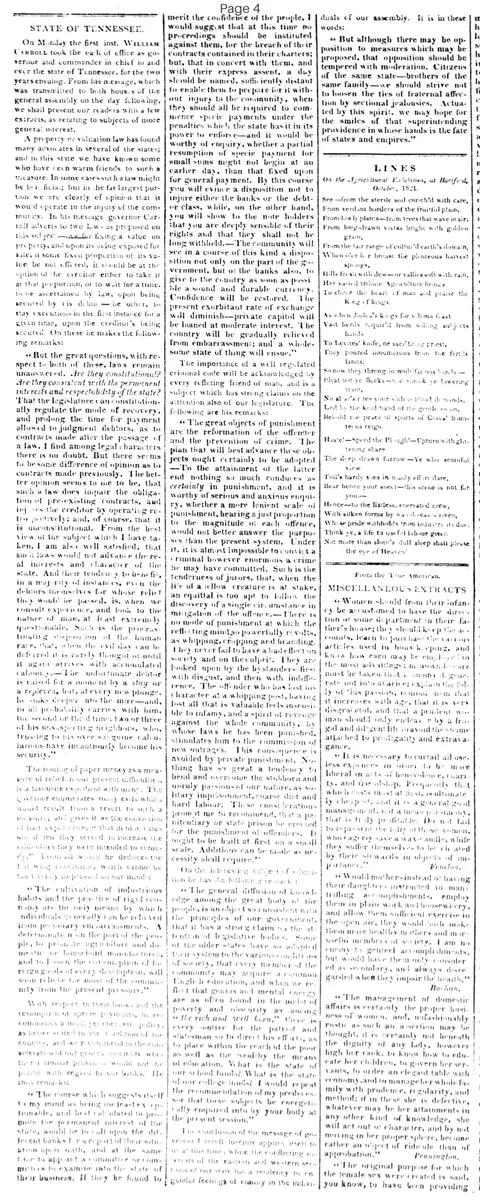
On Monday the first inst. William Carroll took the oath of office as governor and commander in chief in and over the state of Tennessee, for the two years ensuing. From his message, which was transmitted to both houses of the general assembly on the day following, we shall present our readers with a few extracts, as relating to subjects of more general interest.
A property or valuation law has found many advocates in several of the states; and in this state we have known some who have been warm friends to such a measure. In some cases such a law might be beneficial; but in the far largest portion we are clearly of opinion that it would operate to the injury of the community. In his message governor Carroll adverts to two laws as proposed on this subject—one fixing a value on property, and upon its being exposed for sale, if some fixed proportion of its value be not offered, it should be at the option of the creditor either to take it at that proportion, or to wait for a time to be ascertained by law, upon being secured by the debtor—the other, to stay executions in the first instance for a given time, upon the creditor's being secured. On these he makes the following remarks:
"But the great questions, with respect to both of these, laws remain unanswered. Are they constitutional? Are they consistent with the permanent interests and respectability of the state? That the legislature can constitutionally regulate the mode of recovery, and prolong the time for payment allowed to judgment debtors, as to contracts made after the passage of a law, I find among legal characters there is no doubt. But there seems to be some difference of opinion as to contracts made previously. The better opinion seems to me to be, that such a law does impair the obligation of pre-existing contracts, and injures the creditor by operating retroactively; and, of course, that it is unconstitutional. From the best view of the subject which I have taken, I am also well satisfied, that such law, would not advance the real interests and character of the state. And their tendency to bring in a majority of instances, even the debtors themselves for whose relief they would be passed, is, when we consult experience, and look to the nature of man, at least exceedingly questionable. Such is the procrastinating disposition of the human race, that, when the evil day can be deferred it is rarely thought of until it again arises with accumulated calamity—the unfortunate debtor is raised for a moment by a stay or a replevy, but at every new plunge he sinks deeper into the mire—and, in all probability carries with him the second or third time, two or three of his unsuspecting neighbors, who, trusting to his over sanguine calculations have incautiously become his security."
The issuing of paper money as a measure of relief from our present difficulties is a favourite expedient with many. The governor enumerates many evils which would result from a resort to such a measure; and gives it as the conviction of past experience, "that in nine cases out of ten they served to increase the calamities they were intended to remedy." From all which he deduces the following conclusion, which cannot be too deeply impressed on our minds:
"The cultivation of industrious habits and the practice of rigid economy are the only means by which individuals generally can be relieved from pecuniary embarrassments. A determination, on the part of the people, to promote private agriculture and domestic or household manufactures and to lessen the consumption of foreign goods of every description, will soon relieve the mass of the community from the present pressure."
With respect to the bank, and the resumption of specie payments, he recommends a more lenient policy, as better suited to the condition of the country, and we recommend to the consideration of our general assembly whether a similar provision would not be politic with regard to our banks. In this he remarks:
"The course which suggests itself to my mind as being the least exceptionable, and best calculated to promote the permanent interest of the state, would be to call upon the different banks for a report of their situation upon oath, and at the same time to appoint a committee or committees to examine into the state of their business. If they be found to
What sub-type of article is it?
What keywords are associated?
What entities or persons were involved?
Where did it happen?
Domestic News Details
Primary Location
State Of Tennessee
Event Date
Monday The First Inst.
Key Persons
Event Details
William Carroll took the oath of office as governor of Tennessee for two years. His message to the general assembly opposed property valuation laws and stays on executions as unconstitutional and harmful, warned against paper money issuance, promoted industrious habits and economy for relief, and recommended lenient policies for banks to resume specie payments including reports and examinations.