Thank you for visiting SNEWPapers!
Sign up free
The Virginia Gazette
Williamsburg, Virginia
What is this article about?
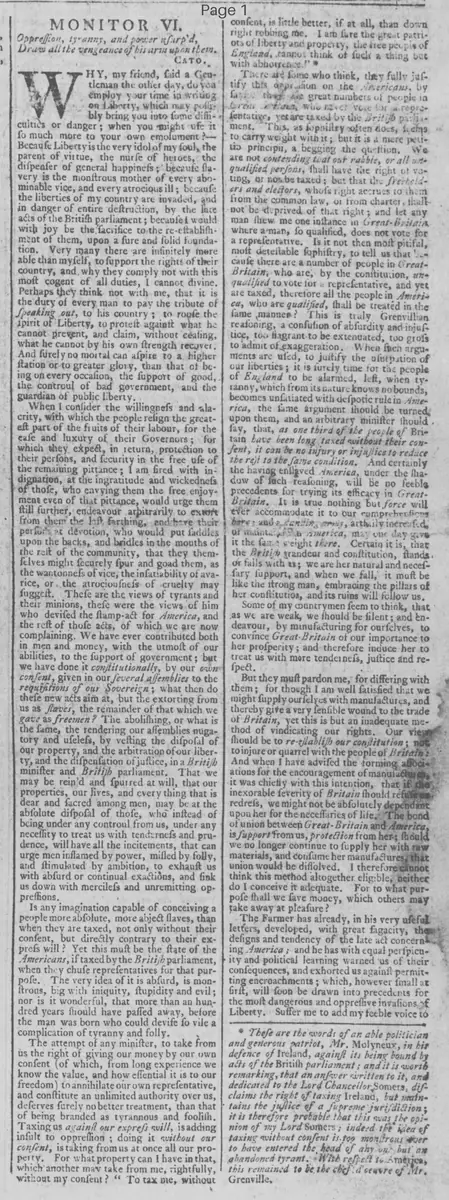
This editorial, titled 'MONITOR VI,' passionately argues against British parliamentary acts like the Stamp Act, defending colonial liberties and opposing taxation without representation as tyrannical, urging Americans to protest and resist to preserve their freedom and constitution.
Merged-components note: This is a continuation of the same editorial piece across pages, with seamless text flow and sequential reading order.
Clippings
1 of 2
OCR Quality
Full Text
Oppression, tyranny, and power usurp'd,
Draw all the vengeance of his arm upon them.
CATO.
WHY, my friend, said a Gentleman the other day, do you employ your time in writing on Liberty, which may possibly bring you into some difficulty or danger; when you might use it so much more to your own emolument?
Because Liberty is the very idol of my soul, the parent of virtue, the nurse of heroes, the dispenser of general happiness: because slavery is the monstrous mother of every abominable vice, and every atrocious ill; because the liberties of my country are invaded, and in danger of entire destruction, by the late acts of the British parliament: because I would with joy be the sacrifice to the re-establishment of them, upon a sure and solid foundation. Very many there are infinitely more able than myself, to support the rights of their country, and, why they comply not with this most cogent of all duties, I cannot divine. Perhaps they think not with me, that it is the duty of every man to pay the tribute of speaking out, to his country; to rouse the spirit of Liberty, to protest against what he cannot prevent, and claim, without ceasing, what he cannot by his own strength recover. And surely no mortal can aspire to a higher station or to greater glory, than that of being on every occasion, the support of good, the controul of bad government, and the guardian of public liberty.
When I consider the willingness and alacrity, with which the people resign the greatest part of the fruits of their labour, for the ease and luxury of their Governors; for which they expect, in return, protection to their persons, and security in the free use of the remaining pittance; I am fired with indignation, at the ingratitude and wickedness of those, who envying them the free enjoyment even of that pittance, would urge them still further, endeavour arbitrarily to extort from them the last farthing. and have their persons at devotion, who would put saddles upon the backs, and bridles in the mouths of the rest of the community, that they themselves might securely spur and goad them, as the wantonness of vice, the insatiability of avarice, or the atrociousness of cruelty may suggest. These are the views of tyrants and their minions, these were the views of him who devised the stamp-act for America, and the rest of those acts, of which we are now complaining. We have ever contributed both in men and money, with the utmost of our abilities, to the support of government; but we have done it constitutionally, by our own consent, given in our several assemblies to the requisitions of our Sovereign; what then do these new acts aim at, but the extorting from us as slaves, the remainder of that which we gave as freemen? The abolishing, or what is the same, the rendering our assemblies nugatory and useless, by vesting the disposal of our property, and the arbitration of our liberty, and the dispensation of justice, in a British minister and British parliament. That we may be rein'd and spurr'd at will, that our properties, our lives, and every thing that is dear and sacred among men, may be at the absolute disposal of those, who instead of being under any controul from us, under any necessity to treat us with tenderness and prudence, will have all the incitements, that can urge men inflamed by power, misled by folly, and stimulated by ambition, to exhaust us with absurd or continual exactions, and sink us down with merciles and unremitting oppressions.
Is any imagination capable of conceiving a people more absolute, more abject slaves, than when they are taxed, not only without their consent, but directly contrary to their express will? Yet this must be the state of the Americans, if taxed by the British parliament, when they chuse representatives for that purpose. The very idea of it is absurd, is monstrous, big with iniquity, stupidity and evil: nor is it wonderful, that more than an hundred years should have passed away, before the man was born who could devise so vile a complication of tyranny and folly.
The attempt of any minister, to take from us the right of giving our money by our own consent (of which, from long experience we know the value, and how essential it is to our freedom) to annihilate our own representative, and constitute an unlimited authority over us, deserves surely no better treatment, than that of being branded as tyrannous and foolish. Taxing us against our express will, is adding insult to oppression; doing it without our consent, is taking from us at once all our property. For what property can I have in that, which another may take from me, rightfully, without my consent? "To tax me, without consent, is little better, if at all, than downright robbing me. I am sure the great patriots of liberty and property, the free people of England, cannot think of such a thing but with abhorrence."
There are some who think, they fully justify this imposition on the Americans. by arguing that as there are great numbers of people in Great Britain who cannot vote to a representative, yet are taxed by the British parliament. This, as sophistry often does, seems to carry weight with it: but it is a mere petitio principii, a begging the question. We are not contending that our rabble, or all unqualified persons, shall have the right of voting or not be taxed: but that the freeholders and electors, whose right accrues to them from the common law, or from charter, shall not be deprived of that right; and let any man shew me one instance in Great-Britain where a man, so qualified, does not vote for a representative. Is it not then most pitiful, most detestable sophistry, to tell us that, because there are a number of people in Great-Britain, who are, by the constitution, unqualified to vote for a representative, and yet are taxed, therefore all the people in America, who are qualified, shall be treated in the same manner? This is truly Grenvillian reasoning, a confusion of absurdity and injustice, too flagrant to be extenuated, too gross to admit of exaggeration. When such arguments are used, to justify the usurpation of our liberties; it is surely time for the people of England to be alarmed, lest, when tyranny, which from its nature knows no bounds, becomes unsatiated with despotic rule in America, the same argument should be turned upon them, and an arbitrary minister should say, that, as one third of the people of Britain have been long taxed without their consent, it can be no injury or injustice to reduce the rest to the same condition. And certainly the having enslaved America, under the shadow of such reasoning, will be no feeble precedents for trying its efficacy in Great-Britain. It is true nothing but force will ever accommodate it to our comprehensions here; and a standing army, arbitrarily increased or maintained in America, may one day give it the due weight there. Certain it is, that the British grandeur and constitution, stands or falls with us: we are her natural and necessary support, and when we fall, it must be like the strong man, embracing the pillars of her constitution, and its ruins will follow us.
Some of my countrymen seem to think, that as we are weak, we should be silent: and endeavour, by manufacturing for ourselves, to convince Great-Britain of our importance to her prosperity; and therefore induce her to treat us with more tenderness, justice and respect.
But they must pardon me, for differing with them; for though I am well satisfied that we might supply ourselves with manufactures, and thereby give a very sensible wound to the trade of Britain, yet this is but an inadequate method of vindicating our rights. Our view should be to re-establish our constitution; not to injure or quarrel with the people of Britain: And when I have advised the forming associations for the encouragement of manufactures, it was chiefly with this intention, that if the inexorable severity of Britain should refuse us redress, we might not be absolutely dependant upon her for the necessaries of life. The bond of union between Great-Britain and America, is support from us, protection from her: should we no longer continue to supply her with raw materials, and consume her manufactures, that union would be dissolved. I therefore cannot think this method altogether eligible, neither do I conceive it adequate. For to what purpose shall we save money, which others may take away at pleasure?
The Farmer has already, in his very useful letters, developed, with great sagacity, the designs and tendency of the late act concerning America; and he has with equal perspicuity and political learning warned us of their consequences, and exhorted us against permitting encroachments; which, however small at first, will soon be drawn into precedents for the most dangerous and oppressive invasions of Liberty. Suffer me to add my feeble voice to his.
* These are the words of an able politician and generous patriot, Mr. Molyneux, in his defence of Ireland, against its being bound by acts of the British parliament; and it is worth remarking, that an answer written to it, and dedicated to the Lord Chancellor Somers, disclaims the right of taxing Ireland, but maintains the justice of a supreme jurisdiction; it is therefore probable that this was the opinion of my Lord Somers; indeed the idea of taxing without consent is too monstrous ever to have entered the head of any man but an abandoned tyrant. -With respect to America, this remained to be the chef-d'oeuvre of Mr. Grenville, his, and exhort you to suppress the disease in its infancy: lest it arrive to a degree of violence, dangerous in its effects, and uncertain in its remedy.
It is easy to show, that the right assumed by any one of the three acts of Parliament, already specified, if given up, would be sufficient to enslave us. As the influence of money and places generally procures to the minister, a majority in Parliament in the conduct, even of British affairs, it will certainly besecure in those of America. This right may therefore be considered, as in the crown and its minister.
Let us suppose then, that the minister possessed the right alone of forming a revenue by duties, upon goods imported from Great-Britain: what would be the consequence? Either that we must cease to take any goods whatever from Britain, and therefore dissolve the union between us; or the minister would have it in his power, to raise money upon us at pleasure. Our Assemblies would then be of no use, we should have no restraint upon the crown, no method of ingratiating ourselves with our Sovereign by granting him aids; the crown would have obtained a perpetual revenue from us, which the Commons of Britain know would be so injurious to their liberties, that they have ever guarded against it with unremitting vigilance. Under the influence of such a right, we should experience the fate of the Roman people, in the deplorable times of their slavery, and be fleeced by every exaction which the ingenuity of tax gatherers could devise; and we should, like that miserable people, pay tributes, not by law and reason, but at the will of the minister. We should be slaves.
But if we possessed, as we ought, the right of granting money for a revenue, by our own Assemblies only: and the minister had either that of supporting and quartering troops upon us at will, or of suspending our legislature at his pleasure, we should, in the same manner, be reduced to slavery: for unless our elections are free, they are useless: and how easy it would be for a minister to force and form them to his own purposes, with troops at his devotion, is self evident. The Parliament of Britain, has therefore taken care to enact that no troops shall ever be near the places of their election. In a similar manner would the suspending power operate to force the voice of the representative body, tho' freely chosen, so that the crown and its minister would, by this single right, be arbitrary in America. It is such a power as this, that renders the Parliament of France useless to the people, and enables their Monarch to rule without control. In short, freedom in electing our members, who shall with a free voice give our consent to the taxes laid upon us, is an indispensable requisite to the preservation of our liberty; it is the essence of our constitution, and every attempt to violate it, is dangerous and alarming.
We therefore, my countrymen, must never cease to remonstrate against every such attempt: and to claim our rights without fear or intermission: we must imitate the illustrious example of the British Barons in their Nolumus leges Angliae mutari.
We will not have the constitution changed.
* Tacitus, after giving a long list of taxes, under which they groan'd, adds et quae alia, exactionibus illicitis nomina publicani invenerunt.
+ Sub imperatoribus vectigalia, non lege ac ratione, sed arbitratu imperatorum procedebant. Burling de trib: et vectig: P. R.
What sub-type of article is it?
What keywords are associated?
What entities or persons were involved?
Editorial Details
Primary Topic
Opposition To British Taxation Without Representation And Defense Of Colonial Liberties
Stance / Tone
Strongly Pro Liberty And Anti Tyrannical, Urging Resistance To Parliamentary Acts
Key Figures
Key Arguments
- liberty is essential to virtue and happiness, while slavery breeds vice.
- british acts like the stamp act invade colonial liberties by taxing without consent.
- colonial assemblies should control taxation, not parliament.
- taxation without representation reduces colonists to slaves.
- sophistry comparing non-voters in britain to qualified american electors is invalid.
- enslaving america threatens british constitution and grandeur.
- manufacturing independence is inadequate; constitutional rights must be re-established.
- any single parliamentary right assumed (taxation, quartering troops, suspending legislature) enslaves america.
- free elections and consent to taxes are essence of liberty.
- remonstrate ceaselessly against encroachments, imitating british barons.