Thank you for visiting SNEWPapers!
Sign up free
Gazette Of The United States
Philadelphia, Philadelphia County, Pennsylvania
What is this article about?
Congressman James Holland writes from Philadelphia on May 7, 1796, reporting on House resolutions asserting rights to deliberate on treaty implementation, debates over the British treaty, passage of bills on Indian/Algone/Spanish/British treaties, land sales northwest of Ohio at $2/acre, military reduction, Tennessee admission, post routes, and personal reflections on service and elections.
Clipping
OCR Quality
Full Text
DEAR SIR,
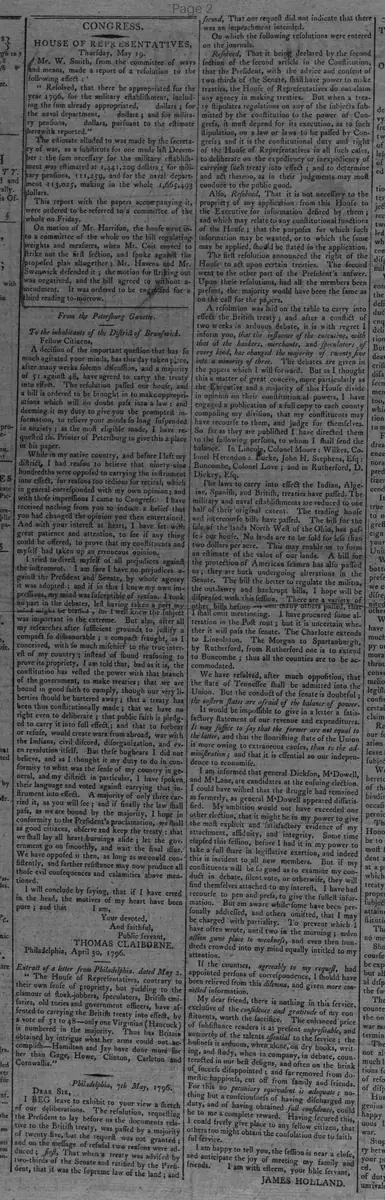
I BEG leave to exhibit to your view a sketch of our deliberations. The resolution, requesting the President to lay before us the documents relative to the British treaty, was passed by a majority of twenty-five, but the request was not granted; and on the message of refusal two reasons were adduced; first, That when a treaty was advised by two-thirds of the Senate and ratified by the President, that it was the supreme law of the land; and second, That our request did not indicate that there was an impeachment intended.
On which the following resolutions were entered on the journals.
Resolved, That it being declared by the second section of the second article in the Constitution, that the President, with the advice and consent of two-thirds of the Senate, shall have power to make treaties, the House of Representatives do not claim any agency in making treaties. But when a treaty stipulates regulations on any of the subjects submitted by the constitution to the power of Congress, it must depend for its execution, as to such stipulation, on a law or laws to be passed by Congress; and it is the constitutional duty and right of the House of Representatives in all such cases, to deliberate on the expediency or inexpediency of carrying such treaty into effect; and to determine and act thereon, as in their judgments may most conduce to the public good.
Also, Resolved, That it is not necessary to the propriety of any application from this House to the Executive for information desired by them; and which may relate to any constitutional functions of the House; that the purpose for which such information may be wanted, or to which the same may be applied, should be stated in the application.
The first resolution announced the right of the House to act upon certain treaties. The second went to the other part of the President's answer. Upon these resolutions, had all the members been present, the majority would have been the same as on the call for the papers.
A resolution was laid on the table to carry into effect the British treaty: and after a conflict of two weeks in arduous debate, it is with regret I inform you, that the influence of the executive, with that of the bankers, merchants, and speculators of every kind, has changed the majority of twenty five into a minority of three. The debates are given in the papers which I will forward. But as I thought this a matter of great concern, more particularly as the Executive and a majority of this House divide in opinion on their constitutional powers, I have engaged a publication of a full copy to each county composing my division, that my constituents may have recourse to them, and judge for themselves. So far as they are published I have directed them to the following persons, to whom I shall send the balance. In Lincoln, Colonel Moore: Wilkes, Colonel Herendon: Burke, John H. Stephens, Esq: Buncombe, Colonel Love; and in Rutherford, D. Dickey, Esq.
The laws to carry into effect the Indian, Algone, Spanish, and British, treaties have passed. The military and naval establishments are reduced to one half of their original extent. The trading house and intercourse bills have passed. The bill for the sale of the lands North West of the Ohio, has passed our house. No lands are to be sold for less than two dollars per acre. This may enable us to form an estimate of the value of our lands. A bill for the protection of American seamen has also passed us; they are both undergoing alterations in the Senate. The bill the better to regulate the militia, the out-lawry and bankrupt bills, I hope will be dispensed with this session. There are a variety of other bills before way aig many others passed, that I shall omit mentioning. I have procured some alteration in the Post rout; but it is uncertain whether it will pass the senate. The Charlotte extends to Lincolnton. The Morgan to Spartanburgh, by Rutherford, from Rutherford one is to extend to Buncombe; thus all the counties are to be accommodated.
We have resolved, after much opposition, that the state of Tennessee shall be admitted into the Union. But the conduct of the senate is doubtful; the eastern states are afraid of the balance of power.
It would be impossible to give in a letter a satisfactory statement of our revenue and expenditures. It may suffice to say that the former are not equal to the latter, and that the flourishing state of the Union is more owing to extraneous causes, than to the administration; and that it is essential to our independence to economise.
I am informed that general Dickson, M'Dowell, and M Lane, are candidates at the ensuing election. I could have wished that the struggle had remained as formerly, as general M Dowell appeared dissatisfied. My ambition would not have exceeded one other election, that it might be in my power to give the most explicit and satisfactory evidence of my attachment, assiduity, and integrity. Some time elapsed this session, before I had it in my power to take a full share in legislative exertion, and indeed this is incident to all new members. But if my constituents will be so good as to examine my conduct in debate, silent vote, or otherwise, they will find themselves attached to my interest. I have had recourse to pen and press, to give the fullest information. But am aware while some have been personally addressed, and others omitted, that I may be charged with partiality. To prevent which I have often wrote, until two in the morning; when action gave place to weakness, and even then hundreds crowded into my mind equally entitled to my attention.
If the counties, agreeably to my request, had appointed persons of correspondence, I should have been relieved from this dilemma, and given more connected information.
My dear friend, there is nothing in this service, exclusive of the confidence and gratitude of my constituents, worth the sacrifice. The enhanced price of subsistence renders it at present unprofitable, and unworthy of the talents essential to the service; the business is arduous, when alone, on dry books, writing, and study, when in company, in debate, counteracted in our best designs, and often on the brink of success disappointed; and far removed from domestic happiness, cut off from family and friends. For this no pecuniary equivalent is adequate; nothing but a consciousness of having discharged my duty, and of having obtained full confidence, could be to me a complete reward. Having secured this, I could freely give place to any fellow citizen, that others too might obtain the consolation due to faithful service.
I am happy to tell you, the session is near a close, and anticipate the joy of meeting my family and friends.
I am with esteem, your hble servant,
JAMES HOLLAND.
What sub-type of article is it?
What themes does it cover?
What keywords are associated?
What entities or persons were involved?
Letter to Editor Details
Author
James Holland
Recipient
Dear Sir
Main Argument
reports on congressional deliberations, including resolutions asserting the house's right to deliberate on treaty implementation despite presidential refusal, the shift in vote on the british treaty due to influences, passage of various bills, and personal commitment to constituents amid service challenges.
Notable Details