Thank you for visiting SNEWPapers!
Sign up free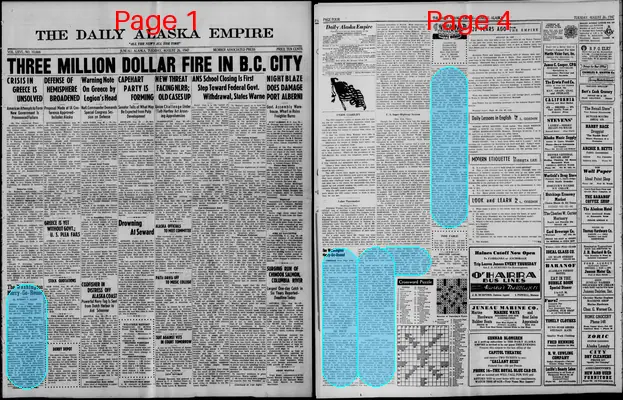
The Daily Alaska Empire
Juneau, Juneau County, Alaska
What is this article about?
Robert S. Allen critiques Field Marshal Montgomery's 'Despatch' on WWII ETO operations, accusing it of factual errors, omissions of US and French contributions, and self-aggrandizement, contrasting it with restrained reports by Eisenhower and Marshall. British distribution in US seen as provocative blunder.
Merged-components note: Continuation of the Washington Merry-Go-Round editorial column across pages; relabeled the continuation from 'story' to 'editorial' as it matches the column's opinionated style.
Clippings
1 of 2
OCR Quality
Full Text
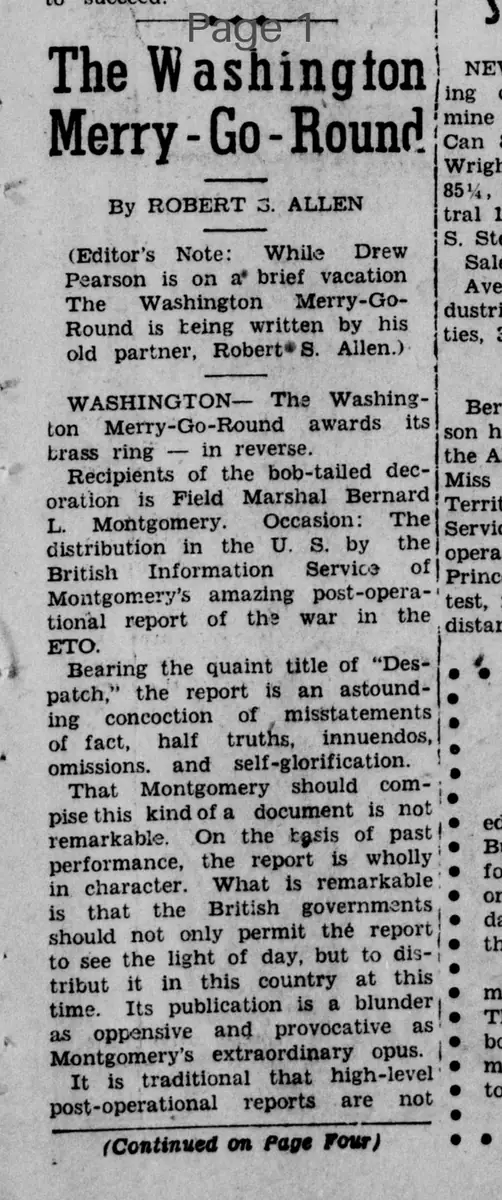
By ROBERT S. ALLEN
(Editor's Note: While Drew Pearson is on a brief vacation The Washington Merry-Go-Round is being written by his old partner, Robert S. Allen.)
WASHINGTON- The Washington Merry-Go-Round awards its brass ring -- in reverse.
Recipients of the bob-tailed decoration is Field Marshal Bernard L. Montgomery.
Occasion: The distribution in the U. S. by the British Information Service of Montgomery's amazing post-operational report of the war in the ETO.
Bearing the quaint title of "Despatch," the report is an astounding concoction of misstatements of fact, half truths, innuendos, omissions, and self-glorification.
That Montgomery should compile this kind of a document is not remarkable. On the basis of past performance, the report is wholly in character. What is remarkable is that the British government should not only permit the report to see the light of day, but to distribute it in this country at this time. Its publication is a blunder as offensive and provocative as Montgomery's extraordinary opus.
It is traditional that high-level post-operational reports are not published until many years after the war.
(Continued on Page Four)
The Washington Merry-Go-Round
Continued from Page One
These reports are noted for complete candor.
Frequently they are more illuminating in what they omit and gloss over than in what they actually relate.
The reports of General Marshall and Eisenhower, published last year, displayed marked symptoms of this occupational disease. Hanson Baldwin, veteran military analyst of the New York Times, sharply criticized the Eisenhower report on this score.
Baldwin particularly ridiculed Eisenhower's bland claim that everything in the ETO had gone 'according to plan.'
But, while tainted with considerable mumbo-jumbo lily-gilding, the Marshall and Eisenhower reports were dignified and restrained.
They were meticulously accurate on the details that were covered.
All participants were studiously given full recognition, and the perpendicular pronoun was used sparingly and modestly.
As far as the reports went, they were gentlemanly and soldierly.
MR. FIX-IT
Montgomery's report is inaccurate, vainglorious, petty and mischievous.
On the very first page is an extraordinary misstatement of fact.
Montgomery declares "Headquarters Twelfth U. S. Army Group were formed in London . . . " that is not so.
Headquarters Twelfth U. S. Army Group did not come into existence until just before the jump-off of the Third U. S. Army's epic break-out of the Cotentin through the Avranches corridor.
The U. S. Army group headquarters set up in London was the First (FUSAG).
Months later, when this headquarters became operational under General Omar Bradley, it was secretly redesignated the Twelfth for deception purposes.
On the next page, makes an even more extraordinary pronouncement.
He lays claim to sole and complete authorship of the assault plan of Operation Overlord. "My plan." he says flatly and unequivocally.
The basic outline of this plan was agreed upon before Montgomery reached London in January, 1944. And a number of senior commanders participated in working out details of the plan.
A large part of the first chapter of Eisenhower's report consists of a detailed account of the evolution of this plan.
Eisenhower makes it crystal-clear that the report was the result of many lengthy conferences, in which Montgomery was only one of a number of participants, and that changes were frequent and far-reaching. Eisenhower repeatedly uses the expression "our decisions," as it was only decent and honorable for him to do under the circumstances.
In striking contrast, Montgomery not only lays categoric claim to full authorship of the plan, but in keeping with his self-proclaimed proprietorship, makes only three fleeting references to Eisenhower in the first forty-four pages (one-half of the "Despatch."
And only one of them is by name. In the other two instances. Eisenhower is referred to merely as the "supreme commander."
PASSING THE BUCK
There is another very significant, and characteristic, aspect to the references to Eisenhower in Montgomery's report.
The first time the "supreme commander" is singled out for marked attention is on page forty-five in an italicized preceding summary the operations beginning with September 1, 1944.
This was the beginning of the tragic period of the war in the ETO.
The period that started with the order, at Montgomery's vehement insistence, halting Patton on the Moselle. when his Third Army had in front of it only a German army disorganized and an unmanned Siegfried Line barring the way to the Rhine the period that culminated finally in the Ardennes disaster.
It is of more than passing note, therefore. that Montgomery should single out the "supreme commander for special mention in this particular portion of the "Despatch," especially in view of the manner in which the reference is made. Says Montgomery. "In September the supreme commander assumed command and direction of the army groups himself . . ."
this will be very interesting news to Eisenhower. According to his report, he was in personal command of all army groups from the jump-off of the invasion.
AMAZING OMISSIONS
There is much more of this sort of thing in the "Despatch." But the most amazing feature of the report is its omissions and half truths. The report is filled with them from start to finish.
The following are a few of the more outstanding:
Not one mention of the heroic role played by the Maquis in the liberation of France and not a single word about the 11 French divisions that fought so gallantly on the Southern flank of the Western front.
The ridiculous statement that "The battle of Normandy was fought exactly as planned before the invasion." The real facts are that Montgomery suffered a crushing defeat at Caen, losing the bulk of his armor when he attempted to drive head-on through the densely hedge-rowed "bocage" that was heavily fortified with massed German artillery.
The amazing omission of any mention of the immortal Battle of Bastogne, where Third Army paratroopers and tankers broke the back of Hitler's counter-offensive.
The omission of any word about the destruction of an entire German army group by Third and Seventh U. S. Armies in eight days in the Palatinate: a victory that broke the back of German resistance on the Rhine and shortened the war by many months.
There was plenty of glory in the war in the ETO to cover all participants with acclaim and decorations from head to foot. Why Field Marshal Montgomery considered it necessary to be niggardly in his official report is something only he can explain. But that kind of "tidying up" does not foster good will and understanding.
(COPYRIGHT, 1947, BELL SYNDICATE. INC)
What sub-type of article is it?
What keywords are associated?
What entities or persons were involved?
Editorial Details
Primary Topic
Critique Of Montgomery's Eto War Report
Stance / Tone
Strongly Critical Of Montgomery's Inaccuracies And Self Glorification
Key Figures
Key Arguments