Thank you for visiting SNEWPapers!
Sign up free
The Enquirer
Richmond, Henrico County, Virginia
What is this article about?
Dramatic account of schooner Little Party's foundering in a Gulf gale, crew's harrowing survival in an open boat with deaths from drowning and exhaustion, and rescue by brig Polly, highlighting human endurance and divine providence. (Charleston to St. Mary's, July-Sept.).
Merged-components note: Direct continuation of the 'Melancholy Case of Shipwreck' narrative across three components on page 4.
Clipping
OCR Quality
Full Text
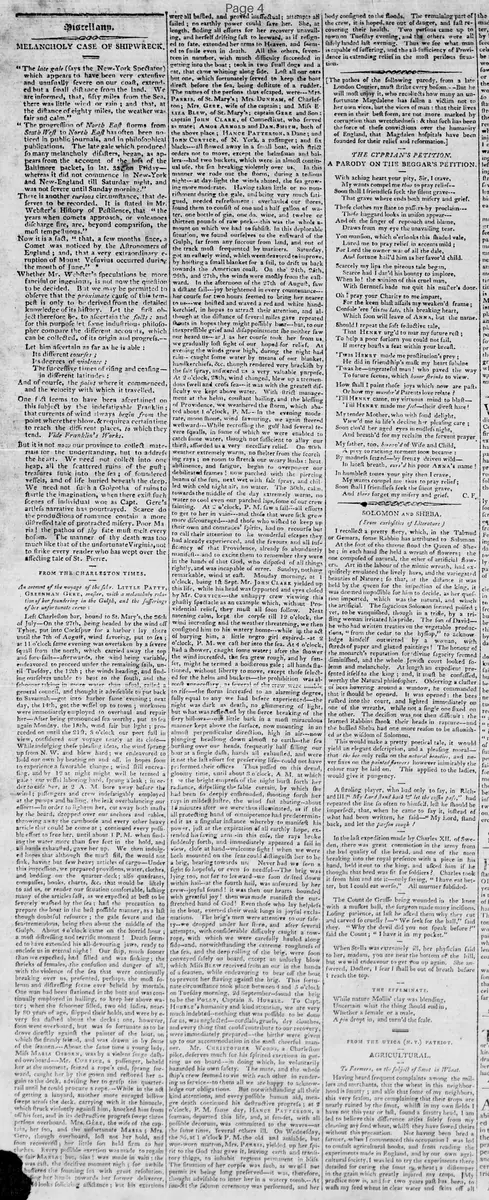
MELANCHOLY CASE OF SHIPWRECK.
"The late gale (says the New-York Spectator) which appears to have been very extensive and unusually severe on our coast, extended but a small distance from the land. We are informed, that, fifty miles from the Sea, there was little wind or rain; and that, at the distance of eighty miles, the weather was fair and calm."
"The progression of North East storms from South West to North East has often been noticed in public journals, and in philosophical publications. The late gale which produced so many melancholy disasters, began, as appears from the account of the loss of the Baltimore packet, in lat. 35 on Friday-- whereas it did not commence in New-York and New-England till Saturday night, and was not severe until Sunday morning."
There is another curious circumstance, that deserves to be recorded. It is stated in Mr. Webster's History of Pestilence, that "the years when comets approach, or volcanoes discharge fire, are, beyond comparison, the most tempestuous."
Now it is a fact, that, a few months since, a Comet was noticed by the Astronomers of England; and, that a very extraordinary eruption of Mount Vesuvius occurred during the month of June."
Whether Mr. Webster's speculations be more fanciful or ingenious, is not now the question to be decided. But we may be permitted to observe that the proximate cause of this tempest is only to be derived from the detailed knowledge of its history. Let the first object therefore be, to ascertain the facts: and for this purpose let some industrious philosopher compare the different accounts, which can be collected, of its origin and progress.-- Let him ascertain as far as he is able:
Its different courses;
Its degrees of violence;
The successive times of rising and ceasing in different latitudes:
And of course, the point where it commenced, and the velocity with which it travelled.
One fact seems to have been ascertained on this subject by the indefatigable Franklin; that currents of wind always begin from the point where they blow, & require a certain time to reach the different places, to which they tend. Vide Franklin's Works.
But it is not now our province to collect materials for the understanding, but to address the heart. We need not collect into one heap, all the scattered ruins of the gust; treasures sunk into the sea: of foundered vessels, and of life buried beneath the deep.
We need not such a Golgotha of ruins to startle the imagination, when there exists such scenes of individual woe as Capt. Gere's artless narrative has pourtrayed. "Scarce do the productions of romance contain a more distressed tale of protracted misery. Poor Maria! the pathos of thy fate must melt every bosom. The manner of thy death was too much like that of the unfortunate Virginia, not to strike every reader who has wept over the affecting tale of St. Pierre."
FROM THE CHARLESTON TIMES.
An account of the voyage of the schr. Little Party, Greenman Gere, master, with a melancholy relation of her foundering in the Gulph, and the sufferings of her unfortunate crew:
Left Charleston bar, bound to St. Mary's, the 26th of July--On the 27th, being headed by the wind off Tybee, put into Cockspur for a harbor: lay there until the 7th of August, wind favoring, put to sea; at 1 o'clock same evening was overtaken by a severe squall from the north, which carried away the top and fore-sails--afterwards, the wind being variable, endeavored to proceed under the remaining sails, until Tuesday, the 12th; the winds heading, and finding ourselves unable to beat to the south, and the schooner taking in more water than usual, called a general council, and thought it advisable to put back to Savannah--got into harbor same evening; next day, the 14th, got the vessel up to town; workmen were immediately employed to overhaul and repair her--After being pronounced sea worthy, put to sea again Monday, the 18th, wind fair but light; proceeded on until the 21st, 3 o'clock our port full in view, considered our voyage nearly at its close-- While indulging these pleasing ideas, the wind sprang up from N. W. and blew hard; we endeavored to hold our own by beating on and off, in hopes soon to experience a favorable change; wind still increasing, and by 12 at night might well be termed a gale: our vessel laboring hard, sprung a leak; in order to ease her, at 2 A. M. bore away before the wind; passengers and crew indefatigably employed at the pumps and bailing, the leak overbalancing our efforts--In order to lighten her, cut away both masts by the board, dropped over our anchors and cables, throwing away the caboose and every other heavy article that could be come at; continued every possible effort to free her, until about 1 P. M. when finding the water more than five feet in the hold, and all hands exhausted, gave her up. We then indulged hopes that although she must fill, she would not sink, having but few heavy articles of cargo--Under this impression, we prepared provisions, water, clothes, and bedding on the quarter-deck; also quadrants, compass, books, charts, &c. that would be likely to aid us, or render our situation comfortable, lashing many of the articles fast, as we expected at best to be severely washed by the sea; had the precaution to prepare the boat in the best possible manner, as a last though doubtful resource; the gale severe and the sea tremendous, being then about the middle of the Gulph. About 4 o'clock came on the horrid hour; a most distressing and terrific moment! Death seemed to have extended his all-devouring jaws, ready to enclose us in eternal night! Our ship, much sooner than we expected, had filled and was sinking: the shrieks of females, the confusion and danger of all, with the violence of the sea that were continually breaking over us, presented, perhaps, the most solemn and distressing scene ever beheld by mortals-- One man had been stationed in the boat and was continually employed in bailing, to keep her above water; when the schooner filled, two old ladies, nearly 80 years of age, slipped their holds, and were by every sea dashed about the decks: one, however, soon went overboard, but was so fortunate as to be drove directly against the painter of the boat, on which she firmly seized, and was drawn in by some of the seamen.---About the same time a young lady, Miss Maria Osborn, was by a violent surge dashed overboard.--Mr. Cushing, a passenger, beheld her at the moment, seized a rope's end, sprang forward, caught her by the gown and restored her again to the deck, advising her to grasp the quarter- rail until he could procure a rope.--While in the act of getting a lanyard, another more enraged billow swept across the deck, carrying with it the binnacle, which struck violently against him, knocked him from off his feet, and in its destructive progress swept three persons overboard. Mrs. Gere, the wife of the captain, her son, and the unfortunate Maria; Mrs. Gere, though overboard, lost not her hold, and soon recovered; her little son held firm to her clothes. Every possible exertion was made to regain fair Maria; but, alas! was made in vain; she was cast, the decisive moment nigh; for awhile buffeted the foaming sea with great resolution, wringing her hands towards her former deliverer, and looks soliciting assistance: but his exertions
were all baffled, and proved ineffectual; attempts all failed; no earthly power could save her. She, at length, finding all efforts for her recovery unavailing, and herself drifting fast to leeward, as if resigned to fate, extended her arms to Heaven, and seemed to smile even in death. All the others, eighteen in number, with much difficulty succeeded in getting into the boat; took in two small dogs and a cat, that came whining along side. Lost all our oars but one, which fortunately served to keep the boat direct before the sea, being destitute of a rudder.
The names of the persons thus escaped, were--Mrs. Parnis, of St. Mary's; Mrs. Dunham, of Charleston; Mrs. Gere, wife of the captain; and Miss Eliza Blue, of St. Mary's; captain Gere and Son; captain John Clark, of Connecticut, who served as mate; Amos Arnold and Danl. Smith, both of the above place: Hance Patterson, a Dane: and John Curtice, of N. York, a passenger; and six blacks--all towed away in a small boat, with strict orders not to move, except the helmsman and bailers.--had two buckets, which were in almost continual use, the sea breaking violently over us. In this manner we rode out the storm, during a tedious night---at day-light the winds abated, the sea growing more moderate. Having taken little or no nourishment during the gale, and being very much fatigued, needed refreshment: overhauled our stores, found them to consist of one and a half gallon of water, one bottle of gin, one do. wine, and twelve or thirteen pounds of raw pork---this was the whole amount on which we had to subsist. In this deplorable situation, we found ourselves to the eastward of the Gulph, far from any succour from land, and out of the track most frequented by mariners. Saturday, got an easterly wind, which we endeavored to improve by hoisting a small blanket for a sail, to drift us back towards the American coast. On the 24th, 25th, 26th, and 27th, the winds were mostly from the eastward. In the afternoon of the 27th of August, saw a distant sail---joy brightened in every countenance--- her course for two hours seemed to bring her nearer to us--we hoisted and waved a red and white handkerchief, in hopes to attract their attention, and although at the distance of several miles gave repeated shouts in hopes they might possibly hear---but, to our inexpressible grief and disappointment she neither saw nor heard us--and as her course took her from us we gradually lost sight of our hoped-for relief. At evening the winds grew high, during the night: had rain-- caught some water by means of our blanket, handkerchiefs, &c. though rendered very brackish by the salt spray, answered us a very valuable purpose. At 2 o'clock, 28th, wind changed, blew up a tremendous swell and cross sea---it was with the greatest difficulty we kept above water. With strict management at the helm, constant bailing, and the blessing of Providence, we weathered the storm, which abated about 1 o'clock, P. M.--In the evening moderate, moon shone, wind favouring, we again steered westward.--While recrossing the gulph had several severe squalls, in some of which we were enabled to catch some water, though not sufficient to allay our thirst, afforded us a very necessary relief. On 29th weather extremely warm, no shelter from the scorching rays; no room to stretch our weary limbs: heat, abstinence, and fatigue, began to overpower our debilitated frames! now parched with the piercing beams of the sun, next wet with salt spray, and chilled with cold night air, no water. The 30th, calm, towards the middle of the day extremely warm, no water to cool even our parched lips, one of our crew fainting. At 2 o'clock, P. M. saw a sail---all efforts to get to her in vain---and those that were sick grew more discouraged---and those who wished to keep up their own and comrades' spirits, had no recourse but to call their attention to the wonderful escapes they had already experienced, and the favours and full sufficiency of that Providence, already so abundantly manifest.-- and to excite them to remember they were in the hands of that God, who disposed of all things rightly, and was incapable of error. Sunday, nothing remarkable, wind at east. Monday morning, at 8 o'clock, being 1st Sept. Mr. John Clark yielded up this life, while his head was supported and eyes closed by Mr. Curtice---the unhappy crew viewing this ghastly spectacle as an example which, without Providential relief, they must all soon follow. Next morning calm, kept the corpse till 12 o'clock, the wind increasing and the weather threatening, we then consigned him to his watery home---while in the act of burying him, a little negro girl expired-- at 2 o'clock, P. M. we cast her into the sea. At 4 o'clock, had a shower, caught some water; after the shower the wind increased, the sea grew rough, and by sun-set, might be termed a boisterous gale; all hands stationed, "without liberty to move, except those elected for the helm and buckets--the prohibition was almost unnecessary, as several of the crew were unable to rise--the storm increased to an alarming degree, fully equal to any we had before experienced--the night was dark as death, no glimmering of light, but what was reflected by the fierce breaking of the fiery billows---our little bark in a most miraculous manner kept above the surface, now mounting in an almost perpendicular direction, high in air---now plunging headlong down almost to earth--the sea bursting over our heads, frequently half filling our boat at a single dash, hands all exhausted, and were it not the last effort for preserving life--could not have performed their offices Thus passed on this dread, gloomy time, until about 8 o'clock, A. M. at which time the bright empress of the night burst forth her radiance, dispelling the sable curtain, by which she had been so deeply enshrouded, shooting forth her rays in mildest lustre, the wind fast abating--about 15 minutes after we were thus illuminated, as if the all protecting hand of omnipotence had predetermined it as a singular instance whereby to manifest his power, just at the expiration of all earthly hope, extended his saving arm--in this case, the rays broke suddenly forth, and immediately appeared a sail in view, close at hand--welcome sight! when we were both mounted on the seas could distinguish her to be a brig, bearing towards us: Never had we seen a sight so hopeful, or even so needful---The brig was lying too, not far to leeward--we soon drifted down within hail--at the fourth hail, was answered by her crew--joyful sound! it was then our hearts bounded with grateful joy! then was made manifest the outstretched hand of God! Even those who lay helpless in the boat, exerted their weak lungs in joyful exclamations. The brig's men were attentive to our safety--we dropped under her stern, and after several attempts, with considerable difficulty caught a tow-rope, with which we were carefully hauled along side--and, notwithstanding the extreme roughness of the sea, and the deep rolling of the brig, were soon conveyed safely on board, except an unlucky blow which Miss Blue received from an oar in the hands of a seaman, while endeavoring to bear off the boat to prevent her striking against the brig. This fortunate circumstance took place between 4 and 5 o'clock on Tuesday morning, 2d September--found the brig to be the Polly, Captain S. Hustler. To Capt. Hustler's humanity and kind attention, we are very much indebted--nothing that was possible to be done for us, was neglected--cordials, gruels, dry clothes, and every thing that could contribute to our recovery, were immediately prepared--the births were given up to our accommodation in the most cheerful manner. Mr. Christopher Woods, a Charleston pilot, deserves much for his spirited exertions in getting us on board--in doing which, he voluntarily hazarded his own safety. The mate, and the whole ship's crew seemed to vie with each other in rendering us service--to them all we are happy to acknowledge our obligations. But notwithstanding all their kind attentions, and every possible human aid, meagre death continued his destructive progress; at 2 o'clock, P. M. same day, Hance Patterson, a seaman, departed this life, and, at sun-set, with all possible decorum, was committed to the waves--at the same time, several others ill. On Wednesday, the 3d, at 1 o'clock P. M. the old and amiable, but woe-worn matron, Mrs. Parnis, yielded up her spirit to the God that gave it, leaving earth and transitory things, to inhabit regions permanent in bliss. The situation of her corpse was such, as would not permit its being long preserved--it was, therefore, thought advisable to inter her in a watery tomb.-- At
body consigned to the floods. The remaining part of the crew, it is hoped, are out of danger, and fast recovering their health. Two persons came up to town on Tuesday evening, and the others were all safely landed last evening. Thus we see what man is capable of suffering, and the all-sufficiency of Providence in extending relief in the most perilous situation.
What sub-type of article is it?
What themes does it cover?
What keywords are associated?
What entities or persons were involved?
Where did it happen?
Story Details
Key Persons
Location
Gulph Stream, Off St. Mary's, From Charleston
Event Date
July 26 To September 2
Story Details
The schooner Little Party, under Capt. Greenman Gere, left Charleston for St. Mary's but faced gales, leaks, and foundered in the Gulph. Crew and passengers endured days in a small boat, suffering thirst, storms, and deaths including Miss Maria Osborn drowned and others from exhaustion. Rescued by brig Polly on Sept. 2 after invoking Providence.