Thank you for visiting SNEWPapers!
Sign up free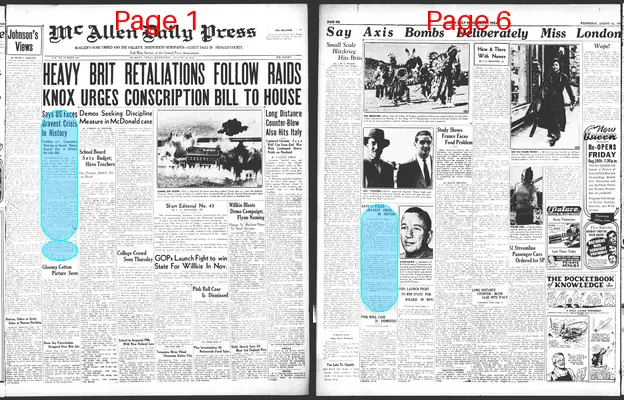
Mcallen Daily Press
Mcallen, Hidalgo County, Texas
What is this article about?
Secretary of the Navy Frank Knox testified before the House military affairs committee on August 14 that conscription is essential amid the US's gravest crisis, while the Senate debated the bill on its fourth day and the House considered a companion mobilization measure, facing opposition from isolationists.
Merged-components note: Merged continuation from page 6; relabeled from 'story' to 'domestic_news' as it covers national political news on conscription.
Clippings
1 of 2
OCR Quality
Full Text
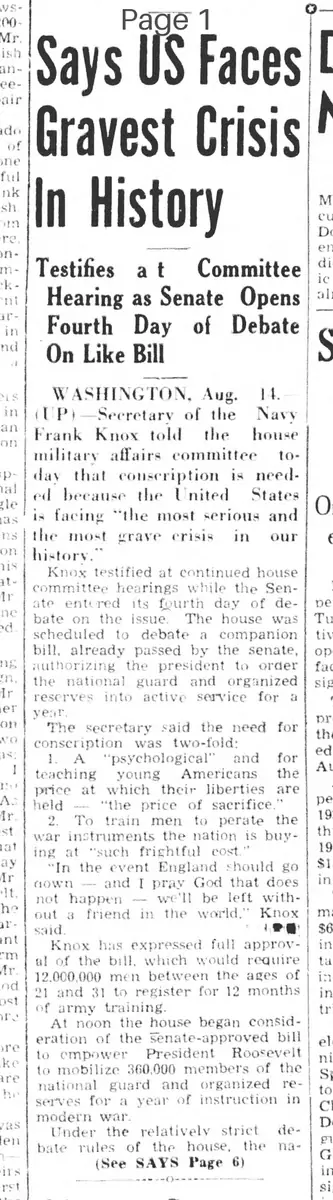
WASHINGTON, Aug. 14.—(UP)—Secretary of the Navy Frank Knox told the house military affairs committee today that conscription is needed because the United States is facing "the most serious and the most grave crisis in our history."
Knox testified at continued house committee hearings while the Senate entered its fourth day of debate on the issue. The house was scheduled to debate a companion bill, already passed by the senate, authorizing the president to order the national guard and organized reserves into active service for a year.
The secretary said the need for conscription was two-fold:
1. A "psychological" one for teaching young Americans the price at which their liberties are held—"the price of sacrifice."
2. To train men to operate the war instruments the nation is buying at "such frightful cost."
"In the event England should go down—and I pray God that does not happen—we'll be left without a friend in the world," Knox said.
Knox has expressed full approval of the bill, which would require 12,000,000 men between the ages of 21 and 31 to register for 12 months of army training.
At noon the house began consideration of the Senate-approved bill to empower President Roosevelt to mobilize 360,000 members of the national guard and organized reserves for a year of instruction in modern war.
Under the relatively strict debate rules of the house, the national (See SAYS Page 6)
SAYS US FACES
GRAVEST
CRISIS
IN
HISTORY
(Continued from page 1)
national guard-reserves bill is expected to reach a vote late tomorrow afternoon, bitter opposition. however. is expected from a group of isolationists and opponents of the Roosevelt administration's foreign policy.
One major amendment will propose that use of the guards and reservists be restricted to the United States, its territories and possessions. As passed by the senate. the bill would permit their use anywhere in the Western Hemisphere.
The house amendment is similar to an amendment the senate rejected by a 38 to 39 vote.
Another controversy is expected over an attempt to restore the senate-approved provision which would make employers subject to Wagner Act prosecution for refusing to rehire employees after their training' period. The "employee protection" provision was deleted by the house military affairs committee.
Meanwhile. senate opponents of the draft believed their cause was strengthened by the army's disclosure that it has abandoned plans to, have 600,000 men in uniform by Oct 1.
Brig. Gen. William E. Shedd. assistant chief of staff, told the house military affairs committee that congressional delays on the conscription bill have made it impossible to achieve that figure before Jan 1. 1941. It can be reached, he said only through the draft.
What sub-type of article is it?
What keywords are associated?
What entities or persons were involved?
Where did it happen?
Domestic News Details
Primary Location
Washington
Event Date
Aug. 14
Key Persons
Outcome
expected house vote late tomorrow afternoon on national guard-reserves bill; opposition from isolationists; senate rejected similar amendment 38 to 39; army abandoned plans for 600,000 men by oct 1, possible only through draft by jan 1, 1941.
Event Details
Secretary of the Navy Frank Knox testified before the House military affairs committee on the need for conscription due to the US facing its gravest crisis, emphasizing psychological benefits and training for war instruments; Senate in fourth day of debate on conscription bill for 12,000,000 men aged 21-31 for 12 months training; House began consideration of Senate-passed bill to mobilize 360,000 national guard and reserves for one year; anticipated amendments to restrict use to US territories and restore employee protection provision.