Thank you for visiting SNEWPapers!
Sign up free
The Kentucky Gazette
Lexington, Fayette County, Kentucky
What is this article about?
B. Waterhouse shares updates from Dr. Woodville's experiments in London inoculating cowpox matter into humans, confirming it provides immunity to smallpox with minimal side effects, based on Dr. Jenner's discovery. Over 600 cases tested, mostly successful, though one infant death occurred.
Merged-components note: Continuation of article on cowpox inoculation and its relation to smallpox.
Clipping
OCR Quality
Full Text
COW POX.
Mr. Russel,
The curiosity of the public has been excited by a newly discovered disease, denominated from its origin, the Cow Pox, an account of which I sent you last March.
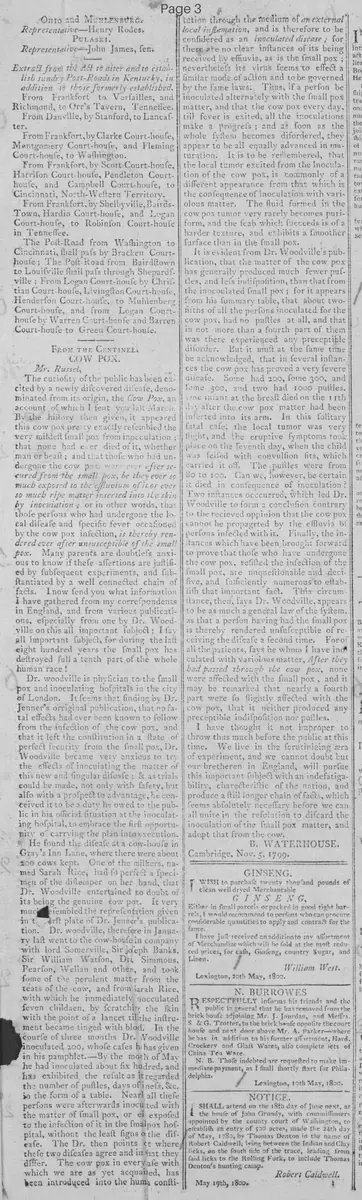
By the history then given, it appeared this cow pox pretty exactly resembled the very mildest small pox from inoculation; that none had ever died of it, whether man or beast: and that those who had undergone the cow pox were put entirely secured from the small pox, be they ever so much exposed to the effluvium of it or ever so much ripe matter inserted into the skin by inoculation; or in other words, that those persons who had undergone the local disease and specific fever occasioned by the cow pox infection, is thereby rendered ever after unsusceptible of the small pox. Many parents are doubtless anxious to know if these assertions are justified by subsequent experiments, and substantiated by a well connected chain of facts. I now send you what information I have gathered from my correspondents in England, and from various publications, especially from one by Dr. Woodville on this all important subject; I say all important subject, for during the last eight hundred years the small pox has destroyed full a tenth part of the whole human race!
Dr. Woodville is physician to the small pox and inoculating hospitals in the city of London. It seems that finding by Dr. Jenner's original publication, that no fatal effects had ever been known to follow from the infection of the cow pox, and that it left the constitution in a state of perfect security from the small pox, Dr. Woodville became very anxious to try the effects of inoculating the matter of this new and singular disease; & as trials could be made, not only with safety, but also with a prospect to advantage, he conceived it to be a duty he owed to the public in his official situation at the inoculating hospital, to embrace the first opportunity of carrying the plan into execution.
He found the disease at a cow-house in Gray's Inn Lane, where there were about 200 cows kept. One of the milkers, named Sarah Rice, had a perfect specimen of the distemper on her hand, that Dr. Woodville entertained no doubt of its being the genuine cow pox. It very much resembled the representation given in the first plate of Dr. Jenner's publication. Dr. Woodville, therefore in January last went to the cow-house in company with lord Somerville, Sir Joseph Banks, Sir William Watson, Dr. Simmons, Pearson, Walker and others, and took some of the purulent matter from the teats of the cow, and from Sarah Rice, with which he immediately inoculated seven children, by scratching the skin with the point of a lancet till the instrument became tinged with blood. In the course of three months Dr. Woodville inoculated 200, whose cases he has given in his pamphlet.—By the month of May he had inoculated about six hundred, and has exhibited the result as it regarded the number of pustules, days of illness, &c. in the form of a table. Nearly all these persons were afterwards inoculated with the matter of small pox, or else exposed to the infection of it in the smallpox hospital, without the least signs of the disease. The Dr. then points out where these two diseases agree and in what they differ. The cow pox in every case with which we are as yet acquainted, has been introduced into the human constitution through the medium of an external local inflammation, and is therefore to be considered as an inoculated disease: for there are no clear instances of its being received by effluvia, as is the small pox; nevertheless its virus seems to effect a similar mode of action and to be governed by the same laws. Thus, if a person be inoculated alternately with the small pox matter, and that the cow pox every day, till fever is excited, all the inoculations make a progress; and as soon as the whole system becomes disordered, they appear to be all equally advanced in maturation. It is to be remembered, that the local tumor excited from the inoculation of the cow pox, is commonly of a different appearance from that which is the consequence of inoculation with variolous matter. The fluid formed in the cow pox tumor very rarely becomes puriform, and the scab which succeeds is of a harder texture, and exhibits a smoother surface than in the small pox.
It is evident from Dr. Woodville's publication, that the matter of the cow pox has generally produced much fewer pustules, and less indisposition, than that from the inoculated small pox; for it appears from his summary table, that about two-fifths of all the persons inoculated for the cow pox, had no pustules at all, and that in not more than a fourth part of them was there experienced any perceptible disorder. But it must at the same time be acknowledged, that in several instances the cow pox has proved a very severe disease. Some had 200, some 300, and some 500, and two had 1000 pustules.
The infant at the breast died on the 11th day after the cow pox matter had been inserted into its arm. In this solitary fatal case; the local tumor was very slight, and the eruptive symptoms took place on the seventh day, when the child was seized with convulsion fits, which carried it off. The pustles were from 80 to 100. Can we, however, be certain it died in consequence of inoculation?
Two instances occurred, which led Dr. Woodville to form a conclusion contrary to the received opinion that the cow pox cannot be propagated by the effluvia of persons infected with it. Finally, the instances which have been brought forward to prove that those who have undergone the cow pox, resisted the infection of the small pox, are unquestionable and decisive, and sufficiently numerous to establish that important fact. This circumstance, then, says Dr. Woodville, appears to be as much a general law of the system, as that a person having had the small pox is thereby rendered unsusceptible of receiving the disease a second time. For of all the patients, says he whom I have inoculated with variolous matter, after they had passed through the cow pox, none were affected with the small pox. and it may be remarked that nearly a fourth part were so slightly affected with the cow pox, that it neither produced any perceptible indisposition nor pustles.
I have thought it not improper to throw thus much before the public at this time. We live in the scrutinizing aera of experiment, and we cannot doubt but our brethren in England, will pursue this important subject with an indefatigability, characteristic of the nation, and produce a still longer chain of facts, which seems absolutely necessary before we can all unite in the resolution to discard the inoculation of the small pox matter, and adopt that from the cow.
B. WATERHOUSE.
Cambridge, Nov. 5, 1799.
What sub-type of article is it?
What themes does it cover?
What keywords are associated?
What entities or persons were involved?
Where did it happen?
Story Details
Key Persons
Location
London, England; Gray's Inn Lane Cow House; Cambridge
Event Date
January 1799; March 1799; May 1799; Nov. 5, 1799
Story Details
Dr. Woodville inoculates cowpox matter into over 600 people in London, confirming it protects against smallpox as per Dr. Jenner's discovery, with mostly mild effects but one infant death; subsequent smallpox exposure shows immunity.