Thank you for visiting SNEWPapers!
Sign up free
Editorial
October 21, 1863
Daily State Sentinel
Indianapolis, Marion County, Indiana
What is this article about?
This Civil War-era editorial critiques the concept of 'unconditional loyalty' to President Lincoln's administration, drawing parallels to historical absolutism under James II, and defends Democratic opposition as upholding constitutional limits on executive power during wartime, separate from military necessities.
Clipping
OCR Quality
96%
Excellent
Full Text
Unconditional Loyalty.
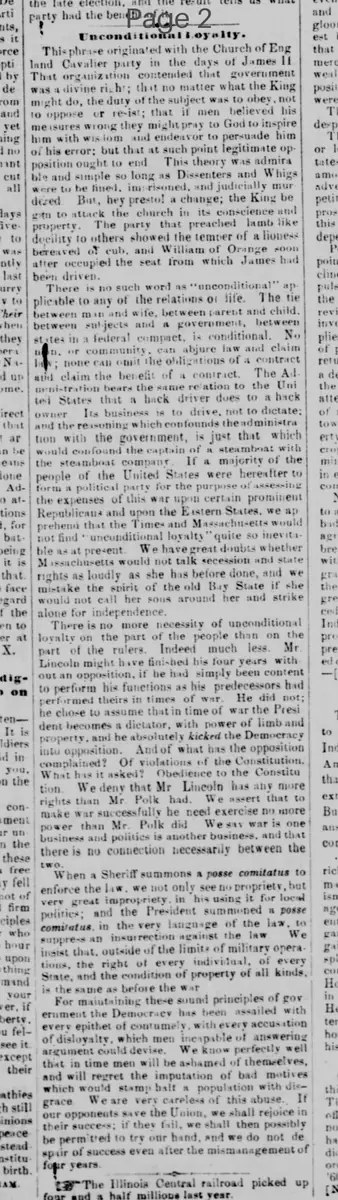
This phrase originated with the Church of England Cavalier party in the days of James II. That organization contended that government was a divine right; that no matter what the King might do, the duty of the subject was to obey, not to oppose or resist; that if men believed his measures wrong they might pray to God to inspire him with wisdom and endeavor to persuade him of his error; but that at such point legitimate opposition ought to end. This theory was admirable and simple so long as Dissenters and Whigs were to be fined, imprisoned, and judicially murdered. But, hey presto! a change; the King began to attack the church in its conscience and property. The party that preached lamb-like docility to others showed the temper of a lioness bereaved of cub, and William of Orange soon after occupied the seat from which James had been driven.
There is no such word as "unconditional" applicable to any of the relations of life. The tie between man and wife, between parent and child, between subjects and a government, between states in a federal compact, is conditional. No man, or community, can abjure law and claim law; none can omit the obligations of a contract and claim the benefit of a contract. The Administration bears the same relation to the United States that a hack driver does to a hack owner. Its business is to drive, not to dictate; and the reasoning which confounds the administration with the government, is just that which would confound the captain of a steamboat with the steamboat company. If a majority of the people of the United States were hereafter to form a political party for the purpose of assessing the expenses of this war upon certain prominent Republicans and upon the Eastern States, we apprehend that the Times and Massachusetts would not find "unconditional loyalty" quite so inevitable as at present. We have great doubts whether Massachusetts would not talk secession and state rights as loudly as she has before done, and we mistake the spirit of the old Bay State if she would not call her sons around her and strike alone for independence.
There is no more necessity of unconditional loyalty on the part of the people than on the part of the rulers. Indeed much less. Mr. Lincoln might have finished his four years without an opposition, if he had simply been content to perform his functions as his predecessors had performed theirs in times of war. He did not; he chose to assume that in time of war the President becomes a dictator, with power of limb and property, and he absolutely kicked the Democracy into opposition. And of what has the opposition complained? Of violations of the Constitution. What has it asked? Obedience to the Constitution. We deny that Mr. Lincoln has any more rights than Mr. Polk had. We assert that to make war successfully he need exercise no more power than Mr. Polk did. We say war is one business and politics is another business, and that there is no connection necessarily between the two.
When a Sheriff summons a posse comitatus to enforce the law, we not only see no propriety, but very great impropriety, in his using it for local politics; and the President summoned a posse comitatus, in the very language of the law, to suppress an insurrection against the law. We insist that, outside of the limits of military operations, the right of every individual, of every State, and the condition of property of all kinds, is the same as before the war.
For maintaining these sound principles of government the Democracy has been assailed with every epithet of contumely, with every accusation of disloyalty, which men incapable of answering argument could devise. We know perfectly well that in time men will be ashamed of themselves, and will regret the imputation of bad motives which would stamp half a population with disgrace. We are very careless of this abuse. If our opponents save the Union, we shall rejoice in their success; if they fail, we shall then possibly be permitted to try our hand, and we do not despair of success even after the mismanagement of four years.
This phrase originated with the Church of England Cavalier party in the days of James II. That organization contended that government was a divine right; that no matter what the King might do, the duty of the subject was to obey, not to oppose or resist; that if men believed his measures wrong they might pray to God to inspire him with wisdom and endeavor to persuade him of his error; but that at such point legitimate opposition ought to end. This theory was admirable and simple so long as Dissenters and Whigs were to be fined, imprisoned, and judicially murdered. But, hey presto! a change; the King began to attack the church in its conscience and property. The party that preached lamb-like docility to others showed the temper of a lioness bereaved of cub, and William of Orange soon after occupied the seat from which James had been driven.
There is no such word as "unconditional" applicable to any of the relations of life. The tie between man and wife, between parent and child, between subjects and a government, between states in a federal compact, is conditional. No man, or community, can abjure law and claim law; none can omit the obligations of a contract and claim the benefit of a contract. The Administration bears the same relation to the United States that a hack driver does to a hack owner. Its business is to drive, not to dictate; and the reasoning which confounds the administration with the government, is just that which would confound the captain of a steamboat with the steamboat company. If a majority of the people of the United States were hereafter to form a political party for the purpose of assessing the expenses of this war upon certain prominent Republicans and upon the Eastern States, we apprehend that the Times and Massachusetts would not find "unconditional loyalty" quite so inevitable as at present. We have great doubts whether Massachusetts would not talk secession and state rights as loudly as she has before done, and we mistake the spirit of the old Bay State if she would not call her sons around her and strike alone for independence.
There is no more necessity of unconditional loyalty on the part of the people than on the part of the rulers. Indeed much less. Mr. Lincoln might have finished his four years without an opposition, if he had simply been content to perform his functions as his predecessors had performed theirs in times of war. He did not; he chose to assume that in time of war the President becomes a dictator, with power of limb and property, and he absolutely kicked the Democracy into opposition. And of what has the opposition complained? Of violations of the Constitution. What has it asked? Obedience to the Constitution. We deny that Mr. Lincoln has any more rights than Mr. Polk had. We assert that to make war successfully he need exercise no more power than Mr. Polk did. We say war is one business and politics is another business, and that there is no connection necessarily between the two.
When a Sheriff summons a posse comitatus to enforce the law, we not only see no propriety, but very great impropriety, in his using it for local politics; and the President summoned a posse comitatus, in the very language of the law, to suppress an insurrection against the law. We insist that, outside of the limits of military operations, the right of every individual, of every State, and the condition of property of all kinds, is the same as before the war.
For maintaining these sound principles of government the Democracy has been assailed with every epithet of contumely, with every accusation of disloyalty, which men incapable of answering argument could devise. We know perfectly well that in time men will be ashamed of themselves, and will regret the imputation of bad motives which would stamp half a population with disgrace. We are very careless of this abuse. If our opponents save the Union, we shall rejoice in their success; if they fail, we shall then possibly be permitted to try our hand, and we do not despair of success even after the mismanagement of four years.
What sub-type of article is it?
Partisan Politics
Constitutional
What keywords are associated?
Unconditional Loyalty
Lincoln Administration
Constitutional Violations
Democratic Opposition
Presidential Power
Civil War Politics
State Rights
Historical Absolutism
What entities or persons were involved?
Mr. Lincoln
Mr. Polk
The Administration
The Democracy
Republicans
Massachusetts
The Times
James Ii
William Of Orange
Editorial Details
Primary Topic
Critique Of Unconditional Loyalty To The Administration During War
Stance / Tone
Opposition To Unconditional Loyalty And Defense Of Constitutional Opposition
Key Figures
Mr. Lincoln
Mr. Polk
The Administration
The Democracy
Republicans
Massachusetts
The Times
James Ii
William Of Orange
Key Arguments
Unconditional Loyalty Originated With The Church Of England Cavalier Party Under James Ii, Promoting Absolute Obedience To The King.
No Relation In Life Is Unconditional; Ties Between Subjects And Government Are Conditional On Law And Contracts.
The Administration Is Like A Hack Driver To The Government Owner, Tasked With Driving Not Dictating.
If Republicans Assessed War Expenses On Themselves And Eastern States, Massachusetts Would Resist With Secession Talk.
People Owe No More Unconditional Loyalty Than Rulers; Lincoln Assumed Dictatorial Powers Beyond Predecessors.
Opposition Arose From Lincoln's Constitutional Violations; It Demands Obedience To The Constitution.
Lincoln Has No More Rights In War Than Polk; War And Politics Are Separate Businesses.
President Should Not Use Posse Comitatus For Local Politics Outside Military Operations.
Individual, State Rights, And Property Conditions Remain Unchanged Outside Military Zones.
Democracy Endures Epithets For Upholding Sound Government Principles Despite Administration Attacks.