Thank you for visiting SNEWPapers!
Sign up free
Martinsburgh Gazette
Martinsburg, Berkeley County, West Virginia
What is this article about?
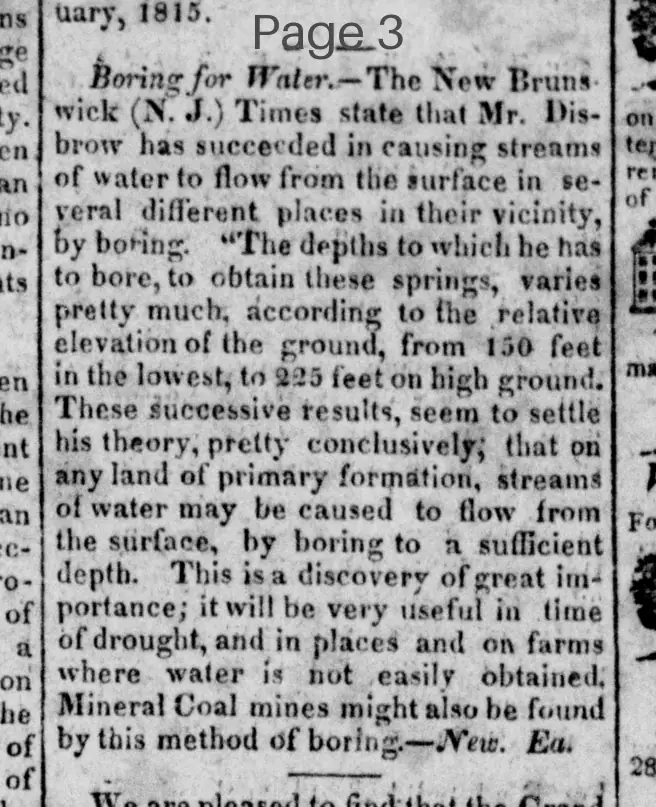
Mr. Disbrow succeeded in boring for water in New Brunswick, N.J., causing streams to flow from the surface at depths of 150-225 feet, confirming his theory for primary formation lands. The discovery is important for droughts, farms, and potentially finding mineral coal mines.
Clipping
OCR Quality
Full Text
What sub-type of article is it?
What keywords are associated?
What entities or persons were involved?
Where did it happen?
Domestic News Details
Primary Location
New Brunswick (N. J.)
Key Persons
Outcome
succeeded in causing streams of water to flow from the surface in several places; theory confirmed for obtaining water by boring on primary formation land; useful in drought and for farms where water is scarce; potential to find mineral coal mines.
Event Details
Mr. Disbrow has succeeded in causing streams of water to flow from the surface in several different places in the vicinity by boring to depths varying from 150 feet in low ground to 225 feet on high ground, according to the relative elevation. These results settle his theory that on any land of primary formation, streams of water may be caused to flow from the surface by boring to a sufficient depth.