Thank you for visiting SNEWPapers!
Sign up free
The Bismarck Tribune
Bismarck, Mandan, Burleigh County, Morton County, North Dakota
What is this article about?
In 1936, David Lawrence assesses Roosevelt's weakened position in Wisconsin's presidential race against Landon, due to radical coalitions and conservative divisions, estimating a narrowed 150,000 majority for Roosevelt amid potential shifts.
Clipping
OCR Quality
Full Text
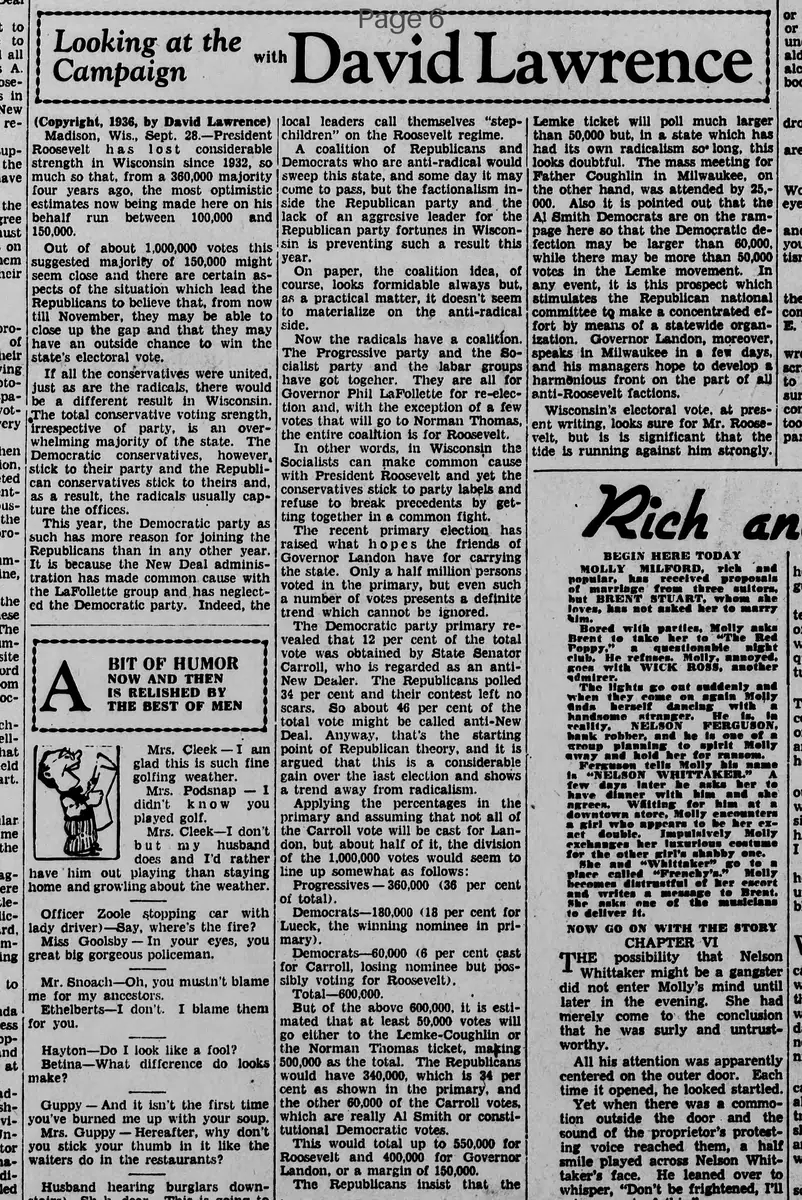
(Copyright, 1936, by David Lawrence)
Madison, Wis., Sept. 28.—President Roosevelt has lost considerable strength in Wisconsin since 1932, so much so that, from a 360,000 majority four years ago, the most optimistic estimates now being made here on his behalf run between 100,000 and 150,000.
Out of about 1,000,000 votes this suggested majority of 150,000 might seem close and there are certain aspects of the situation which lead the Republicans to believe that, from now till November, they may be able to close up the gap and that they may have an outside chance to win the state's electoral vote.
If all the conservatives were united, just as are the radicals, there would be a different result in Wisconsin. The total conservative voting strength, irrespective of party, is an overwhelming majority of the state. The Democratic conservatives, however, stick to their party and the Republican conservatives stick to theirs and, as a result, the radicals usually capture the offices.
This year, the Democratic party as such has more reason for joining the Republicans than in any other year. It is because the New Deal administration has made common cause with the LaFollette group and has neglected the Democratic party. Indeed, the local leaders call themselves "step-children" on the Roosevelt regime.
A coalition of Republicans and Democrats who are anti-radical would sweep this state, and some day it may come to pass, but the factionalism inside the Republican party and the lack of an aggressive leader for the Republican party fortunes in Wisconsin is preventing such a result this year.
On paper, the coalition idea, of course, looks formidable always but, as a practical matter, it doesn't seem to materialize on the anti-radical side.
Now the radicals have a coalition. The Progressive party and the Socialist party and the labor groups have got together. They are all for Governor Phil LaFollette for re-election and, with the exception of a few votes that will go to Norman Thomas, the entire coalition is for Roosevelt.
In other words, in Wisconsin the Socialists can make common cause with President Roosevelt and yet the conservatives stick to party labels and refuse to break precedents by getting together in a common fight.
The recent primary election has raised what hopes the friends of Governor Landon have for carrying the state. Only a half million persons voted in the primary, but even such a number of votes presents a definite trend which cannot be ignored.
The Democratic party primary revealed that 12 per cent of the total vote was obtained by State Senator Carroll, who is regarded as an anti-New Dealer. The Republicans polled 34 per cent and their contest left no scars. So about 46 per cent of the total vote might be called anti-New Deal. Anyway, that's the starting point of Republican theory, and it is argued that this is a considerable gain over the last election and shows a trend away from radicalism.
Applying the percentages in the primary and assuming that not all of the Carroll vote will be cast for Landon, but about half of it, the division of the 1,000,000 votes would seem to line up somewhat as follows:
Progressives—360,000 (36 per cent of total).
Democrats—180,000 (18 per cent for Lueck, the winning nominee in primary).
Democrats—60,000 (6 per cent cast for Carroll, losing nominee but possibly voting for Roosevelt).
Total—600,000.
But of the above 600,000, it is estimated that at least 50,000 votes will go either to the Lemke-Coughlin or the Norman Thomas ticket, making 500,000 as the total. The Republicans would have 340,000, which is 34 per cent as shown in the primary, and the other 60,000 of the Carroll votes, which are really Al Smith or constitutional Democratic votes.
This would total up to 550,000 for Roosevelt and 400,000 for Governor Landon or a margin of 150,000.
Lemke ticket will poll much larger than 50,000 but, in a state which has had its own radicalism so long, this looks doubtful. The mass meeting for Father Coughlin in Milwaukee, on the other hand, was attended by 25,000. Also it is pointed out that the Al Smith Democrats are on the rampage here so that the Democratic defection may be larger than 60,000, while there may be more than 50,000 votes in the Lemke movement. In any event, it is this prospect which stimulates the Republican national committee to make a concentrated effort by means of a statewide organization. Governor Landon, moreover, speaks in Milwaukee in a few days, and his managers hope to develop a harmonious front on the part of all anti-Roosevelt factions.
Wisconsin's electoral vote, at present writing, looks sure for Mr. Roosevelt, but it is significant that the tide is running against him strongly.
What sub-type of article is it?
What themes does it cover?
What keywords are associated?
What entities or persons were involved?
Where did it happen?
Story Details
Key Persons
Location
Wisconsin
Event Date
1936
Story Details
David Lawrence reports on the 1936 presidential campaign in Wisconsin, highlighting Roosevelt's loss of support from a 360,000 majority in 1932 to an estimated 100,000-150,000. He discusses divisions between conservatives and radicals, failed anti-radical coalitions, radical alliances supporting LaFollette and Roosevelt, primary election trends showing anti-New Deal votes, and projected vote splits giving Roosevelt a 150,000 margin but with potential Republican gains.