Thank you for visiting SNEWPapers!
Sign up free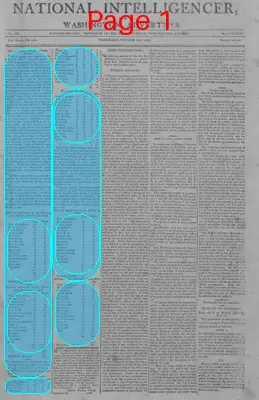
The National Intelligencer And Washington Advertiser
Washington, District Of Columbia
What is this article about?
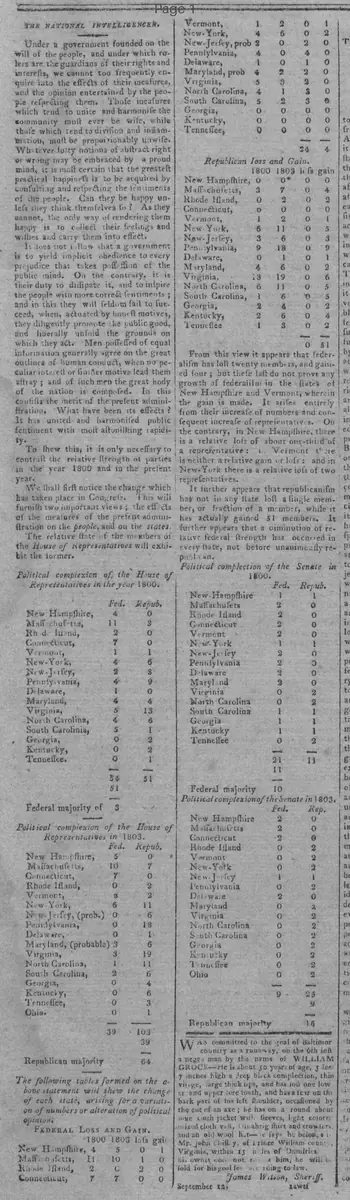
Editorial in The National Intelligencer praises the Republican administration's unifying effects on public sentiment, evidenced by shifts in congressional party composition from Federal majority in 1800 to Republican dominance in 1803, with tables showing state-by-state gains and losses.
Merged-components note: Merged multiple tables into the surrounding editorial text on the effects of the administration and changes in the political complexion of Congress from 1800 to 1803.
Clipping
OCR Quality
Full Text
| Vermont, | 1 | 2 | 0 | 1 |
| New-York, | 4 | 6 | 0 | 2 |
| New-Jersey, prob | 2 | 0 | 2 | 0 |
| Pennsylvania, | 4 | 0 | 4 | 0 |
| Delaware, | 1 | 0 | 1 | 0 |
| Maryland, prob | 4 | 2 | 2 | 0 |
| Virginia, | 5 | 3 | 2 | 0 |
| North Carolina, | 4 | 1 | 3 | 0 |
| South Carolina, | 5 | 2 | 3 | 0 |
| Georgia, | 0 | 0 | 0 | 0 |
| Kentucky, | 0 | 0 | 0 | 0 |
| Tennessee, | 0 | 0 | 0 | 0 |
| New Hampshire, 4 | 5 | 0 | 1 |
| Massachusetts, 11 | 10 | 1 | 0 |
| Rhode Island, 2 | 0 | 2 | 0 |
| Connecticut, 7 | 7 | 0 | 0 |
THE NATIONAL INTELLIGENCER.
Under a government founded on the will of the people, and under which rulers are the guardians of their rights and interests, we cannot too frequently enquire into the effects of their measures, and the opinion entertained by the people respecting them. Those measures which tend to unite and harmonize the community must ever be wise, while those which tend to division and inflammation, must be proportionably unwise.
Whatever lofty notions of abstract right or wrong may be embraced by a proud mind, it is most certain that the greatest practical happiness is to be acquired by consulting and respecting the sentiments of the people. Can they be happy unless they think themselves so? As they cannot, the only way of rendering them happy is to collect their feelings and wishes and carry them into effect.
It does not follow that a government is to yield implicit obedience to every prejudice that takes possession of the public mind. On the contrary, it is their duty to dissipate it, and to inspire the people with more correct sentiments; and in this they will seldom fail to succeed, when, actuated by honest motives, they diligently promote the public good, and liberally unfold the grounds on which they act. Men possessed of equal information generally agree on the great outlines of human conduct, when no peculiar interest or sinister motive lead them astray; and of such men the great body of the nation is composed. In this consists the merit of the present administration. What have been its effects? It has united and harmonized public sentiment with most astonishing rapidity.
To shew this, it is only necessary to contrast the relative strength of parties in the year 1800 and in the present year.
We shall first notice the change which has taken place in Congress. This will furnish two important views; the effects of the measures of the present administration on the people, and on the states. The relative state of the members of the House of Representatives will exhibit the former.
Political complexion of the House of Representatives in the year 1800.
Political complexion of the House of Representatives in 1803.
Republican majority
The following tables formed on the above statement will shew the change of each state, arising from a variation of numbers or alteration of political opinion.
FEDERAL LOSS AND GAIN
Republican loss and Gain.
From this view it appears that federalism has lost twenty members, and gained four; but these last do not prove any growth of federalism in the states of New Hampshire and Vermont, wherein the gain is made. It arises entirely from their increase of numbers and consequent increase of representatives. On the contrary, in New Hampshire, there is a relative loss of about one-third of a representative; in Vermont there is neither a relative gain or loss: and in New-York there is a relative loss of two representatives.
It further appears that republicanism has not in any state lost a single member, or fraction of a member, while it has actually gained 51 members. It further appears that a diminution of relative federal strength has occurred in every state, not before unanimously republican.
Political complexion of the Senate in 1800.
Federal majority 10
Political complexion of the Senate in 1803.
| Fed. | Repub. | |
| New Hampshire, | 4 | 0 |
| Massachusetts, | 11 | 3 |
| Rhode Island, | 2 | 0 |
| Connecticut, | 7 | 0 |
| Vermont, | 1 | 1 |
| New York, | 4 | 6 |
| New Jersey, | 2 | 8 |
| Pennsylvania, | 4 | 9 |
| Delaware, | 1 | 0 |
| Maryland, | 4 | 4 |
| Virginia, | 5 | 13 |
| North Carolina, | 4 | 6 |
| South Carolina, | 5 | 1 |
| Georgia, | 0 | 2 |
| Kentucky, | 0 | 2 |
| Tennessee. | 0 | 1 |
| 54 | 51 | |
| 51 | ||
| Federal majority of | 3 |
| Fed. | Repub. | |
| New Hampshire, | 5 | 0 |
| Massachusetts, | 10 | 7 |
| Connecticut, | 7 | 0 |
| Rhode Island, | 0 | 2 |
| Vermont, | 2 | 2 |
| New York, | 6 | 11 |
| New Jersey, (prob.) | 0 | 6 |
| Pennsylvania, | 0 | 18 |
| Delaware, | 0 | 1 |
| Maryland, (probable) | 3 | 6 |
| Virginia, | 3 | 19 |
| North Carolina, | 1 | 11 |
| South Carolina, | 2 | 6 |
| Georgia, | 0 | 4 |
| Kentucky, | 0 | 6 |
| Tennessee, | 0 | 3 |
| Ohio. | 0 | 1 |
| 39 | 103 | |
| 39 |
| New Hampshire, | 0 | 0 | 0 | 0 |
| Massachusetts, | 3 | 7 | 0 | 4 |
| Rhode Island, | 0 | 2 | 0 | 2 |
| Connecticut, | 0 | 0 | 0 | 0 |
| Vermont, | 1 | 2 | 0 | 1 |
| New York, | 6 | 11 | 0 | 5 |
| New Jersey, | 3 | 6 | 0 | 3 |
| Pennsylvania, | 9 | 18 | 0 | 9 |
| Delaware, | 0 | 1 | 0 | 1 |
| Maryland, | 4 | 6 | 0 | 2 |
| Virginia, | 13 | 19 | 0 | 6 |
| North Carolina, | 6 | 11 | 0 | 5 |
| South Carolina, | 1 | 6 | 0 | 5 |
| Georgia, | 2 | 4 | 0 | 2 |
| Kentucky, | 2 | 6 | 0 | 4 |
| Tennessee | 1 | 3 | 0 | 2 |
| Fed. | Rep. | |
| New-Hampshire | 1 | 1 |
| Massachusetts | 2 | 0 |
| Rhode Island | 2 | 0 |
| Connecticut | 2 | 0 |
| Vermont | 2 | 0 |
| New-York | 1 | 1 |
| New-Jersey | 2 | 0 |
| Pennsylvania | 2 | 0 |
| Delaware | 2 | 0 |
| Maryland | 2 | 0 |
| Virginia | 0 | 2 |
| North Carolina | 0 | 2 |
| South Carolina | 1 | 1 |
| Georgia | 1 | 1 |
| Kentucky | 1 | 1 |
| Tennessee | 0 | 2 |
| Fed. | Rep. | |
| New Hampshire | 2 | 0 |
| Massachusetts | 2 | 0 |
| Connecticut | 2 | 0 |
| Rhode Island | 0 | 2 |
| Vermont | 0 | 2 |
| New-York | 0 | 2 |
| New Jersey | 1 | 1 |
| Pennsylvania | 0 | 2 |
| Delaware | 2 | 0 |
| Maryland | 0 | 2 |
| Virginia | 0 | 2 |
| North Carolina | 0 | 2 |
| South Carolina | 0 | 2 |
| Georgia | 0 | 2 |
| Kentucky | 0 | 2 |
| Tennessee | 0 | 2 |
| Ohio | 0 | 2 |
| 9 | 25 | |
| 9 | ||
| 16 |
What sub-type of article is it?
What keywords are associated?
What entities or persons were involved?
Editorial Details
Primary Topic
Shifts In Congressional Party Composition 1800 To 1803
Stance / Tone
Supportive Of Republican Administration Unifying Effects
Key Figures
Key Arguments