Thank you for visiting SNEWPapers!
Sign up free
The Jasper Weekly Courier
Jasper, Dubois County, Indiana
What is this article about?
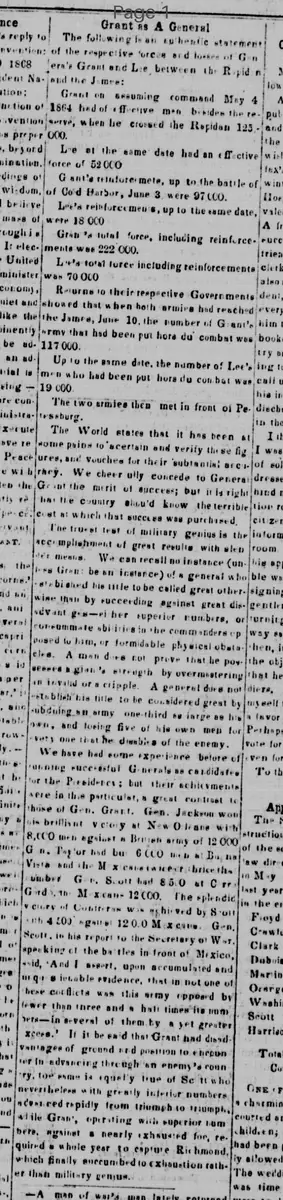
Analysis of Union General Grant's forces (125,000 initial, total 222,000 with reinforcements) versus Confederate General Lee's (52,000 initial, total 70,000) and losses (Grant: 117,000; Lee: 19,000) from May 4 to June 16, 1864, between Rapidan and James Rivers, critiquing the high cost of Grant's success against a smaller foe, compared to generals like Jackson, Taylor, and Scott who triumphed over larger armies.
Merged-components note: Sequential reading order and continuous text on Grant's military record and comparisons to other generals
Clipping
OCR Quality
Full Text
The following is a phenomenal statement
of the respective forces and losses of General's
Grant and Lee between the Rapidan
and the James:
Grant on assuming command May 4
1864 had of effective men beside the reserve,
when he crossed the Rapidan 125,000.
Lee at the same date had an effective
force of 52,000
Grant's reinforcements, up to the battle of
Cold Harbor, June 3, were 97,000.
Lee's reinforcements, up to the same date,
were 18,000
Grant's total force, including reinforcements
was 222,000.
Lee's total force including reinforcements
was 70,000
Returns to their respective Governments
showed that when both armies had reached
the James, June 16, the number of Grant's
army that had been put hors du combat was
117,000.
Up to the same date, the number of Lee's
men who had been put hors du combat was
19,000.
The two armies then met in front of Petersburg
The World states that it has been at
some pains to ascertain and verify these figures,
and vouches for their substantial accuracy.
We cheerfully concede to General
Grant the merit of success; but it is right
that the country should know the terrible
cost at which that success was purchased.
The truest test of military genius is the
accomplishment of great results with small
expenditures. We can recall no instance (unless
Grant be an instance) of a general who
established his title to be called great otherwise
than by succeeding against great disadvantage
of numbers, or consummate skill in the commandership
opposed to him, or formidable physical obstacles.
A man does not prove that he possesses
a giant's strength by overmastering
an invalid or a cripple. A general does not
establish his title to be considered great by
subduing an army one-third as large as his
own, and losing five of his own men for
every one that he disables of the enemy.
We have had some experience before of
running successful Generals as candidates
for the Presidency: but their achievements
were in this particular, a great contrast to
those of Gen. Grant. Gen. Jackson won
his brilliant victory at New Orleans with
8,000 men against a British army of 12,000
Gen. Taylor had but 6,000 men at Buena
Vista and the Mexicans outnumbered
Gen. Scott had 8,500 at Cerro
Gordo, against 12,000 Mex. The splendid
victory of Contreras was achieved by Scott
with 4,000 against 12,000 Mex. Gen.
Scott, in his report to the Secretary of War,
speaking of the battles in front of Mexico,
said, 'And I assert, upon accumulated and
reliable evidence, that in not one of
these conflicts was this army opposed by
fewer than three and a half times its number-in several of them, by a yet greater
excess.' If it be said that Grant had disadvantages
of ground and position to encounter in advancing through an enemy's country,
the same is equally true of Scott who
nevertheless with greatly inferior numbers
advanced rapidly from triumph to triumph,
while Grant operating with superior numbers
against a nearly exhausted foe, required a whole year to capture Richmond
which finally succumbed to exhaustion rather
than military genius.
What sub-type of article is it?
What themes does it cover?
What keywords are associated?
What entities or persons were involved?
Where did it happen?
Story Details
Key Persons
Location
Between The Rapidan And The James, Petersburg
Event Date
May 4 1864 To June 16 1864
Story Details
Comparison of Grant and Lee's forces and losses during 1864 campaign, emphasizing Grant's numerical superiority and high casualties versus Lee's smaller force, contrasted with historical generals' victories against odds.