Thank you for visiting SNEWPapers!
Sign up free
The Hillsborough Recorder
Hillsboro, Orange County, North Carolina
What is this article about?
In the North Carolina House of Commons on December 19, 1821, Mr. J. S. Smith argues in favor of submitting to voters the question of calling a convention to amend the state constitution, addressing unequal representation, historical precedents, and countering opponents' concerns about faction and timing.
Clipping
OCR Quality
Full Text
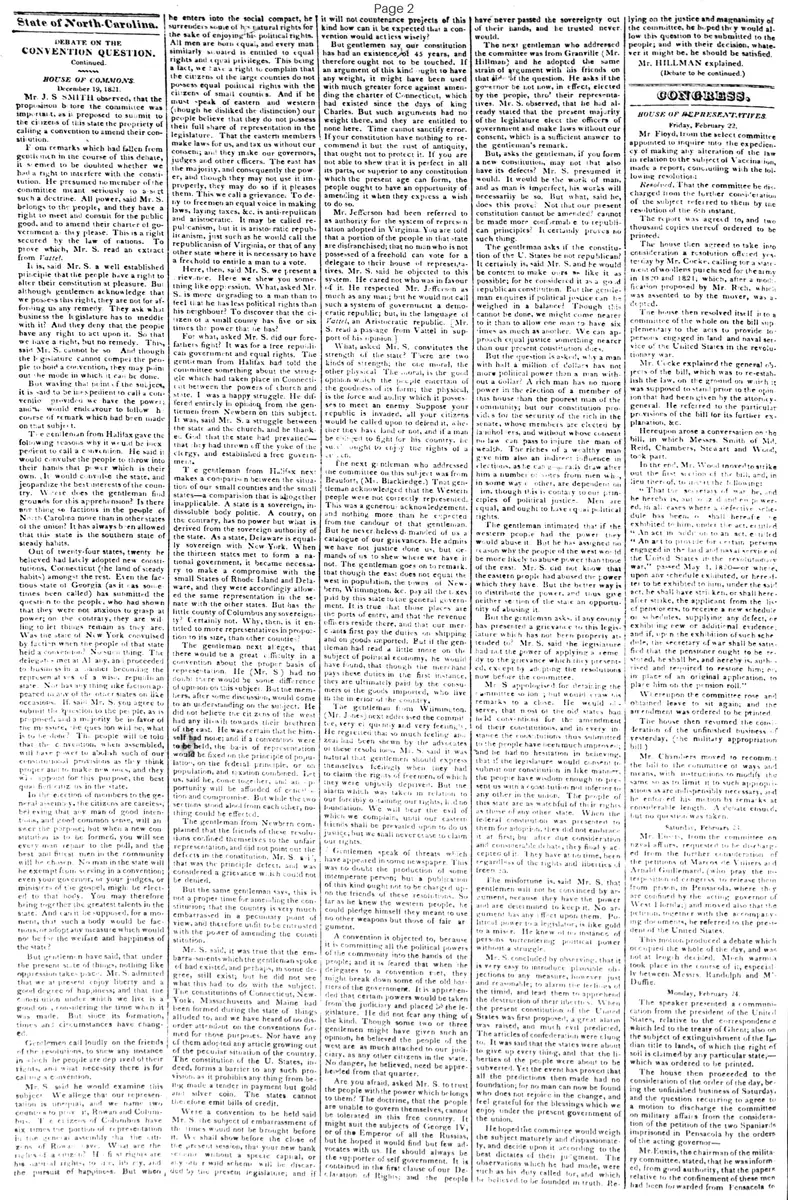
DEBATE ON THE CONVENTION QUESTION.
Continued.
HOUSE OF COMMONS
December 19, 1821.
Mr. J. S. SMITH observed, that the proposition before the committee was important, as it proposed to submit to the citizens of this state the propriety of calling a convention to amend their constitution. From remarks which had fallen from gentlemen in the course of this debate, it seemed to be doubted whether we had a right to interfere with the constitution. He presumed no member of the committee meant seriously to assert such a doctrine. All power, said Mr. S., belongs to the people, and they have a right to meet and consult for the public good, and to amend their charter of government as they please. This is a right secured by the law of nations. To prove which, Mr. S. read an extract from Vattel.
It is, said Mr. S., a well established principle that the people have a right to alter their constitution at pleasure. But although gentlemen acknowledge that we possess this right, they are not for affording us any remedy. They ask what business the legislature has to meddle with it? And they deny that the people have any right to act upon it. So that we have a right, but no remedy. This, said Mr. S., cannot be so. And though the legislature cannot compel the people to hold a convention, they may point out the mode in which it can be done.
But waving that point of the subject, it is said to be inexpedient to call a convention provided we have the power; and he would endeavour to follow a course of remark which had been made on that subject.
The gentleman from Halifax gave the following reasons why it would be inexpedient to call a convention. He said it would convulse the people to throw into their hands that power which is their own. It would convulse the state, and jeopardize the best interests of the country. Whence does the gentleman find grounds for this apprehension? Is there any thing so factious in the people of North Carolina more than in other states of the union? It has always been allowed that this state is the southern state of steady habits.
Out of twenty-four states, twenty he believed had lately adopted new constitutions, Connecticut (the land of steady habits) amongst the rest. Even the factious state of Georgia (as it has sometimes been called) has submitted the question to the people, who had shown that they were not anxious to grasp at power; on the contrary, they are willing to let things remain as they are.
Was the state of New York convulsed by faction when the people of that state held a convention? No such thing. The delegates met at Albany, and proceeded to business in a manner becoming the representatives of a wise republican state. Nor has any thing like faction appeared in any of the other states on like occasions. If, said Mr. S., you agree to submit the question to the people, as is proposed, and a majority be in favor of the measure, the question will be, what is to be done? The people will be told that the convention, when assembled, will have power to abolish such of our constitutional provisions as they think proper and to make new ones, and they will appoint for this purpose, the best qualified citizens in the state.
In the election of members to the general assembly, the citizens are careless, believing that any man of good intentions and good common sense, will answer the purpose; but when a new constitution is to be formed, you will see every man repair to the poll, and the best and fittest men in the community will be chosen. No man in the state will be exempt from serving in a convention; even your governor, or your judges, or ministers of the gospel, might be elected to that body. You may therefore bring together the greatest talents in the state. And can it be supposed, for a moment, that such a body would be factious, or adopt any measure which would not be for the welfare and happiness of the state?
But gentlemen have said, that under the present state of things, nothing like oppression takes place. Mr. S. admitted that we at present enjoy liberty and a good degree of happiness; and that the Constitution under which we live is a good one, considering the time when it was made. But since its formation, times and circumstances have changed.
Gentlemen call loudly on the friends of the resolutions, to shew any instance in which the people are deprived of their rights, and what necessity there is for calling a convention.
Mr. S. said he would examine this subject. We allege that our representation is unequal, and we name two counties to prove it, Rowan and Columbus. The citizens of Columbus have six times the portion of representation in the general assembly that the city has. What are the rights of a citizen? His natural rights, to life, liberty, and the pursuit of happiness. But when he enters into the social compact, he surrenders some of his natural rights for the sake of enjoying his political rights. All men are born equal, and every man similarly situated is entitled to equal rights and equal privileges. This being a fact, we have a right to complain that the citizens of the large counties do not possess equal political rights with the citizens of small counties. And if he must speak of eastern and western (though he disliked the distinction) our people believe that they do not possess their full share of representation in the legislature. That the eastern members make laws for us, and tax us without our consent; and they make our governors, judges and other officers. The east has the majority, and consequently the power, and though they may not use it improperly, they may do so if it pleases them. This we call a grievance. To deny to freemen an equal voice in making laws, laying taxes, &c. is anti-republican and aristocratic. It may be called republicanism, but it is aristocratic republicanism, just such as he would call the republicanism of Virginia, or that of any other state where it is necessary to have a freehold to entitle a man to a vote.
Here, then, said Mr. S., we present a grievance. Here we shew you something like oppression. What, asked Mr. S., is more degrading to a man than to feel that he has less political rights than his neighbour? To discover that the citizen of a small county has five or six times the power that he has?
For what, asked Mr. S., did our forefathers fight? It was for a free republican government and equal rights. The gentleman from Halifax had told the committee something about the struggle which had taken place in Connecticut between the powers of church and state. It was a happy struggle. He differed entirely in opinion from the gentleman from Newbern on this subject. It was, said Mr. S., a struggle between the state and the church, and he thanked God that the state had prevailed—that they had thrown off the yoke of the clergy, and established a free government.
The gentleman from Halifax next makes a comparison between the situation of our small counties and the small states—a comparison that is altogether inapplicable. A state is a sovereign, indissoluble body politic. A county, on the contrary, has no power but what is derived from the sovereign authority of the state. As a state, Delaware is equally sovereign with New York. When the thirteen states met to form a national government, it became necessary to make a compromise with the small States of Rhode Island and Delaware, and they were accordingly allowed the same representation in the senate with the other states. But has the little county of Columbus any sovereignty? Certainly not. Why, then, is it entitled to more representatives in proportion to its size, than other counties?
The gentleman next alleges, that there would be a great difficulty in a convention about the proper basis of representation. He (Mr. S.) had no doubt there would be some difference of opinion on this subject. But the members, after some discussion, would come to an understanding on the subject. He did not believe the citizens of the west had any ill-will towards their brethren of the east. He was certain that he himself had none: and if a convention were to be held, the basis of representation would be fixed on the principle of population, on the federal principle, or on population and taxation combined. Let us, said he, come together, and an opportunity will be afforded of conciliation and compromise. But while the two sections stood aloof from each other, nothing could be effected.
The gentleman from Newbern complained that the friends of these resolutions confined themselves to the unfair representation, and did not point out the defects in the constitution. Mr. S. said that was the principal defect, and was considered a grievance which could not be denied.
But the same gentleman says, this is not a proper time for amending the constitution; that the country is very much embarrassed in a pecuniary point of view, and therefore unfit to be entrusted with the power of amending the constitution.
Mr. S. said, it was true that the embarrassments which the gentleman spoke of had existed, and perhaps, in some degree, still exist; but he did not see what this had to do with the subject. The constitutions of Connecticut, New York, Massachusetts and Maine had been formed during the state of things alluded to, and we have heard of no disorder attendant on the conventions formed for those purposes. Nor have any of them adopted any article growing out of the peculiar situation of the country. The constitution of the U. States, indeed, forms a barrier to any such provision, as it prohibits any thing from being made a tender in payment but gold and silver coin. The states cannot therefore emit bills of credit.
Were a convention to be held said Mr. S., the subject of embarrassment of the times would not be brought before it. It shall show before the close of the present session, that your new bank scheme without a specie capital, or any other wild scheme will be discarded by the present legislature; and if it will not countenance projects of this kind how can it be expected that a convention would act less wisely?
But gentlemen say, our constitution has had an existence of 45 years, and therefore ought not to be touched. If an argument of this kind ought to have any weight, it might have been used with much greater force against amending the charter of Connecticut, which had existed since the days of king Charles. But such arguments had no weight there, and they are entitled to none here. Time cannot sanctify error. If your constitution have nothing to recommend it but the rust of antiquity, that ought not to protect it. If you are not able to shew that it is perfect in all its parts, or superior to any constitution which the present age can form, the people ought to have an opportunity of amending it when they express a wish to do so.
Mr. Jefferson had been referred to as authority for the system of representation adopted in Virginia. You are told that a portion of the people in that state are disfranchised; that no man who is not possessed of a freehold can vote for a delegate to their house of representatives. Mr. S. said he objected to this system. He cared not who was in favour of it. He respected Mr. Jefferson as much as any man; but he would not call such a system of government a democratic republic; but, in the language of Vattel, an Aristocratic republic. Mr. S. read a passage from Vattel in support of his opinion.
What, asked Mr. S., constitutes the strength of the state? There are two kinds of strength; the one moral, the other physical. The moral, is the good opinion which the people entertain of the goodness of its form; the physical, is the force and ability which it possesses to meet an enemy. Suppose your republic is invaded, all your citizens would be called upon to defend it, whether they have land or not, and if a man be obliged to fight for his country, he surely ought to enjoy the rights of a citizen.
The next gentleman who addressed the committee on this subject was from Beaufort, (Mr. Blackledge.) That gentleman acknowledged that the Western people were not correctly represented. This was a generous acknowledgement, and nothing more than he expected from the candour of that gentleman. But he nevertheless demanded of us a catalogue of our grievances. He admits we have not justice done us, but demands of us to shew where we have it not. The gentleman goes on to remark, that though the east does not equal the west in population, the towns of Newbern, Wilmington, &c. pay all the taxes paid by this state to the general government. It is true that those places are the ports of entry, and that the revenue officers reside there, and that our merchants first pay the duties on shipping and on goods imported. But if the gentleman had read a little more on the subject of political economy, he would have found, that though the merchant pays these duties in the first instance, they are ultimately paid by the consumers of the goods imported, who live in the interior of the country.
The gentleman from Wilmington, (Mr. Jones) next addressed the committee, very eloquently and very feelingly. He regretted that so much feeling and zeal had been shewn by the advocates of these resolutions. Mr. S. said it was natural that gentlemen should express themselves feelingly when they had to claim the rights of freemen, of which they were unjustly deprived. But the alarm which was taken in relation to our forcibly obtaining our rights, had no foundation. We will bear the evil of which we complain, until our eastern friends shall be prevailed upon to do us justice; but we shall never cease to claim our rights.
Gentlemen speak of threats which have appeared in some newspaper. This was no doubt the production of some intemperate person; but a publication of this kind ought not to be charged upon the friends of these resolutions. So far as he knew the western people, he could pledge himself they meant to use no other weapons but those of fair argument.
A convention is objected to, because it is committing all the political powers of the community into the hands of the people; and it is feared that when the delegates to a convention meet, they might break down some of the old barriers of the government. It is apprehended that certain powers would be taken from the judiciary and placed in the legislature. He did not fear any thing of the kind. Though some two or three gentlemen might have given such an opinion, he believed the people of the west are as much attached to our judiciary, as any other citizens in the state. No danger, he believed, need be apprehended from that quarter.
Are you afraid, asked Mr. S., to trust the people with the power which belongs to them? The doctrine, that the people are unable to govern themselves, cannot be tolerated in this free country. It might suit the subjects of George IV, or of the Emperor of all the Russias, but he hoped it would find but few advocates with us. He should always be the supporter of self government. It is contained in the first clause of our Declaration of Rights; and the people have never passed the sovereignty out of their hands, and he trusted never would.
The next gentleman who addressed the committee was from Granville (Mr. Hillman); and he adopted the same strain of argument with his friends on that side of the question. He asks if the governor be not now, in effect, elected by the people, thro' their representatives. Mr. S. observed, that he had already stated that the present majority of the legislature elect the officers of government and make laws without our consent, which is a sufficient answer to the gentleman's remark.
But, asks the gentleman, if you form a new constitution, may not that also have its defects? Mr. S. presumed it would. It would be the work of man, and as man is imperfect, his works will necessarily be so. But what, said he, does this prove? Not that our present constitution cannot be amended? cannot be made more conformable to republican principles? It certainly proves no such thing.
The gentleman asks if the constitution of the U. States be not republican? It certainly is, said Mr. S. and he would be content to make ours on like it as possible; for he considered it as a good republican constitution. But the gentleman enquires if political justice can be weighed in a balance? Though this cannot be done, we might come nearer to it than to allow one man to have six times as much as another. We can approach equal justice something nearer than our present constitution does.
But the question is asked, why a man with half a million of dollars has not more political power than a man without a dollar? A rich man has no more power in the election of a member of this house than the poorest man of the community: but our constitution provides for the security of the rich in the senate, whose members are elected by landholders, and without whose consent no law can pass to injure the man of wealth. The riches of a wealthy man give him also an indirect influence in elections, as he can draw after him a number of votes from men who, in some way or other, are dependent on him, though this is contrary to our principles of political justice. Men are equal, and ought to have equal political rights.
The gentleman intimated that if the western people had the power they would abuse it. But he has assigned no reason why the people of the west would be more likely to abuse power than those of the east. Mr. S. did not know that the eastern people had abused the power which they have. But the better way is to distribute the power, and thus give neither section of the state an opportunity of abusing it.
But the gentleman asks if any county has presented a grievance to this legislature which has not been properly attended to? Mr. S. said the legislature had not the power of applying a remedy to the grievance which they presented, except by adopting the resolutions now before the committee.
Mr. S. apologised for detaining the committee so long; but would draw his remarks to a close. He would observe, that most of the old states had held conventions for the amendment of their constitutions, and in every instance the constitutions thus submitted to the people have been much improved; and he had no hesitation in believing, that if the legislature would consent to submit our constitution in like manner, the people have wisdom enough to present us with a constitution not inferior to any other in the union. The people of this state are as watchful of their rights as those of any other state. When the federal constitution was presented to them for adoption, they did not embrace it at first; but after due consideration and considerable debate, they finally accepted of it. They have at no time, been regardless of the rights and liberties of freemen.
The misfortune is, said Mr. S., that gentlemen will not be convinced by argument, because they have the power and are determined to keep it. No argument has any effect upon them. Political power to a legislator, is like gold to a miser. He knew of no instance of persons surrendering political power without a struggle.
Mr. S. concluded by observing, that it is very easy to introduce plausible objections to any measure, however just and reasonable: to alarm the feelings of the timid, and lead them to apprehend the destruction of their liberties. When the present constitution of the United States was first proposed, a great alarm was raised, and much evil predicted. The articles of confederation were clung to. It was said that the states were about to give up every thing, and that the liberties of the people were about to be subverted. Yet the event has proved that all the predictions then made had no foundation; for no man can now be found who does not rejoice in the change, and feel grateful for the blessings which we enjoy under the present government of the union.
He hoped the committee would weigh the subject maturely and dispassionately, and decide upon it according to the best dictates of their judgment. The observations which he had made, were such as his duty called for, and which he believed to be founded in truth. Relying on the justice and magnanimity of the committee, he hoped they would allow this question to be submitted to the people; and with their decision, whatever it might be, he should be satisfied.
Mr. HILLMAN explained.
(Debate to be continued.)
What sub-type of article is it?
What themes does it cover?
What keywords are associated?
What entities or persons were involved?
Where did it happen?
Story Details
Key Persons
Location
North Carolina, House Of Commons
Event Date
December 19, 1821
Story Details
Mr. J. S. Smith delivers a lengthy speech advocating for submitting the question of a constitutional convention to the people, arguing for the right to amend the constitution, highlighting unequal representation between eastern and western counties, countering fears of faction and economic instability, and citing historical precedents from other states.