Thank you for visiting SNEWPapers!
Sign up free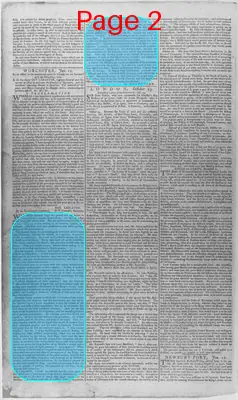
Editorial
February 10, 1776
The Virginia Gazette
Richmond, Williamsburg, Richmond County, Virginia
What is this article about?
A satirical editorial by 'A Bostonian' critiques General Gage's proclamation justifying British troops' actions at Lexington and Concord on April 19, 1775, accusing it of falsehood, treachery, and poor reasoning amid rising colonial tensions.
Clipping
OCR Quality
98%
Excellent
Full Text
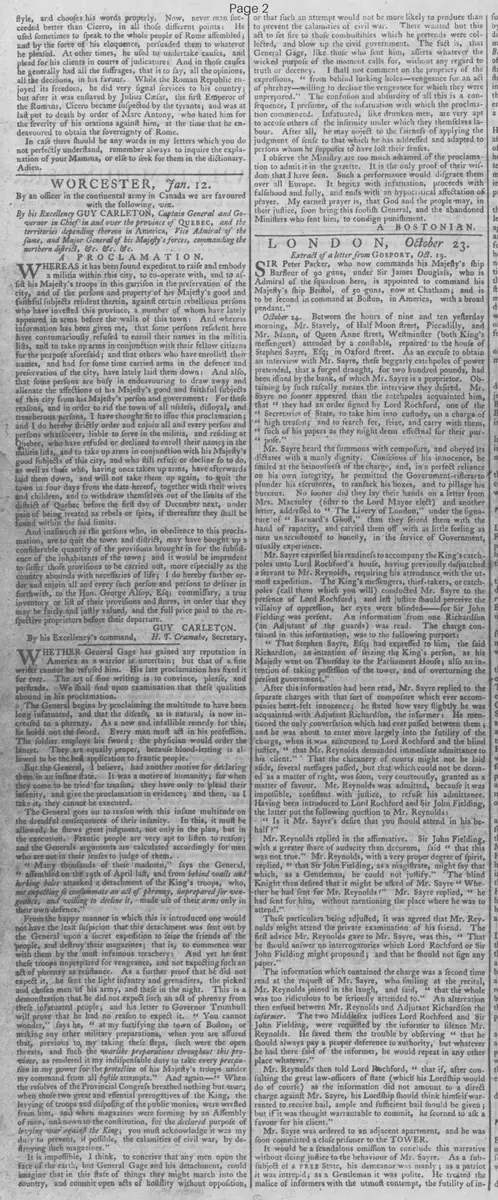
WHETHER General Gage has gained any reputation in America as a warrior is uncertain; but that of a fine writer cannot be refused him. His late proclamation has fixed it for ever. The art of fine writing is to convince, please, and persuade. We shall find upon examination that these qualities abound in his proclamation.
The General begins by proclaiming the multitude to have been long infatuated, and that the disease, as is natural, is now increased to a phrenzy. As a new and infallible remedy for this, he holds out the sword. Every man must act in his profession. The soldier employs his sword; the physician would order the lancet. They are equally proper, because blood-letting is allowed to be the best application to frantic people.
But the General, I believe, had another motive for declaring them in an insane state. It was a motive of humanity; for when they come to be tried for treason, they have only to plead their inanity, and give the proclamation in evidence; and then, as I take it, they cannot be executed.
The General goes on to reason with this insane multitude on the dreadful consequences of their insanity. In this, it must be allowed, he shews great judgment, not only in the plan, but in the execution. Frantic people are very apt to listen to reason; and the General's arguments are calculated accordingly for men who are not in their senses to judge of them.
"Many thousands of these madmen," says the General, "assembled on the 19th of April last, and from behind walls and lurking holes attacked a detachment of the King's troops, who, not expecting so consummate an act of phrenzy, unprepared for vengeance, and willing to decline it, made use of their arms only in their own defence."
From the happy manner in which this is introduced one would not have the least suspicion that this detachment was sent out by the General upon a secret expedition to seize the friends of the people, and destroy their magazines; that is, to commence war with them by the most infamous treachery: And yet he sent these troops unprepared for vengeance, and not expecting such an act of phrenzy as resistance. As a further proof that he did not expect it, he sent the light infantry and grenadiers, the picked and chosen men of his army, and these in the night. This is a demonstration that he did not expect such an act of phrenzy from these infatuated people; and his letter to Governor Trumbull will prove that he had no reason to expect it. "You cannot wonder," says he, "at my fortifying the town of Boston, or making any other military preparations, when you are assured that, previous to my taking these steps, such were the open threats, and such the warlike preparations throughout this province, as rendered it my indispensable duty to take every precaution in my power for the protection of his Majesty's troops under my command from all hostile attempts." And again—"When the resolves of the Provincial Congress breathed nothing but war; when those two great and essential prerogatives of the King, the levying of troops and disposing of the public monies, were wrested from him, and when magazines were forming by an Assembly of men, unknown to the constitution, for the declared purpose of levying war against the King; you must acknowledge it was my duty to prevent, if possible, the calamities of civil war, by destroying such magazines."
It is impossible, I think, to conceive that any men upon the face of the earth, but General Gage and his detachment, could imagine that in this state of things they might march into the country, and commit open acts of hostility without opposition, or that such an attempt would not be more likely to produce than to prevent the calamities of civil war. There wanted but this act to set fire to those combustibles which he pretends were collected, and blow up the civil government. The fact is, that General Gage, like those who sent him, asserts whatever the wicked purpose of the moment calls for, without any regard to truth or decency. I shall not comment on the propriety of the expressions, "from behind lurking holes—vengeance for an act of phrenzy—willing to decline the vengeance for which they were unprepared." The confusion and absurdity of all this is a consequence, I presume, of the infatuation with which the proclamation commenced. Infatuated, like drunken men, are very apt to accuse others of the infirmity under which they themselves labour. After all, he may object to the fairness of applying the judgment of sober to that which he has addressed and adapted to persons whom he supposes to have lost their senses.
I observe the Ministry are too much ashamed of the proclamation to admit it in the gazette. It is the only proof of their wisdom that I have seen. Such a performance would disgrace them over all Europe. It begins with infatuation, proceeds with falsehood and folly, and ends with an hypocritical affectation of prayer. My earnest prayer is, that God and the people—may, in their justice, soon bring this foolish General, and the abandoned Ministers who sent him, to condign punishment.
A BOSTONIAN.
The General begins by proclaiming the multitude to have been long infatuated, and that the disease, as is natural, is now increased to a phrenzy. As a new and infallible remedy for this, he holds out the sword. Every man must act in his profession. The soldier employs his sword; the physician would order the lancet. They are equally proper, because blood-letting is allowed to be the best application to frantic people.
But the General, I believe, had another motive for declaring them in an insane state. It was a motive of humanity; for when they come to be tried for treason, they have only to plead their inanity, and give the proclamation in evidence; and then, as I take it, they cannot be executed.
The General goes on to reason with this insane multitude on the dreadful consequences of their insanity. In this, it must be allowed, he shews great judgment, not only in the plan, but in the execution. Frantic people are very apt to listen to reason; and the General's arguments are calculated accordingly for men who are not in their senses to judge of them.
"Many thousands of these madmen," says the General, "assembled on the 19th of April last, and from behind walls and lurking holes attacked a detachment of the King's troops, who, not expecting so consummate an act of phrenzy, unprepared for vengeance, and willing to decline it, made use of their arms only in their own defence."
From the happy manner in which this is introduced one would not have the least suspicion that this detachment was sent out by the General upon a secret expedition to seize the friends of the people, and destroy their magazines; that is, to commence war with them by the most infamous treachery: And yet he sent these troops unprepared for vengeance, and not expecting such an act of phrenzy as resistance. As a further proof that he did not expect it, he sent the light infantry and grenadiers, the picked and chosen men of his army, and these in the night. This is a demonstration that he did not expect such an act of phrenzy from these infatuated people; and his letter to Governor Trumbull will prove that he had no reason to expect it. "You cannot wonder," says he, "at my fortifying the town of Boston, or making any other military preparations, when you are assured that, previous to my taking these steps, such were the open threats, and such the warlike preparations throughout this province, as rendered it my indispensable duty to take every precaution in my power for the protection of his Majesty's troops under my command from all hostile attempts." And again—"When the resolves of the Provincial Congress breathed nothing but war; when those two great and essential prerogatives of the King, the levying of troops and disposing of the public monies, were wrested from him, and when magazines were forming by an Assembly of men, unknown to the constitution, for the declared purpose of levying war against the King; you must acknowledge it was my duty to prevent, if possible, the calamities of civil war, by destroying such magazines."
It is impossible, I think, to conceive that any men upon the face of the earth, but General Gage and his detachment, could imagine that in this state of things they might march into the country, and commit open acts of hostility without opposition, or that such an attempt would not be more likely to produce than to prevent the calamities of civil war. There wanted but this act to set fire to those combustibles which he pretends were collected, and blow up the civil government. The fact is, that General Gage, like those who sent him, asserts whatever the wicked purpose of the moment calls for, without any regard to truth or decency. I shall not comment on the propriety of the expressions, "from behind lurking holes—vengeance for an act of phrenzy—willing to decline the vengeance for which they were unprepared." The confusion and absurdity of all this is a consequence, I presume, of the infatuation with which the proclamation commenced. Infatuated, like drunken men, are very apt to accuse others of the infirmity under which they themselves labour. After all, he may object to the fairness of applying the judgment of sober to that which he has addressed and adapted to persons whom he supposes to have lost their senses.
I observe the Ministry are too much ashamed of the proclamation to admit it in the gazette. It is the only proof of their wisdom that I have seen. Such a performance would disgrace them over all Europe. It begins with infatuation, proceeds with falsehood and folly, and ends with an hypocritical affectation of prayer. My earnest prayer is, that God and the people—may, in their justice, soon bring this foolish General, and the abandoned Ministers who sent him, to condign punishment.
A BOSTONIAN.
What sub-type of article is it?
War Or Peace
Partisan Politics
Constitutional
What keywords are associated?
General Gage
Lexington Concord
British Proclamation
Colonial Resistance
American Revolution
Treachery
Infatuation
What entities or persons were involved?
General Gage
King's Troops
Ministry
Governor Trumbull
Provincial Congress
Editorial Details
Primary Topic
Critique Of General Gage's Proclamation On Lexington And Concord
Stance / Tone
Satirical And Strongly Anti British
Key Figures
General Gage
King's Troops
Ministry
Governor Trumbull
Provincial Congress
Key Arguments
Gage's Proclamation Falsely Portrays Colonists As Insane Aggressors
British Troops Initiated Hostilities Through Secret Expedition To Destroy Magazines
Gage's Actions Provoked Rather Than Prevented Civil War
Proclamation Is Hypocritical, False, And Poorly Written
Ministry Ashamed Of The Document