Thank you for visiting SNEWPapers!
Sign up free
Litchfield Enquirer
Litchfield, Litchfield County, Connecticut
What is this article about?
General Edmund P. Gaines writes a letter defending Major General William Henry Harrison's military record in the War of 1812, praising his leadership against British and Indian forces, critiquing party politics, and endorsing Harrison for U.S. President as a principled Whig who prioritizes country over party.
Clipping
OCR Quality
Full Text
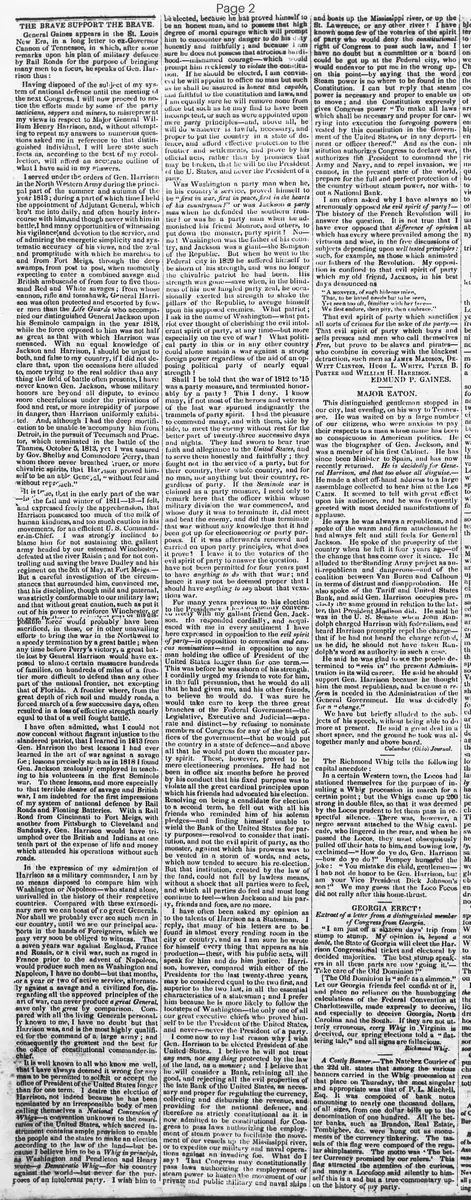
General Gaines appears in the St. Louis New Era, in a long letter to ex-Governor Cannon of Tennessee, in which, after some remarks upon his plan of military defence by Rail Roads for the purpose of bringing many men to a focus, he speaks of Gen. Harrison thus:
Having disposed of the subject of my system of national defence until the meeting of the next Congress, I will now proceed to notice the efforts made by some of the party tacticians, sappers and miners, to misrepresent my views in respect to Major General William Henry Harrison, and, without attempting to repeat my answers to numerous questions asked me in reference to that distinguished individual, I will here state such facts as, according to the best of my recollection, will afford an accurate outline of what I have said in my answers.
I served under the orders of Gen. Harrison in the North Western Army during the principal part of the summer and autumn of the year 1813; during a part of which time I held the appointment of Adjutant General, which brought me into daily, and often hourly intercourse with him, and though never with him in battle, I had many opportunities of witnessing his vigilance and devotion to the service, and of admiring the energetic simplicity and systematic accuracy of his views, and the zeal and promptitude with which he marched to and from Fort Meigs, through the deep swamps, from post to post, when momently expecting to enter a combined savage and British ambuscade of from four to five thousand Red and White savages; from whose cannon, rifle and tomahawk, General Harrison was often protected and escorted by fewer men than the Life Guards who accompanied our distinguished General Jackson upon his Seminole campaign in the year 1818, while the force opposed to him was not half as great as that with which Harrison was menaced. With an equal knowledge of Jackson and Harrison, I should be unjust to both, and false to my country, if I did not declare that, upon the occasions here alluded to, more trying to the real soldier than anything the field of battle often presents, I have never known Gen. Jackson, whose military honors are beyond all dispute, to evince more cheerfulness under the privations of food and rest, or more intrepidity of purpose in danger, than Harrison uniformly exhibited. And, although I had the deep mortification to be unable to accompany him from Detroit, in the pursuit of Tecumseh and Proctor, which terminated in the battle of the Thames, October 5, 1813, yet I was assured by Gov. Shelby and Commodore Perry, than whom there never breathed truer, or more chivalric spirits, that Harrison proved himself to be an able General, "without fear and without reproach."
It is true, that in the early part of the war, in the fall and winter of 1811-13—I felt, and expressed freely the apprehension, that Harrison possessed too much of the milk of human kindness, and too much caution in his movements, for an efficient U. S. Commander-in-Chief. I was strongly inclined to blame him for not sustaining the gallant army headed by our esteemed Winchester, defeated at the river Raisin; and for not controlling and saving the brave Dudley and his regiment on the 5th of May, at Fort Meigs.—But a careful investigation of the circumstances that surrounded him, convinced me, that his discipline, though mild and paternal, was strictly conformable to our military law; and that without great caution, such as put it out of his power to reinforce Winchester, or a disposable force would probably have been sacrificed, in these, or in other unavailing efforts to bring the war in the Northwest to a speedy termination by a great battle; when any time before Perry's victory, a great battle lost by General Harrison would have exposed to almost certain massacre hundreds of families, on hundreds of miles of a frontier more difficult to defend than any other part of the national frontier, not excepting that of Florida. A frontier where, from the great depth of rich soil and muddy roads, a forced march of a few successive days, often resulted in a loss of effective strength nearly equal to that of a well fought battle.
I have often admitted, what I could not now conceal without flagrant injustice to the slandered patriot, that I learned in 1813 from Gen. Harrison the best lessons I had ever learned in the art of war against a savage foe: lessons precisely such as in 1818 I found Gen. Jackson zealously employed in teaching to his volunteers in the first Seminole war. To these lessons, and more especially to that terrible theatre of savage and British war, I am indebted for the first impressions of my system of national defence by Rail Roads and Floating Batteries. With a Rail Road from Cincinnati to Fort Meigs, with another from Pittsburgh to Cleveland and Sandusky, Gen. Harrison would have triumphed over the British and Indians at one tenth part of the expense of life and money which attended his operations without such roads.
In the expression of my admiration of Harrison as a military commander, I am by no means disposed to compare him with Washington or Napoleon—who stand alone, unrivalled in the history of their respective countries. Compared with these extraordinary men we can boast of no great Generals. Nor shall we probably ever see such men in our country, until we see our principal seaports in the hands of Foreigners, which we may very soon be obliged to witness. That a seven years war against England, France and Russia, or a civil war, such as raged in France prior to the advent of Napoleon, would produce such men as Washington and Napoleon, I have no doubt—but that months, or a year or two of active service, alternately against a savage and a civilized foe, disregarding all the approved principles of the art of war, can never produce a great General, save only the great by comparison. Compared with all the living Generals personally known to me, I have no doubt but that Harrison was, and is the most highly qualified for the command of a large army; and consequently the greatest and the best for the office of constitutional commander-in-chief.
"It is well known to all who know me well, that I have always deemed it wrong for any man to be permitted to solicit or accept the office of President of the United States longer than for one term. I desire the election of Harrison, not indeed because he has been nominated by an irresponsible body of men calling themselves a National Convention of Whigs—a convention unknown to the constitution of the United States, which sacred instrument contains ample provision to enable the people and the states to make an election according to the law of the land—but because I believe him to be a Whig in principle, as Washington and Pendleton and Henry were—Democratic Whig—for his country against the world—but never for the purposes of an intolerant party. I wish him to be elected, because he has proved himself to be an honest man, and to possess that high degree of moral courage which will prompt him to encounter any danger to do his duty honestly and faithfully: and because I am sure he does not possess that atrocious hardihood—misnamed courage—which would prompt him recklessly to violate the constitution. If he should be elected, I am convinced he will appoint to office no man but such as he shall be assured is honest and capable, and faithful to the constitution and laws, and I am equally sure he will remove none from office but such as he may find to have been incompetent, or such as were appointed upon mere party principles—and, above all, he will do whatever is lawful, necessary, and proper to put the country in a state of defence, and afford effective protection to the frontier and settlements, and prove by his official acts, rather than by promises that may be broken, that he will be the President of the U. States, and never the President of a party.
Was Washington a party man when he, in his country's service, proved himself to be "first in war, first in peace, first in the hearts of his countrymen?" or was Jackson a party man when he defended the southern frontier? or was he a party man when he admonished his friend Monroe, and others, to put down the monster, party spirit? No—no! Washington was the father of his country, and Jackson was a giant—the Sampson of the Republic. But when he went to the Federal city in 1829 he suffered himself to be shorn of his strength, and was no longer the chivalric patriot he had been. His strength was gone—save when, in the blindness of his new fangled party zeal, he occasionally exerted his strength to shake the pillars of the Republic, to avenge himself upon his supposed enemies. What patriot, I ask in the name of Washington—what patriot ever thought of cherishing the evil intolerant spirit of party, at any time—but more especially on the eve of war? What political party in this or in any other country could alone sustain a war against a strong foreign power regardless of the aid of an opposing political party of nearly equal strength?
Shall I be told that the war of 1812 to '15 was a party measure, and terminated honorably by a party? This I deny. I know many, if not most of the heroes and veterans of the last war spurned indignantly the trammels of party spirit. I had the pleasure to command many, and with them, side by side, to meet the enemy without rest for the better part of twenty-three successive days and nights. They had sworn to bear true faith and allegiance to the United States, and to serve them honestly and faithfully; they fought not in the service of a party, but for their country, their whole country, and for no man, nor anything but their country, regardless of party. If the Seminole war is claimed as a party measure, I need only to remark here that the officer within whose military division the war commenced, and whose duty it was to terminate it, did meet and beat the enemy, and did thus terminate that war without any knowledge that it had been got up for electioneering or party purposes. If it was afterwards renewed and carried on upon party principles, what does it prove? I leave it to the votaries of the evil spirit of party to answer the question. I have not been permitted for four years past to have anything to do with that war: and hence it may not be deemed proper that I should have anything to say about that vexatious war.
For many years previous to his election to the Presidency I had frequently conversed nicely with my gallant friend Gen. Jackson. He responded cordially, and acquiesced with me in every sentiment I have here expressed in opposition to the evil spirit of party—in opposition to convention and caucus nominations—and in opposition to any man holding the office of President of the United States longer than for one term.—This was before he was shorn of his strength. I cordially urged my friends to vote for him, in the full persuasion, that he would do all that he had given me, and his other friends, to believe he would do. I was sure he would take care to keep the three great branches of the Federal Government—the Legislative, Executive and Judicial—separate and distinct—by refusing to nominate members of Congress for any of the high offices of the government—that he would put the country in a state of defence—and above all that he would put down the monster party spirit. These, however, proved to be mere electioneering promises. He had not been in office six months before he proved by his conduct that his fixed purpose was to violate all the great cardinal principles upon which his friends had advocated his election. Resolving on being a candidate for election to a second term, he fell out with all his friends who reminded him of his solemn pledges—and finding himself unable to wield the Bank of the United States for party purposes—resolved to consider that institution, and not the evil spirit of party, as the monster, against which his prowess was to be vented in a storm of words, and acts, which now tended to secure his re-election. But that institution, created by the law of the land, could not fall by lawless means, without a shock that all parties were to feel, and which all parties do feel and must long continue to feel—when Jackson and his party, friends and foes, are no more.
I have often been asked my opinion as to the talents of Harrison as a Statesman. I reply, that many of his letters are to be found in almost every reading room in the city or country, and as I am sure he wrote for himself every thing that appears as his production—these, with his public acts, will speak for him and do him justice. Harrison, however, compared with either of the Presidents for the last twenty-three years, may be considered equal to the two first, and superior to the two last, in all the essential characteristics of a statesman; and I prefer him because he is more likely to follow the footsteps of Washington—the only one of all our great executive chiefs who proved himself to be the President of the United States, and never—never the President of a party.
I come now to my last reason why I wish Gen. Harrison to be elected President of the United States. I believe he will not treat any man, nor any thing protected by the law of the land, as a monster; and I believe that he will consider a Bank, retaining all the good, and rejecting all the evil properties of the late Bank of the United States, as necessary and proper for regulating the currency, collecting and disbursing the revenue, and providing for the national defence, and therefore as strictly constitutional as it is now admitted to be constitutional for Congress to pass laws authorizing the employment of steam power to facilitate the movement of our vessels up the Mississippi river, or to expedite our military and naval operations against an invading foe. What do I say? That Congress may constitutionally pass laws authorizing the employment of steam power to hasten the movement of our private and public military and naval ships and boats up the Mississippi river, or up the St. Lawrence, or any other river? I have known some few of the votaries of the spirit of party who would deny the constitutional right of Congress to pass such law, and I have no doubt but a committee or a board could be got up at the Federal city, who would endeavor to put me in the wrong upon this point—by saying that the word Steam power is no where to be found in the Constitution. I can but reply that steam power is necessary and proper to enable us to move: and the Constitution expressly gives Congress power "To make all laws which shall be necessary and proper for carrying into execution the foregoing powers vested by this constitution in the Government of the United States, or in any department or officer thereof." And as the constitution authorizes Congress to declare war, authorizes the President to command the Army and Navy, and to repel invasion, we cannot, in the present state of the world, prepare for the full and perfect protection of the country without steam power, nor without a National Bank.
I am often asked why I have always so strenuously opposed the evil spirit of party?—The history of the French Revolution will answer the question. It is not true that I have ever opposed that difference of opinion which has every where prevailed among the virtuous and wise, in the free discussions of subjects depending upon well tested principles: such, for example, as those which animated our fathers of the Revolution. My opposition is confined to that evil spirit of party which my old friend, Jackson, in his best days denounced as
"A monster, of such hideous mien,
That, to be hated needs but to be seen,
Yet seen too oft, familiar with her face,
We first endure, then pity, then embrace."
That evil spirit of party which sanctifies all sorts of crimes for the sake of the party.—That evil spirit of party which buys and sells presses and men who call themselves Free, but prove to be slaves and pirates—who combine in covering with the blackest detraction, such men as James Madison, De Witt Clinton, Hugh L. White, Peter B. Porter and William H. Harrison.
EDMUND P. GAINES.
What sub-type of article is it?
What themes does it cover?
What keywords are associated?
What entities or persons were involved?
Where did it happen?
Story Details
Key Persons
Location
North Western Army, Fort Meigs, Detroit, River Raisin, Battle Of The Thames, Northwestern Frontier
Event Date
1813, 1811 1813, October 5, 1813, 1818
Story Details
General Gaines recounts his service under Harrison in 1813, defends his cautious strategy against British and Indian forces, praises his leadership in the Battle of the Thames, critiques early doubts, endorses Harrison for president over Jackson for prioritizing country over party, and advocates national defense improvements like railroads and a national bank.