Thank you for visiting SNEWPapers!
Sign up free
Providence Patriot, Columbian Phenix
Providence, Providence County, Rhode Island
What is this article about?
Partisan letter from Washington dated Jan. 23, 1830, criticizing Federalist opposition in Senate debates on public lands surveys. Highlights Webster's failed alliance attempts with the West and attacks on the South, countered by eloquent speeches from Senators Benton and Hayne supporting Republican administration.
Clipping
OCR Quality
Full Text
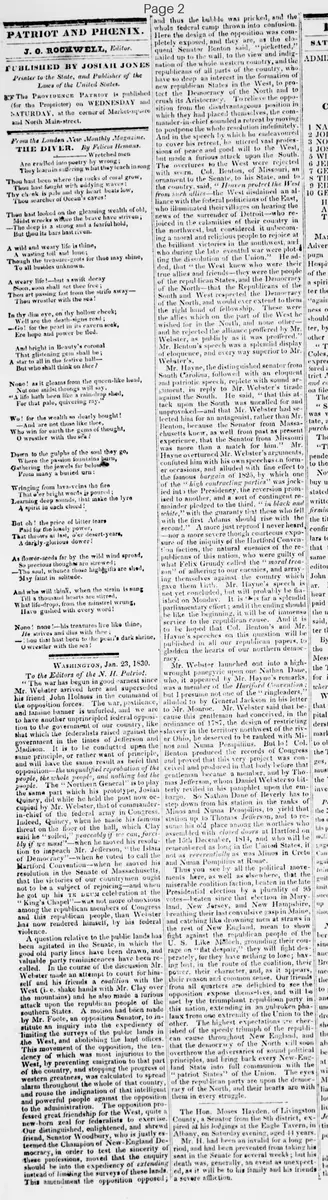
To the Editors of the N. H. Patriot.
The war has begun in good earnest since his friend John Holmes in the command of Mr. Webster arrived here and superseded the opposition forces. The war, pestilence, and famine banner is unfurled, and we are to have another unprincipled federal opposition to the government of our country, like that which the federalists raised against the government in the times of Jefferson and Madison. It is to be conducted upon the same principle, or rather want of principle, and will have the same result as before that opposition--the unqualified reprobation of the people. The "Northern General" is to play the same part which his prototype, Josiah Quincy, did while he held the post now occupied by Mr. Webster, that of commander-in-chief of the federal army in Congress. Indeed, Quincy, when he made his famous threat on the floor of the hall, which Clay said he "spoiled," peaceably if we can, forcibly if we must--when he moved his resolution to impeach Mr. Jefferson, "the Islam of Democracy"--when he voted to call the Hartford Convention--when he moved his resolution in the Senate of Massachusetts that the victories of our countrymen ought not to be a subject of rejoicing--and when he got up his Te Deum celebration at the "King's Chapel"--was not more obnoxious among the republican members of Congress and this republican people, than Webster has now rendered himself, by his federal violence.
A question relative to the public lands has been agitated in the Senate, in which the good old party lines have been drawn, and called. In the course of the discussion Mr. Webster made an attempt to court for himself and his friends a coalition with the West (i. e. shake hands with Mr. Clay over the mountains) and he also made a furious attack upon the republican people of the southern States. A motion had been made by Mr. Foote, an opposition Senator, to institute an inquiry into the expediency of limiting the surveys of the public lands in the West, and abolishing the land offices. This movement of the opposition, the tendency of which was most injurious to the interests of the country, and stopping the progress of western greatness, was calculated to spread alarm throughout the whole of that country, and rouse the indignation of that intelligent and powerful people against the opposition to the administration. The opposition professed great friendship for the West, quite a new-born zeal for federalists to exercise. Our distinguished, enlightened, and shrewd friend, Senator Woodbury, who is justly esteemed the Champion of New-England Democracy, in order to test the sincerity of these professions, moved that the enquiry should be into the expediency of extending instead of limiting the surveys of these lands. This amendment the opposition opposed; and thus the bubble was pricked, and the whole federal camp thrown into confusion. Here the design of the opposition was completely exposed, and they are, as the eloquent Senator Benton said, "picketted," hailed up to the wall, to the view and indignation of the whole western country, and the republicans of all parts of the country, who have so deep an interest in the formation of new republican States in the West, to protect the Democracy of the North and to crush its Aristocracy. To relieve the opposition from the disadvantageous position in which they had placed themselves, the commander-in-chief sounded a retreat by moving to postpone the whole resolution indefinitely. And in the speech by which he endeavoured to cover his retreat, he uttered vast professions of peace and good will to the West, but made a furious attack upon the South. The overtures to the West were rejected with scorn. Col. Benton, of Missouri, an ornament to the Senate, to his State, and to the country, said, "Heaven protect the West from such allies--the West disdained an alliance with the federal politicians of the East, who illuminated their villages on hearing the news of the surrender of Detroit--who rejoiced in the calamities of their country in the northwest, but considered it unbecoming a moral and religious people to rejoice at the brilliant victories in the southwest, and who during the late eventful war were plotting the dissolution of the Union." He added, that "the West knew who were their true allies and friends--they were the people of the republican States, and the Democracy of the North--that the Republicans of the South and West respected the Democracy of the North, and would ever extend to them the right hand of fellowship. These were the allies which on the part of the West he wished for in the North, and none other--and he rejected the alliance proffered by Mr. Webster, as publicly as it was proffered."
Mr. Benton's speech was a splendid display of eloquence, and every way superior to Mr. Webster's. Mr. Hayne, the distinguished senator from South Carolina, followed with an eloquent and patriotic speech, replete with sound argument, in reply to Mr. Webster's tirade against the South. He said, "that this attack upon the South was uncalled for and unprovoked--and that Mr. Webster had selected him for an antagonist, rather than Mr. Benton, because the Senator from Massachusetts knew, as well from past as present experience, that the Senator from Missouri was more than a match for him." Mr. Hayne overturned Mr. Webster's arguments, confuted him with his own speeches on former occasions, and alluded with fine effect to the famous bargain of 1825, by which one of the "high contracting parties" was jockeyed into the Presidency, the reversion promised to another, and a sort of contingent remainder pledged to the third, "in black and white," with the guaranty that those who fell with the first Adams should rise with the second." A more just reproof I never heard--nor a more severe though courteous exposure of the iniquity of the Hartford Convention faction, the natural enemies of the republicans of this nation, who were guilty of what Felix Grundy called the "moral treason of adhering to our enemies, and arraying themselves against the country which gave them birth." Mr. Hayne's speech is not yet concluded, but will probably be finished on Monday. It is as far a splendid parliamentary effort; and if the ending should be like the beginning, it will be of immense service to the republican cause. And it is to be hoped that Col. Benton's and Mr. Hayne's speeches on this question will be published in all our republican papers, to gladden the hearts of our northern democracy.
Mr. Webster launched out into a high-wrought panegyric upon one Nathan Dane, who, it appeared by Mr. Hayne's remarks, was a member of the Hartford Convention: but I presume not one of the "ringleaders," alluded to by General Jackson in his letter to Mr. Monroe. Mr. Webster said that because this gentleman had conceived, in the ordinance of 1787, the design of restricting slavery in the territory northwest of the river Ohio, he deserved to be ranked with Minos and Numa Pompilius. But lo! Col. Benton produced the records of Congress and proved that this very project was conceived and produced in that body before that gentleman became a member, and by Thomas Jefferson, whom Daniel Webster so bitterly reviled in his pamphlet upon the embargo. So Nathan Dane of Beverly has to step down from his station in the ranks of Minos and Numa Pompilius, to yield that station up to Thomas Jefferson, and to resume his old place among the worthies who assembled with closed doors at Hartford on the 15th December, 1814, and who will be remembered as long in the United States, if not as reverentially as was Minos in Crete and Numa Pompilius at Rome.
Thus you see by all the political movements here, as well as elsewhere, that the miserable coalition faction, beaten in the late Presidential election by a plurality of 95 votes--beaten since that election in Maryland, New Jersey, and New Hampshire, breathing their last convulsive gasps in Maine and catching like drowning men at straws in the rest of New England, mean to show fight against the republican people of the U. S. "Like Moloch, grounding their courage on that despair," they will fight desperately, for they have nothing to lose; having lost, in the route of the coalition, their power, their character, and, as it appears, their reason and common sense. Our friends from all quarters are delighted to see the opposition expose themselves, and will be met by the triumphant republican party in this nation, extending in an unbroken phalanx from one extremity of the Union to the other. The highest expectations are cherished of the speedy triumph of the republican cause throughout New England, and that the democracy of the North will soon overthrow the adversaries of sound political principles, and bring back every New-England State into full communion with the "patriot States" of the Union. The eyes of the republican party are upon the democracy of the North, and their hearts are with them in every struggle.
What sub-type of article is it?
What themes does it cover?
What keywords are associated?
What entities or persons were involved?
Where did it happen?
Story Details
Key Persons
Location
Washington
Event Date
Jan. 23, 1830
Story Details
Partisan report on Senate debate over public lands surveys, where opposition motion to limit surveys is countered by Woodbury's amendment to extend them, exposing insincerity. Webster's alliance overtures to West rejected by Benton; Hayne defends South against Webster's attacks, referencing past political deals and Hartford Convention.